
How to Run Faster: The 80/20 Week and 5 Key Sessions
Raceblock team Updated November 15, 2026 14 min read
Free training plan for your race date
Free training plan for your race date
Build my free planIn this article
To run faster, keep about 80% of your running easy and spend the other 20% on short, specific fast work: strides, hill repeats, intervals and one tempo run. Then repeat that week for 6 to 8 weeks and add a little more distance as you go.
That sounds backwards, and it is where most runners get stuck. They try to run every run a bit quicker, end up tired and medium-paced every day, and never run fast enough on the days that are supposed to be fast. Slower easy days are what make the fast days work, and the same medium-pace habit is why running every day wears so many people down. If your problem is fading early rather than speed, start with why slowing down lets you run for longer.
How can I train to run faster?
Train with two kinds of running and almost nothing in between: easy runs that build your aerobic base, and short fast sessions that teach your legs speed. Do that for several weeks in a row and add distance slowly.
The split comes from how endurance athletes actually train. In a review of well-trained endurance athletes, sport scientist Stephen Seiler found that about 80% of their sessions were at low intensity and about 20% were dominated by hard work such as intervals (Seiler, 2010). Recreational runners tend to do the opposite: most runs land in a grey middle zone that is too hard to recover from and too easy to make you fast.
Here are the five sessions that do the work, and what each one is for.
| Session | What it looks like | Effort | How often |
|---|---|---|---|
| Easy run | 30 to 60 minutes at a pace you can talk at | Full sentences | Most runs of the week |
| Strides | 4 to 6 x 20 seconds, about 100 m (110 yd), after an easy run | Fast but relaxed, not a sprint | 1 to 2 times a week |
| Hill repeats | 6 to 8 x 60 to 90 seconds uphill, walk or jog down | Hard, steady breathing | Once a week, first weeks |
| Intervals | 5 x 3 minutes hard with 2 minutes jogging, or 6 x 400 m (0.25 mi) with 90 seconds jogging | Around your 5 km (3.1 mi) race effort | Once a week |
| Tempo run | 15 to 25 minutes in the middle of a run | Comfortably hard, a few words at a time | Once a week, or every other week |
| Long run | Your longest run of the week | Easy, same as easy days | Once a week |
You do not need all of them at once. Two fast sessions a week is plenty for most runners, and one is enough when you are starting out. They sit on top of a base of easy running, so check how many miles a week you should run for your goal before you add the first one.
The 80/20 rule: run slower to run faster
The 80% rule for running means about 80% of your training is easy and about 20% is hard. Easy means you could hold a conversation in full sentences. If you run four times a week, that is three easy runs and one fast session.

Easy runs are where most of your speed is built, just not in a way you can feel that day. They grow the engine: more distance at low cost, so your body gets better at delivering oxygen and you recover in time for the hard day. Run them too fast and the hard day suffers. For how long each kind of session takes to absorb, see our guide to recovery after running.
A simple check: if you finish an easy run feeling like you could turn round and run it again, the pace was right. If your watch says your easy pace is slower than you expected, that is normal. Your training paces should come from a recent race, not from how fast you want to be. For how pace and effort fit together on every type of run, see our guide to running pace.
These are the training paces the Raceblock plan engine sets for a runner with a 27:00 5 km (3.1 mi). Your own come from your own 5 km time.
Training paces per km and per mile
- Easy
- 6:45 to 7:17 /km (10:52 to 11:44 /mi)
- Steady
- 5:56 to 6:13 /km (9:34 to 10:00 /mi)
- Tempo
- 5:37 to 5:50 /km (9:02 to 9:23 /mi)
- Intervals
- 5:18 to 5:30 /km (8:31 to 8:52 /mi)
- Long
- 6:45 to 7:17 /km (10:52 to 11:44 /mi)
- Goal
- 6:03 to 6:16 /km (9:44 to 10:05 /mi)
| Recent 5k | Easy conversational | Steady comfortably steady | Tempo comfortably hard | Intervals controlled hard efforts | Race effort controlled |
|---|---|---|---|---|---|
| 21:00 | 5:15 to 5:40 /km (8:27 to 9:07 /mi) | 4:37 to 4:50 /km (7:26 to 7:46 /mi) | 4:22 to 4:32 /km (7:02 to 7:18 /mi) | 4:07 to 4:17 /km (6:37 to 6:54 /mi) | 4:42 to 4:52 /km (7:34 to 7:50 /mi) |
| 24:00 | 6:00 to 6:29 /km (9:39 to 10:26 /mi) | 5:17 to 5:31 /km (8:30 to 8:53 /mi) | 5:00 to 5:11 /km (8:02 to 8:21 /mi) | 4:42 to 4:54 /km (7:34 to 7:53 /mi) | 5:23 to 5:34 /km (8:39 to 8:58 /mi) |
| 27:00pace used in the table | 6:45 to 7:17 /km (10:52 to 11:44 /mi) | 5:56 to 6:13 /km (9:34 to 10:00 /mi) | 5:37 to 5:50 /km (9:02 to 9:23 /mi) | 5:18 to 5:30 /km (8:31 to 8:52 /mi) | 6:03 to 6:16 /km (9:44 to 10:05 /mi) |
| 30:00 | 7:30 to 8:06 /km (12:04 to 13:02 /mi) | 6:36 to 6:54 /km (10:37 to 11:06 /mi) | 6:14 to 6:29 /km (10:03 to 10:26 /mi) | 5:53 to 6:07 /km (9:28 to 9:51 /mi) | 6:43 to 6:58 /km (10:49 to 11:12 /mi) |
| 33:00 | 8:15 to 8:55 /km (13:17 to 14:20 /mi) | 7:16 to 7:35 /km (11:41 to 12:13 /mi) | 6:52 to 7:08 /km (11:03 to 11:28 /mi) | 6:28 to 6:44 /km (10:25 to 10:50 /mi) | 7:24 to 7:39 /km (11:54 to 12:19 /mi) |
| 36:00 | 9:00 to 9:43 /km (14:29 to 15:39 /mi) | 7:55 to 8:17 /km (12:45 to 13:20 /mi) | 7:29 to 7:47 /km (12:03 to 12:31 /mi) | 7:03 to 7:21 /km (11:21 to 11:49 /mi) | 8:04 to 8:21 /km (12:59 to 13:26 /mi) |
General training guidance, not medical advice. Check with a doctor before increasing training if you have symptoms or a health condition.
The fast sessions, from easiest to hardest
Add speed in this order. Each step is harder on your legs than the last, so start at the top and only move down once the earlier session feels routine.
Strides: the first speed work to add
Strides are short, quick runs of about 20 seconds at the end of an easy run. Speed up smoothly, hold a fast, relaxed pace for a few seconds, then ease off and walk back. Do 4 to 6.
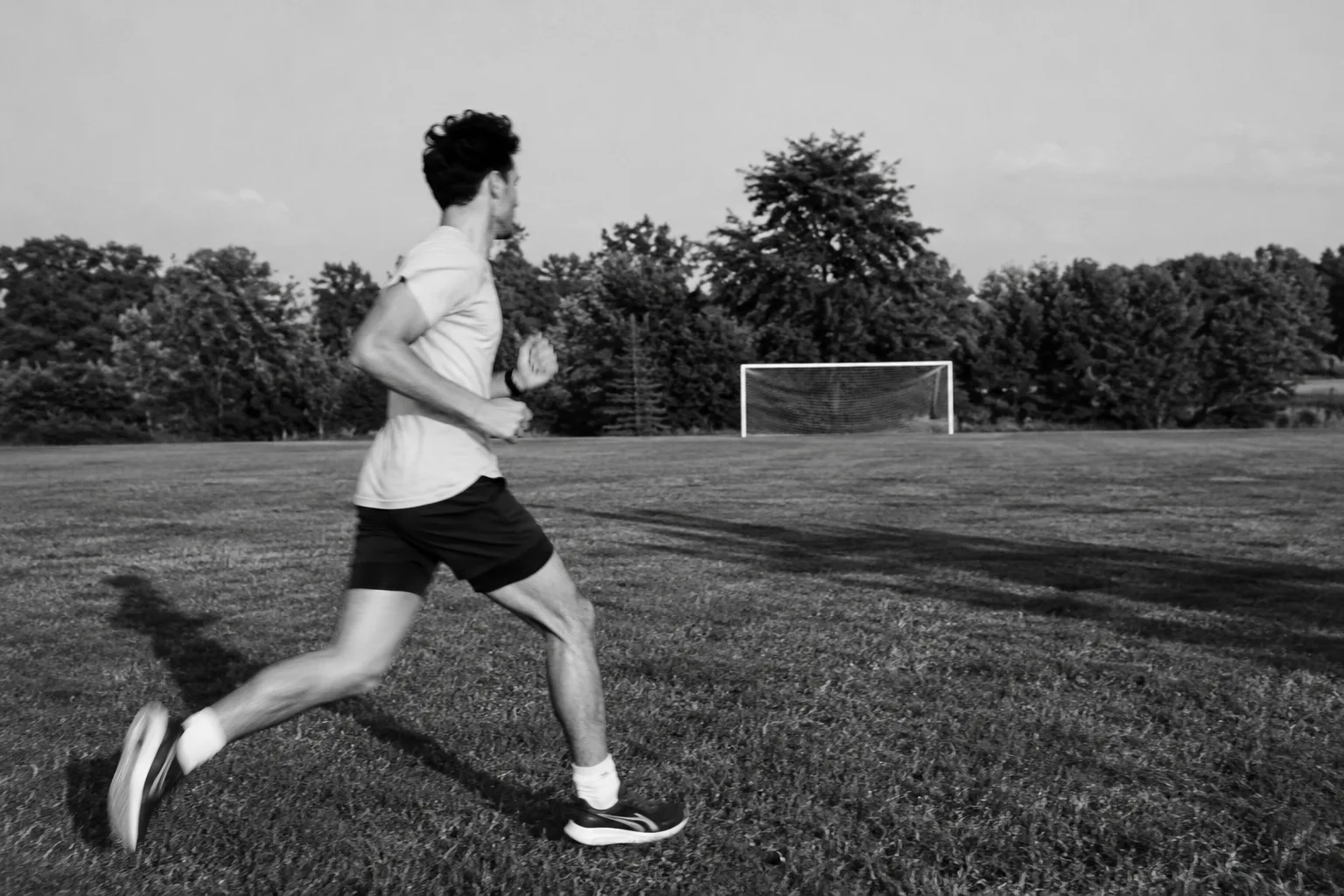
They teach your legs to turn over faster without the fatigue of a full workout. If you only add one thing from this guide, add strides twice a week after easy runs.
Hill repeats: strength and speed together
Find a hill that takes 60 to 90 seconds to run up. Run up hard but controlled, then walk or jog down and start again when your breathing settles. Begin with 6 and build to 8.

Hills force a strong push from the hips and a quick step, which is most of good running technique. They are also kinder than flat sprints, because the slope limits how fast you can go. If your goal is a faster 50 m (55 yd) or 100 m (109 yd) rather than a faster 5 km (3.1 mi), our guide on how to run faster sprints covers sprint form, drills and full rest sessions.
Intervals: time at race effort
Intervals are repeated hard efforts with easy jogging in between. A good first session is 5 x 3 minutes at about the effort you could hold for a 5 km (3.1 mi) race, with 2 minutes of easy jogging after each. On a track, 6 x 400 m (0.25 mi) with 90 seconds of jogging does the same job. If a track and a stopwatch feel like too much, a fartlek run gives you the same mix of hard and easy running by feel. To turn that first session into a full block, follow this interval training plan for running, which adds reps week by week at the same pace.

Run every repeat at the same pace. If the last one is much slower than the first, you started too fast. Warm up with 10 to 15 minutes of easy running first and jog for 10 minutes after.
Tempo run: holding a fast pace for longer
A tempo run is 15 to 25 minutes at comfortably hard effort, the pace you could hold for about an hour in a race. You can say a few words, not full sentences. Put it in the middle of a run with easy running before and after.
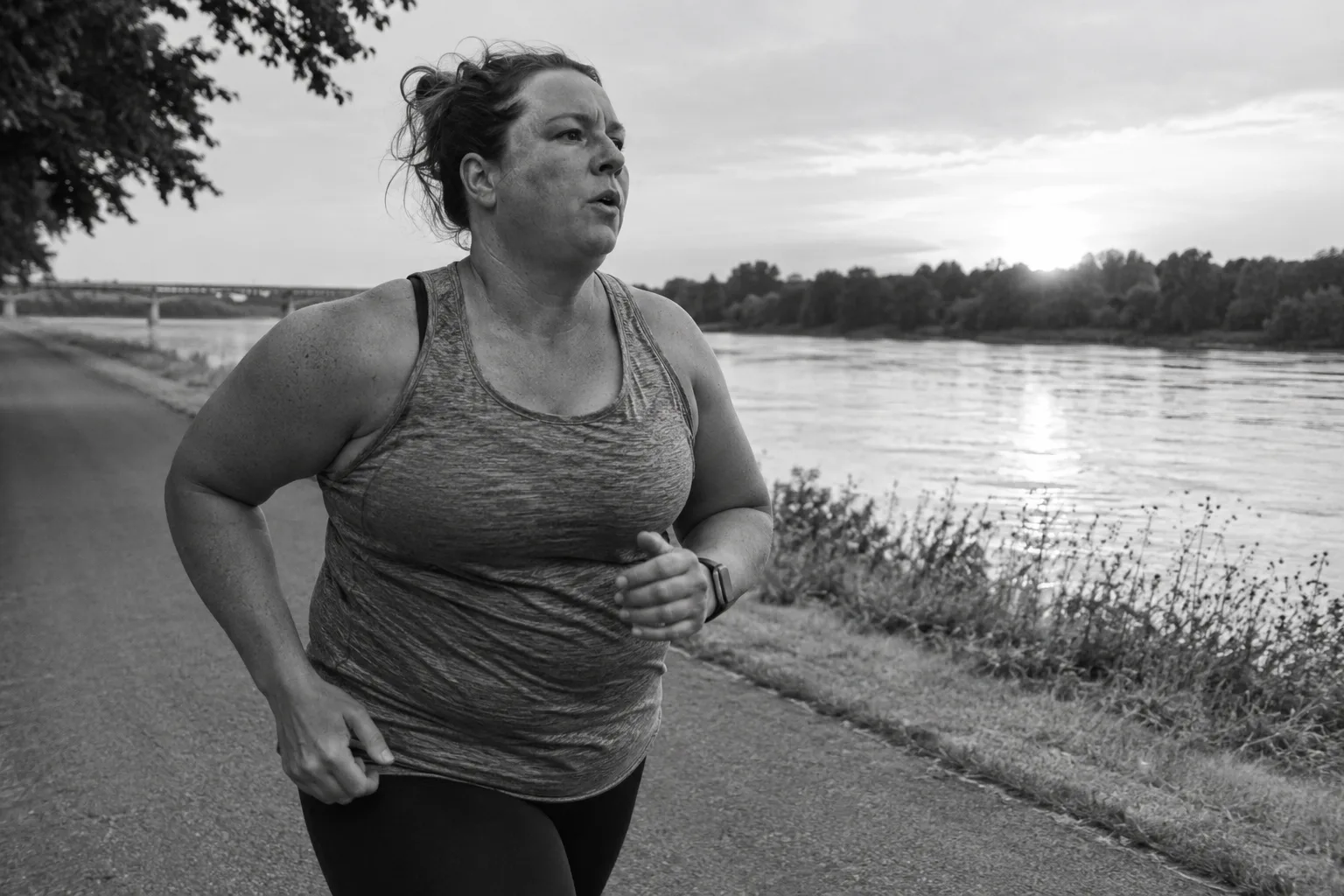
This is the session that helps most with 10 km (6.2 mi), half marathon and marathon races. For a goal pace on race day, the half marathon pace chart and the marathon pace chart give the splits per km and per mile.
What running technique helps you run faster?
Quick, light steps under your body help most. Run tall, keep your shoulders loose, let your arms swing forward and back rather than across, and land with your foot close to under your hips rather than far out in front. If you want a number to work with, here is how to measure and raise your cadence by about 5%.
Do not try to rebuild your stride in one go. Strides and hill repeats fix most of it on their own, because you cannot overstride uphill and you cannot sprint with tight shoulders. If you want one cue to think about on easy runs, think "quick and quiet feet". If you want to see what your stride is actually doing, our guide to proper form when running has a 10 minute self check.
Strength twice a week
Short strength sessions help you hold good form when you are tired. The NHS physical activity guidelines ask adults to do strengthening activities that work all the major muscles on at least 2 days a week.

For runners, 15 to 20 minutes of single-leg work covers it: split squats, step-ups, calf raises and a plank. For sets, reps and a full two-day routine, see our guide to strength training for long distance runners. Put it after an easy run or on a rest day, never the day before a fast session.
How to run faster, by where you are now
What to change first depends on what you are doing today. Find your row.
| Where you are | Change this first | Fast sessions a week |
|---|---|---|
| New to running, under 3 runs a week | Run more often, all easy; add strides after 4 weeks | 0 to 1 |
| Running 3 to 4 times a week, every run the same pace | Slow the easy days down; add strides and hills | 1 |
| Stuck at the same 5 km (3.1 mi) time for months | Add intervals and a tempo run, keep the rest easy | 2 |
| Training for a half marathon or marathon | Keep the long run easy; tempo run plus strides | 1 to 2 |
If you are new, the honest answer to how to run faster is to run more, easily. Speed work comes after a few weeks of steady running, not instead of it.
When your race is a half marathon or marathon
Longer races reward a steady pace you can hold, not a sprint finish. Build the long run, keep the tempo run, and use strides to keep your legs quick. A marathon training routine shows where the fast day and the long run sit in a real week, and the race time predictor turns a recent 5 km or 10 km into a realistic goal.
Why are the first minutes of a run so hard?
Because your body is still warming up. In the first 10 to 20 minutes your heart rate, breathing and muscles are catching up with the work, so even an easy pace can feel heavy. It usually settles once you are warm.
Two fixes help. Start every run slower than you think you need to, and before a fast session run 10 to 15 minutes easy plus a few strides. Racing the first kilometer is the most common reason a run feels hard all the way through.
An 8 week plan to run faster
Here is how to put it together over 8 weeks with 4 runs a week. Keep the same days each week; only the fast session changes.
How to run faster in 8 weeks
- Weeks 1 and 2: slow the easy days
Run 4 times a week, all easy, and add 4 strides after two of the runs.
- Weeks 3 and 4: add hills
Replace one easy run with 6 hill repeats of 60 to 90 seconds. Keep the strides.
- Weeks 5 and 6: add intervals
Swap the hills for 5 x 3 minutes at 5 km effort with 2 minutes jogging. Add 5 to 10 minutes to the long run.
- Week 7: add a tempo run
Keep the intervals and run 15 to 20 minutes of tempo in the middle of one easy run, so two runs that week have fast work, never on back-to-back days.
- Week 8: ease off and test
Cut your distance by about a third, then run a 5 km (3.1 mi) time trial or parkrun at the end of the week.
What faster looks like in numbers: going from a 30:00 to a 28:00 5 km means moving from 6:00 per km (9:39 per mi) to 5:36 per km (9:01 per mi). Some runners see that in 8 weeks, some take longer, and no plan can promise a time. Retest every 6 to 8 weeks and set your training paces from the new result. Treat the retest like a race and keep breakfast light and early; here is what to eat before a 5k run so your stomach is not what slows you down. To see where a new result sits against other runners, check the average 5K time by age for men and women.
Mistakes that keep you slow
- Every run at the same medium pace. Too hard to recover from, too easy to make you fast.
- Two hard days in a row. The second one is slow and the risk of picking up a niggle goes up.
- Racing your intervals. A too-fast first repeat ruins the rest of the session.
- Adding speed and distance in the same week. Change one thing at a time.
- Skipping the warm-up. Fast running on cold legs feels awful and goes badly.
- Judging it after 2 weeks. Speed comes from weeks of repeated training, not one good session.
General training guidance, not medical advice. Check with a doctor before increasing training if you have symptoms or a health condition. Pain, swelling, chest pain or feeling faint means stop and see a doctor or physio.
When your week stops matching the plan
Everything above works with a notebook. Pick your row, write the 8 weeks into your calendar and run them. If you have a race coming up, a half marathon training plan or a marathon training plan puts the same easy and fast days on a schedule that ends at the start line.
The wall comes the first time real life moves. A cold eats your interval week, a work trip lands on the long run, or your race date changes. A written plan does not move when your week does, so you end up guessing which session to keep and which to drop.
That is the part Raceblock handles. Build your free plan for your race date. On the Coach plan, next week re-plans itself when you miss a run.
Free training plan
Build your free plan for your race date.
Pick your race and race date. Every week from today to race day is planned for you, with distances in km and miles.
Run faster in one line
Keep most of your running easy, add one or two short fast sessions a week in the order strides, hills, intervals, tempo, and give it 6 to 8 weeks before you retest. The slow days are not wasted; they are what let the fast days count.
If you have a race booked, build a free plan for your race date and let the fast sessions sit in the right weeks for you.
Source: intensity split from Seiler (2010), International Journal of Sports Physiology and Performance; strength guidance from the NHS physical activity guidelines for adults. Training paces on this page are computed by the Raceblock plan engine.
Frequently asked questions
It means running about 80% of your training at an easy, conversational pace and about 20% hard. For four runs a week, that is three easy runs and one fast session such as intervals, hills or a tempo run. The easy days let you recover so the hard day is actually hard.
Keep most runs easy and add one or two fast sessions a week, never on back-to-back days. Start with strides after easy runs, then hill repeats, then intervals and a tempo run. Repeat the week for 6 to 8 weeks and add distance slowly.
Quick, light steps with your feet landing close to under your hips, a tall posture, loose shoulders and arms swinging forward and back. Strides and hill repeats train most of this without you having to think about it.
No. A 20 minute 5 km (3.1 mi) is 4:00 per km (6:26 per mi), which is a quick time for a recreational runner. Getting below it usually takes regular interval and tempo sessions on top of a solid easy base.
Yes, for a recreational runner it is a solid pace. 12 km (7.5 mi) in an hour is 5:00 per km (8:03 per mi). Whether it is an easy or a hard pace for you depends on your recent race times.
Your heart, breathing and muscles are still catching up with the work, so the start feels harder than the middle. Start slower than you think you need to, and warm up with 10 to 15 minutes of easy running before any fast session.
Free training plan
Build your free plan for your race date.
On the Coach plan, next week re-plans itself when you miss a run.
Share article
About the author
More running training guides

Running basics · 12 min
What Is a Recovery Run? Pace, Length and When to Skip It
A recovery run is a short, very easy run you do the day after a long run or hard session. Here is how slow to run it, how long, how it differs from an easy run and a rest day, where it fits in a half or marathon week, and when to skip it.

Running basics · 10 min
10K Beginner Training Schedule: 10 Weeks From Run-Walk
A 10k beginner training schedule for runners starting from run-walk: 10 weeks, three timed sessions a week, a long session that grows to about 70 minutes, the paces behind common finish times and how to adjust the plan to your week.

Running basics · 11 min
10K Training Routine: 3 Runs a Week for 8 Weeks
A 10k training routine is three runs a week on fixed days: one easy run, one faster session and a long run that builds to the full 10 km (6.2 mi) at an easy pace. Here is the weekly layout, the 8-week schedule, the paces and the mistakes that break it.

Running basics · 11 min
5K Training Routine: The Weekly Schedule to Repeat
A good 5K training routine is three or four runs a week on fixed days: one key session, one longer easy run and easy running in between. Here are both weekly layouts, your paces, an 8-week schedule and the mistakes that stall it.

Running basics · 11 min
Interval Training Plan for Running: 8 Weeks With Paces
A simple 8-week interval training plan for running: one session a week at 5 km to 10 km effort, with paces per km and per mile, jog recoveries, a sample week and how to adjust it for a half marathon, a marathon or a comeback.
Running basics · 10 min
Running in the Heat: 9 Tips to Train Safely All Summer
Running in the heat tips that work: run early, run by effort instead of pace, drink and add salt on long runs, adapt over two weeks, and know the warning signs that mean stop.