
How to Run Longer Without Getting Tired: Slow Down First
Raceblock team Updated November 13, 2026 10 min read
Free training plan for your race date

Free training plan for your race date
Build my free planIn this article
To run longer without getting tired, slow down until you can talk in full sentences, add walk breaks if you need them, and stretch one run a week by about 5 minutes. Most runners who fade after 15 or 20 minutes are not short on fitness. They are running a pace they could only hold for 15 or 20 minutes.
That is the whole idea of this guide. The fix that matters most is the one people resist: going slower than feels like "real" running. Everything else (walk breaks, fuel, sleep, form) helps, but only once the pace is right.
Why you get tired so fast when you run
You get tired fast because you start too hard. Every runner has a pace they can hold for an hour or more and a pace that runs them into the ground in 10 minutes, and for newer runners those two paces are much closer together than they think. Start at the second one and your breathing goes ragged, your legs fill up and you stop, however motivated you are.
The good news: the pace you can hold for a long time is slower than you expect, and it rises with training. You don't build endurance by suffering through fast runs. You build it by spending more time running at an effort you can actually sustain.

The talk test: the pace that lets you keep going
The talk test is the simplest way to find your sustainable pace: you should be able to say a full sentence out loud without gasping between words. If you can't, slow down until you can, even if that means a very slow jog or a short walk.
It is not just folk wisdom. Researchers found that the point where people can no longer speak comfortably lines up closely with the effort where breathing starts to run away from you, and that it tracks fitness as it changes (Foster et al., 2008). Below that line you can keep going for a long time. Above it, you are on the clock. If you want the breathing side in more detail, our guide on how to breathe while running covers rhythm and belly breathing.
Don't trust your watch over your breath. A pace that felt easy last week can feel hard today after a bad night, a hot afternoon or a hilly route. The talk test adjusts for all of that automatically, which is also the first rule for summer runs in hot weather.
Run longer by situation: start here
Runners get tired in different places for different reasons. Find the line that sounds like you and start with that fix.
| Where you get tired | Most likely cause | Start with |
|---|---|---|
| Within the first 5 to 10 minutes | Starting too fast, no warm-up | Slow the first 10 minutes to a walk-jog |
| You can't run 20 minutes without stopping | Pace too fast for current fitness | Run-walk: 4 minutes run, 1 minute walk |
| You are stuck at about 5 km (3 mi) | Every run is the same length and effort | Stretch one run a week by 5 minutes |
| Long runs fade after about an hour | Not eating or drinking, pace too quick | Fuel from about 45 minutes, slow down early |
| Legs feel heavy on every run | Too many runs too close, poor sleep | Add an easy day or rest day, sleep more |
You can't run 20 minutes without stopping
Use run-walk on purpose instead of stopping when you're spent. Run for 4 minutes at talk-test pace, walk briskly for 1 minute, and repeat. A walk break taken before you're tired is short and you recover from it. A forced stop after you're spent ends the run.
Every week or two, nudge the ratio: 5 and 1, then 6 and 1, then 8 and 1. You'll be running 20 to 30 minutes without walks sooner than you expect, and you'll have done it without a single miserable run.

You are stuck at about 5 km (3 mi)
This is the most common plateau, and the cause is usually that every run is the same: same route, same distance, same slightly-too-hard effort. Your body has adapted to exactly that, so nothing changes.
Pick one run a week and make it the longer one. Add about 5 minutes to it each week and run it slower than your other runs. Keep the rest of your week short and easy. If you want a number for the whole week, our guide on how many miles a week you should run gives a starting point for every goal.
Your long runs fade after about an hour
Past about an hour, two things catch up with you: pace and fuel. If you start a long run at the pace of your shorter runs, the last third becomes a survival shuffle. Start slower than feels necessary and treat the first 20 minutes as warm-up.
Then eat and drink. Bring water or a sports drink, and take some carbohydrate (a gel, chews or a few dried fruits) from about 45 minutes in, then roughly every 30 minutes after. Practise it on training runs so race day holds no surprises. Our guide on what to eat before a run covers the meal that comes first.

Your legs feel heavy on every run
Heavy legs on every run usually mean too little recovery, not too little effort. Back-to-back runs, short sleep and hard days stacked together leave you starting each run already tired. Put an easy day or a rest day between harder sessions and protect your sleep. Our recovery after running guide covers the first hour and the next three days.
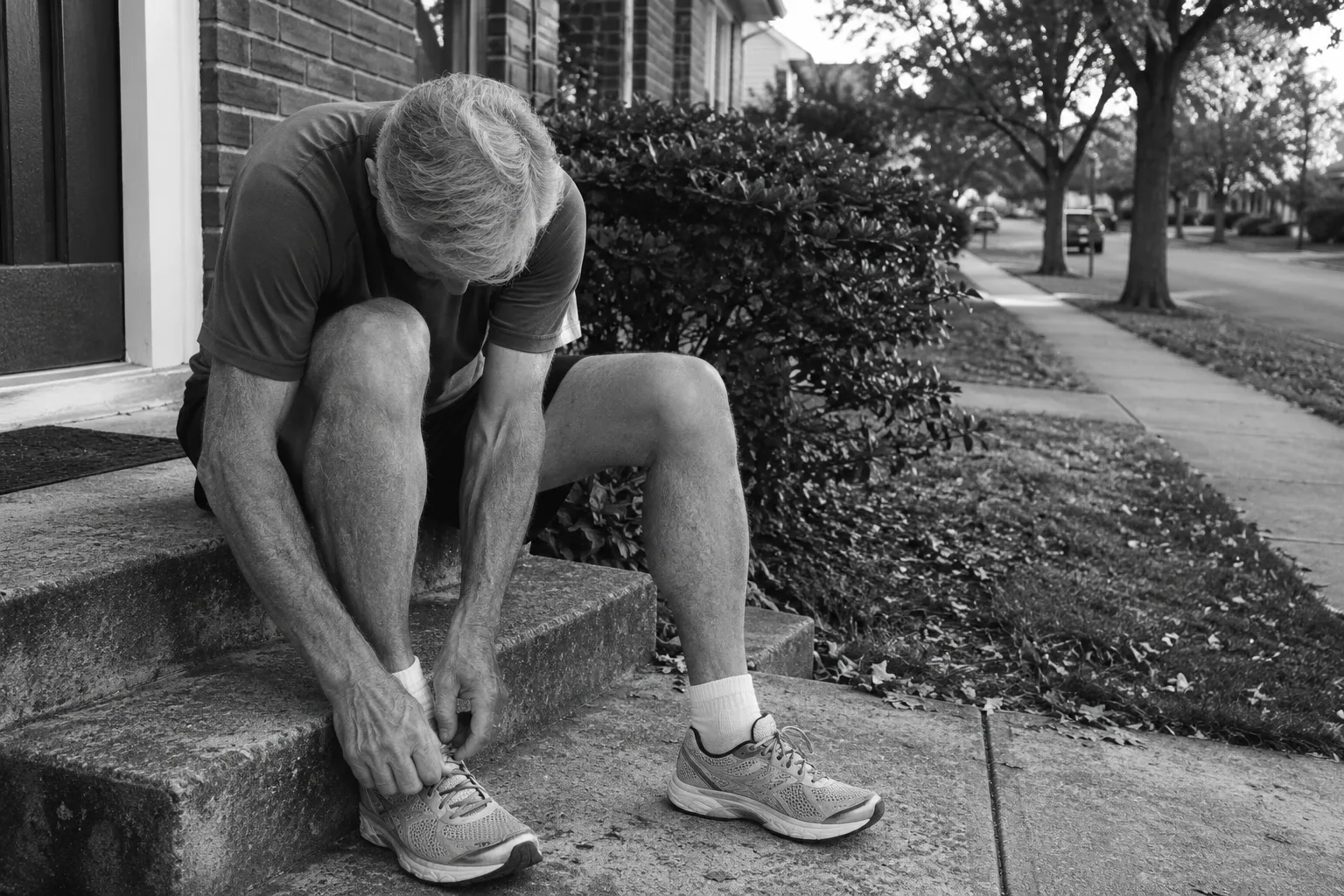
How to run longer without getting tired, step by step
This is the full method. It needs no plan, no app and no gadget, just patience.
How to run longer without getting tired
- Slow down to talk-test pace
Run every easy run at a pace where you can speak a full sentence. If that means a very slow jog, that is the right pace for now.
- Warm up for 5 to 10 minutes
Start with brisk walking and a very easy jog. The first 10 minutes of any run feel worst; a gentle start stops you from spending your energy before your body has settled.
- Use walk breaks before you need them
If you can't run 20 to 30 minutes yet, run 4 minutes and walk 1. Lengthen the running part every week or two until the walks disappear.
- Make one run a week your longer run
Add about 5 minutes to that run each week, at an even easier pace than your other runs. Every fourth week, hold it steady or shorten it to let your body catch up.
- Fuel and drink on runs over an hour
Eat a light, carb-based snack beforehand and take carbohydrate and fluid from about 45 minutes into longer runs.
- Recover between runs
Leave at least one easy or rest day between your harder runs, sleep 7 to 9 hours where you can, and keep most of the week easy.

Here is what that looks like for a runner who can currently manage about 20 minutes. The times are for the one longer run each week; the other two or three runs stay at 20 to 30 minutes.
| Week | Longer run | How to run it |
|---|---|---|
| 1 | 20 minutes | Run 4, walk 1 |
| 2 | 25 minutes | Run 5, walk 1 |
| 3 | 30 minutes | Run 6, walk 1 |
| 4 | 25 minutes | Lighter week, run 8, walk 1 |
| 5 | 35 minutes | Run 8, walk 1, or continuous if it feels easy |
| 6 | 40 minutes | Continuous at talk-test pace |
Most of your running should feel easy. That is not just a beginner rule: across studies of well-trained endurance athletes, about 80% of sessions are done at low intensity and only about 20% hard (Seiler, 2010). If you want to get quicker once the distance comes, our guide on how to run faster builds the harder 20% on top.
Mistakes that make you tired sooner
- Starting every run fast. The first kilometer (0.6 mi) sets the tone for the rest. Start slow and finish feeling like you had more.
- Running every run at the same "medium hard" effort. It is too hard to build endurance and too easy to build speed.
- Adding distance too quickly. Big jumps leave you sore and tired for days. Add time to one run, not to all of them.
- Skipping fuel on long runs. Past about an hour, an empty tank feels like a fitness problem but isn't.
- Fighting your form. Tense shoulders, clenched hands and overstriding all cost energy. Our guide to proper form when running has five fixes that hold up late in a run.
- Ignoring warning signs. Chest pain, dizziness, fainting or breathlessness out of proportion to the effort means stop and see a doctor.

From running longer to running a race
Once you can run 30 to 40 minutes without stopping, you have the base for a training plan. A marathon training plan is the same method at a larger scale: mostly easy running, one long run that grows a little each week, and lighter weeks built in.
The method only works if the weeks keep coming, though. A cold, a work trip or a missed long run is where most runners stall: a paper schedule doesn't move when your week does, so you either skip the session or cram it in and run tired again.
Build your free plan for your race date. On the Coach plan, next week re-plans itself when you miss a run.
Free training plan
Build your free plan for your race date.
Pick your race and race date. Every week from today to race day is planned for you, with distances in km and miles.
General training guidance, not medical advice. Check with a doctor before increasing training if you have symptoms or a health condition.
Running longer without getting tired comes down to running slower than you think you should, taking walk breaks before you need them and growing one run a week by about 5 minutes. Fix the pace first and the distance follows.
When you're ready to aim that new endurance at a race, build your free plan for your race date and let the easy days do the work.
Frequently asked questions
Usually because you start too fast. If you can't speak a full sentence in the first few minutes, you are above the effort you can sustain. Slow down, warm up with brisk walking and use short walk breaks, and the same route will start to feel manageable.
Lengthen one run a week by about 5 minutes and keep your other runs short and easy. Every third or fourth week, hold that run steady or shorten it so your body can catch up before you add more.
It usually means the 80/20 approach: about 80% of your running at an easy, conversational effort and about 20% harder. For running longer without getting tired, the easy 80% is the part that matters most.
Free training plan
Build your free plan for your race date.
On the Coach plan, next week re-plans itself when you miss a run.
Share article
About the author
More running training guides

Running basics · 12 min
What Is a Recovery Run? Pace, Length and When to Skip It
A recovery run is a short, very easy run you do the day after a long run or hard session. Here is how slow to run it, how long, how it differs from an easy run and a rest day, where it fits in a half or marathon week, and when to skip it.

Running basics · 10 min
10K Beginner Training Schedule: 10 Weeks From Run-Walk
A 10k beginner training schedule for runners starting from run-walk: 10 weeks, three timed sessions a week, a long session that grows to about 70 minutes, the paces behind common finish times and how to adjust the plan to your week.

Running basics · 11 min
10K Training Routine: 3 Runs a Week for 8 Weeks
A 10k training routine is three runs a week on fixed days: one easy run, one faster session and a long run that builds to the full 10 km (6.2 mi) at an easy pace. Here is the weekly layout, the 8-week schedule, the paces and the mistakes that break it.

Running basics · 11 min
5K Training Routine: The Weekly Schedule to Repeat
A good 5K training routine is three or four runs a week on fixed days: one key session, one longer easy run and easy running in between. Here are both weekly layouts, your paces, an 8-week schedule and the mistakes that stall it.

Running basics · 11 min
Interval Training Plan for Running: 8 Weeks With Paces
A simple 8-week interval training plan for running: one session a week at 5 km to 10 km effort, with paces per km and per mile, jog recoveries, a sample week and how to adjust it for a half marathon, a marathon or a comeback.

Running basics · 10 min
Running in the Heat: 9 Tips to Train Safely All Summer
Running in the heat tips that work: run early, run by effort instead of pace, drink and add salt on long runs, adapt over two weeks, and know the warning signs that mean stop.