
Marathon Training Plan and Schedule: Free, Week by Week
Raceblock team Updated November 14, 2026 11 min read
Free marathon plan for your race date
Free marathon plan for your race date
Build my free planIn this article
A marathon training plan takes you from the running you do now to a long run near 29 km (18 mi), then cuts back over a 3-week taper before the 42.2 km (26.2 mi) race. Start with the 16-week beginner plan for a first marathon, or the sub-4 plan if you are training around a 4:00 goal, and date either one to your race.
The detail that decides which plan fits is not the peak week everyone looks at first. It is week one. A first-marathon plan here opens at 42.2 km (26.2 mi) and a goal-time plan at 50 km (31.1 mi), so the right plan is the one whose first week you could run this week.
Compare the marathon training plans
Every number below is computed from the plan itself, so you can compare lengths before you open one.
| Plan | Weeks | Runs a week | Peak week | Longest run | Level |
|---|---|---|---|---|---|
| 16-week marathon plan for beginners | 16 | 4 | 68.1 km (42.3 mi) | 29 km (18 mi) | Beginner |
| Sub-4 marathon plan | 16 | 5 | 80.6 km (50.1 mi) | 29.9 km (18.6 mi) | Intermediate |
| Plan | Weeks | Level | Runs a week | Week one | Peak week | Longest run | Taper |
|---|---|---|---|---|---|---|---|
| 16-week beginner marathon plan | 16 | Beginner | 4 | 42.2 km (26.2 mi) | 68.1 km (42.3 mi) | 29 km (18 mi) | 3 weeks |
| Sub-4 hour marathon plan | 16 | Intermediate, 4:00 goal | 5 | 50 km (31.1 mi) | 80.6 km (50.1 mi) | 29.9 km (18.6 mi) | 3 weeks |
How to choose a marathon training plan
- Write down your current week
Count the runs, the total distance and the longest run of an ordinary recent week.
- Compare it with week one
Pick the plan whose first week you could run this week: 42.2 km (26.2 mi) over 4 runs, or 50 km (31.1 mi) over 5.
- Count the weeks to race day
With more than 16 weeks, run easy base weeks first; with fewer, build a plan from your race date.
- Decide on a goal or a finish
A first marathon usually suits the finish-focused plan; a 4:00 goal suits the sub-4 plan.
- Date the plan
Write the date of each Monday beside its week number so the 3-week taper ends on race day.
How does a marathon training plan work?
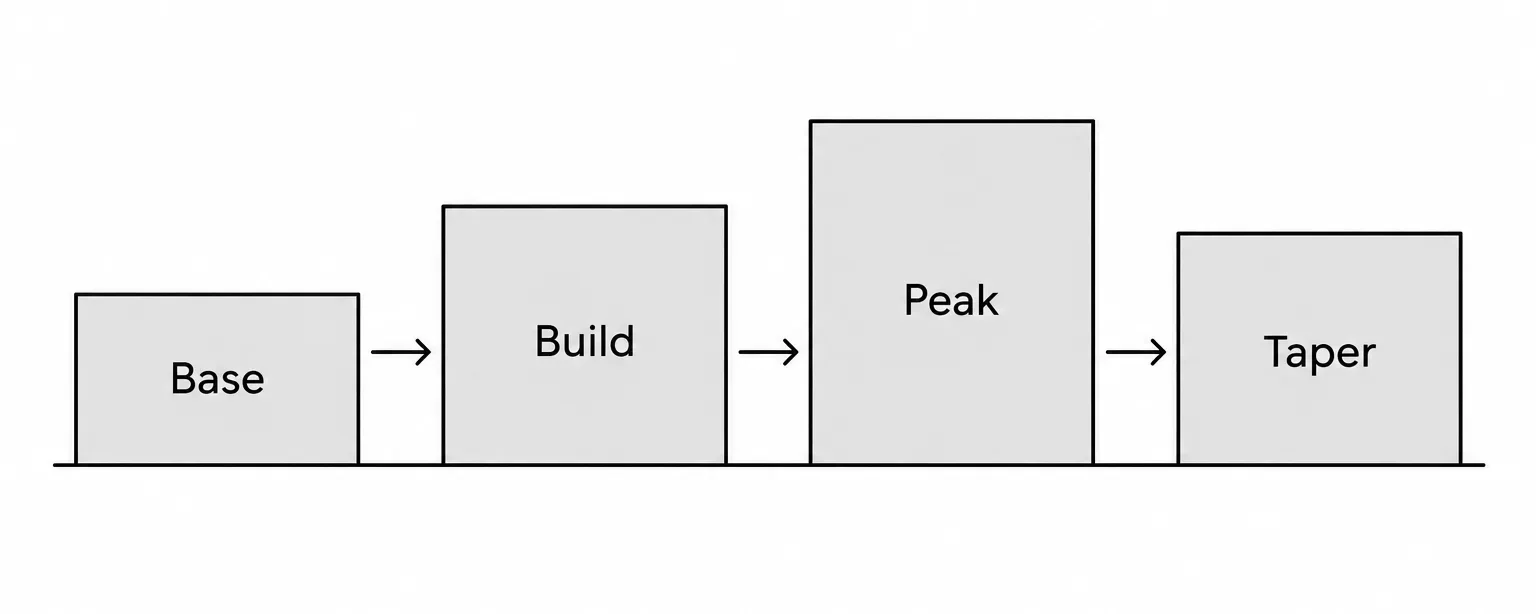
Every plan here moves through the same four phases, and the long run carries all of them. It grows in small steps, drops back every fourth week and reaches its longest about three to five weeks before race day. If you are still picturing what 42.195 km (26.2 mi) means in hours on your feet, this marathon length guide works it out for every pace.
- Base weeks 1 to 5
- Build weeks 6 to 13
- Peak weeks 14 to 17
- Taper weeks 18 to 20
- Lighter weeks 4, 8, 12 and 16
| Phase | What it does | What it feels like |
|---|---|---|
| Base | Builds the weekly routine with easy runs and a steady long run | Easy, almost too easy |
| Build | Grows the long run and adds one quality session a week | The first long runs that need a plan for water and food |
| Peak | The biggest weeks and the longest run of the block | Tired legs on Monday, normal by Wednesday |
| Taper | Cuts distance over 3 weeks, keeps the same running days | Restless, then fresh |
Everything else in the week exists to support the long run: easy runs build volume without stealing recovery, and the quality session teaches pace control. In the beginner plan that session is a steady Thursday run in some build and peak weeks. In the sub-4 plan it is a tempo run plus a goal-pace finish on some long runs.
A sample week: the peak of the beginner plan
This is week 11 of the 16-week marathon training plan for beginners, its biggest week, with paces for a 29:00 5k (3.1 mi). It totals 68.1 km (42.3 mi).
| Day | Session | Distance | Pace |
|---|---|---|---|
| Monday | Easy | 13.1 km (8.1 mi) | 7:15 to 7:50 /km (11:40 to 12:36 /mi) |
| Tuesday | Easy | 13 km (8.1 mi) | 7:15 to 7:50 /km (11:40 to 12:36 /mi) |
| Wednesday | Rest | ||
| Thursday | Steady | 13 km (8.1 mi) | 6:23 to 6:40 /km (10:16 to 10:44 /mi) |
| Friday | Rest | ||
| Saturday | Rest | ||
| Sunday | Long | 29 km (18 mi) | 7:15 to 7:50 /km (11:40 to 12:36 /mi) |
Look at how little of that week is fast. One steady run, three easy runs, and a long run at easy pace. That is the shape of nearly every week in a marathon plan.
General training guidance, not medical advice. Check with a doctor before increasing training if you have symptoms or a health condition.
Marathon training plan: 3, 4 or 5 days a week?
The number of days you can run matters more than any other choice, because it sets how the weekly distance is spread. The published plans use 4 and 5 days.
| Days a week | Who it fits | What the week looks like |
|---|---|---|
| 3 | Busy weeks, returning runners, a first marathon with a conservative long run | Two shorter runs and a long run; a longer plan helps |
| 4 | Most first marathons | Three easy runs and a long run, one easy run becomes steady in some weeks; the beginner plan |
| 5 | Runners with a goal time and an existing five-day habit | Easy runs, a tempo run and a long run with a goal-pace finish; the sub-4 plan |
A three-day marathon plan is possible with a conservative long run and a longer runway. Pick three days when you build a plan and the week is spread across those runs; then compare its first week and longest run with your calendar.

A worked sample: 20 weeks, 4 runs a week
Neither published plan covers a longer runway, so here is one more sample computed by the same plan engine: 20 weeks, 4 runs a week, for an intermediate runner already covering 40 km (25 mi) or more a week with a recent 26:00 5k (3.1 mi). The extra weeks go into a longer base and build, so the steps between weeks stay small.
Read its first row as the entry check, the same way you would on any plan: if week one is more than you run today, start with base weeks or choose a shorter, gentler block.
20-week marathon training plan
Every distance is in km and miles; every pace is per km and per mile. Lighter weeks are marked under the week number.
| Week | Mon | Tue | Wed | Thu | Fri | Sat | Sun | Total |
|---|---|---|---|---|---|---|---|---|
| Week 1Base | MonEasy7.3 km (4.5 mi)6:30 to 7:01 /km (10:28 to 11:18 /mi) | TueEasy7.3 km (4.5 mi)6:30 to 7:01 /km (10:28 to 11:18 /mi) | WedRest | ThuEasy7.3 km (4.5 mi)6:30 to 7:01 /km (10:28 to 11:18 /mi) | FriRest | SatRest | SunLong16.2 km (10.1 mi)6:30 to 7:01 /km (10:28 to 11:18 /mi) | Week total38.1 km (23.7 mi) |
| Week 2Base | MonEasy8 km (5 mi)6:30 to 7:01 /km (10:28 to 11:18 /mi) | TueEasy7.9 km (4.9 mi)6:30 to 7:01 /km (10:28 to 11:18 /mi) | WedRest | ThuEasy7.9 km (4.9 mi)6:30 to 7:01 /km (10:28 to 11:18 /mi) | FriRest | SatRest | SunLong17.7 km (11 mi)6:30 to 7:01 /km (10:28 to 11:18 /mi) | Week total41.5 km (25.8 mi) |
| Week 3Base | MonEasy8.7 km (5.4 mi)6:30 to 7:01 /km (10:28 to 11:18 /mi) | TueEasy8.7 km (5.4 mi)6:30 to 7:01 /km (10:28 to 11:18 /mi) | WedRest | ThuEasy8.6 km (5.3 mi)6:30 to 7:01 /km (10:28 to 11:18 /mi) | FriRest | SatRest | SunLong19.2 km (11.9 mi)6:30 to 7:01 /km (10:28 to 11:18 /mi) | Week total45.2 km (28.1 mi) |
| Week 4Base, lighter week | MonEasy7.8 km (4.8 mi)6:30 to 7:01 /km (10:28 to 11:18 /mi) | TueEasy7.8 km (4.8 mi)6:30 to 7:01 /km (10:28 to 11:18 /mi) | WedRest | ThuEasy7.8 km (4.8 mi)6:30 to 7:01 /km (10:28 to 11:18 /mi) | FriRest | SatRest | SunLong17.3 km (10.7 mi)6:30 to 7:01 /km (10:28 to 11:18 /mi) | Week total40.7 km (25.3 mi) |
| Week 5Base | MonEasy8.5 km (5.3 mi)6:30 to 7:01 /km (10:28 to 11:18 /mi) | TueEasy8.5 km (5.3 mi)6:30 to 7:01 /km (10:28 to 11:18 /mi) | WedRest | ThuEasy8.5 km (5.3 mi)6:30 to 7:01 /km (10:28 to 11:18 /mi) | FriRest | SatRest | SunLong18.9 km (11.7 mi)6:30 to 7:01 /km (10:28 to 11:18 /mi) | Week total44.4 km (27.6 mi) |
| Week 6Build | MonEasy9.3 km (5.8 mi)6:30 to 7:01 /km (10:28 to 11:18 /mi) | TueEasy9.3 km (5.8 mi)6:30 to 7:01 /km (10:28 to 11:18 /mi) | WedRest | ThuTempo9.2 km (5.7 mi)5:24 to 5:37 /km (8:42 to 9:02 /mi) | FriRest | SatRest | SunLong20.6 km (12.8 mi)6:30 to 7:01 /km (10:28 to 11:18 /mi) | Week total48.4 km (30.1 mi) |
| Week 7Build | MonEasy10.1 km (6.3 mi)6:30 to 7:01 /km (10:28 to 11:18 /mi) | TueEasy10.1 km (6.3 mi)6:30 to 7:01 /km (10:28 to 11:18 /mi) | WedRest | ThuTempo10.1 km (6.3 mi)5:24 to 5:37 /km (8:42 to 9:02 /mi) | FriRest | SatRest | SunLong22.4 km (13.9 mi)6:30 to 7:01 /km (10:28 to 11:18 /mi) | Week total52.7 km (32.7 mi) |
| Week 8Build, lighter week | MonEasy9.1 km (5.7 mi)6:30 to 7:01 /km (10:28 to 11:18 /mi) | TueEasy9.1 km (5.7 mi)6:30 to 7:01 /km (10:28 to 11:18 /mi) | WedRest | ThuEasy9 km (5.6 mi)6:30 to 7:01 /km (10:28 to 11:18 /mi) | FriRest | SatRest | SunLong20.2 km (12.6 mi)6:30 to 7:01 /km (10:28 to 11:18 /mi) | Week total47.4 km (29.5 mi) |
| Week 9Build | MonEasy9.9 km (6.2 mi)6:30 to 7:01 /km (10:28 to 11:18 /mi) | TueEasy9.9 km (6.2 mi)6:30 to 7:01 /km (10:28 to 11:18 /mi) | WedRest | ThuEasy9.9 km (6.2 mi)6:30 to 7:01 /km (10:28 to 11:18 /mi) | FriRest | SatRest | SunLong22 km (13.7 mi)6:30 to 7:01 /km (10:28 to 11:18 /mi) | Week total51.7 km (32.1 mi) |
| Week 10Build | MonEasy10.8 km (6.7 mi)6:30 to 7:01 /km (10:28 to 11:18 /mi) | TueEasy10.8 km (6.7 mi)6:30 to 7:01 /km (10:28 to 11:18 /mi) | WedRest | ThuTempo10.8 km (6.7 mi)5:24 to 5:37 /km (8:42 to 9:02 /mi) | FriRest | SatRest | SunLong24 km (14.9 mi)6:30 to 7:01 /km (10:28 to 11:18 /mi) | Week total56.4 km (35 mi) |
| Week 11Build | MonEasy11.8 km (7.3 mi)6:30 to 7:01 /km (10:28 to 11:18 /mi) | TueEasy11.8 km (7.3 mi)6:30 to 7:01 /km (10:28 to 11:18 /mi) | WedRest | ThuTempo11.7 km (7.3 mi)5:24 to 5:37 /km (8:42 to 9:02 /mi) | FriRest | SatRest | SunLong26.1 km (16.2 mi)6:30 to 7:01 /km (10:28 to 11:18 /mi) | Week total61.4 km (38.2 mi) |
| Week 12Build, lighter week | MonEasy10.6 km (6.6 mi)6:30 to 7:01 /km (10:28 to 11:18 /mi) | TueEasy10.6 km (6.6 mi)6:30 to 7:01 /km (10:28 to 11:18 /mi) | WedRest | ThuEasy10.6 km (6.6 mi)6:30 to 7:01 /km (10:28 to 11:18 /mi) | FriRest | SatRest | SunLong23.5 km (14.6 mi)6:30 to 7:01 /km (10:28 to 11:18 /mi) | Week total55.3 km (34.4 mi) |
| Week 13Build | MonEasy11.6 km (7.2 mi)6:30 to 7:01 /km (10:28 to 11:18 /mi) | TueEasy11.5 km (7.1 mi)6:30 to 7:01 /km (10:28 to 11:18 /mi) | WedRest | ThuEasy11.5 km (7.1 mi)6:30 to 7:01 /km (10:28 to 11:18 /mi) | FriRest | SatRest | SunLong25.7 km (16 mi)6:30 to 7:01 /km (10:28 to 11:18 /mi) | Week total60.3 km (37.5 mi) |
| Week 14Peak | MonEasy12.6 km (7.8 mi)6:30 to 7:01 /km (10:28 to 11:18 /mi) | TueEasy12.6 km (7.8 mi)6:30 to 7:01 /km (10:28 to 11:18 /mi) | WedRest | ThuTempo12.5 km (7.8 mi)5:24 to 5:37 /km (8:42 to 9:02 /mi) | FriRest | SatRest | SunLong28 km (17.4 mi)6:30 to 7:01 /km (10:28 to 11:18 /mi) | Week total65.7 km (40.8 mi) |
| Week 15Peak | MonEasy13.7 km (8.5 mi)6:30 to 7:01 /km (10:28 to 11:18 /mi) | TueEasy13.7 km (8.5 mi)6:30 to 7:01 /km (10:28 to 11:18 /mi) | WedRest | ThuTempo13.7 km (8.5 mi)5:24 to 5:37 /km (8:42 to 9:02 /mi) | FriRest | SatRest | SunLong30.5 km (19 mi)6:30 to 7:01 /km (10:28 to 11:18 /mi) | Week total71.6 km (44.5 mi) |
| Week 16Peak, lighter week | MonEasy12.4 km (7.7 mi)6:30 to 7:01 /km (10:28 to 11:18 /mi) | TueEasy12.4 km (7.7 mi)6:30 to 7:01 /km (10:28 to 11:18 /mi) | WedRest | ThuEasy12.3 km (7.6 mi)6:30 to 7:01 /km (10:28 to 11:18 /mi) | FriRest | SatRest | SunLong27.4 km (17 mi)6:30 to 7:01 /km (10:28 to 11:18 /mi) | Week total64.5 km (40.1 mi) |
| Week 17Peak | MonEasy13.5 km (8.4 mi)6:30 to 7:01 /km (10:28 to 11:18 /mi) | TueEasy13.5 km (8.4 mi)6:30 to 7:01 /km (10:28 to 11:18 /mi) | WedRest | ThuEasy13.4 km (8.3 mi)6:30 to 7:01 /km (10:28 to 11:18 /mi) | FriRest | SatRest | SunLong29.9 km (18.6 mi)6:30 to 7:01 /km (10:28 to 11:18 /mi) | Week total70.3 km (43.7 mi) |
| Week 18Taper | MonEasy10.1 km (6.3 mi)6:30 to 7:01 /km (10:28 to 11:18 /mi) | TueEasy10.1 km (6.3 mi)6:30 to 7:01 /km (10:28 to 11:18 /mi) | WedRest | ThuEasy10.1 km (6.3 mi)6:30 to 7:01 /km (10:28 to 11:18 /mi) | FriRest | SatRest | SunLong22.4 km (13.9 mi)6:30 to 7:01 /km (10:28 to 11:18 /mi) | Week total52.7 km (32.7 mi) |
| Week 19Taper | MonEasy7.6 km (4.7 mi)6:30 to 7:01 /km (10:28 to 11:18 /mi) | TueEasy7.6 km (4.7 mi)6:30 to 7:01 /km (10:28 to 11:18 /mi) | WedRest | ThuEasy7.5 km (4.7 mi)6:30 to 7:01 /km (10:28 to 11:18 /mi) | FriRest | SatRest | SunLong16.8 km (10.4 mi)6:30 to 7:01 /km (10:28 to 11:18 /mi) | Week total39.5 km (24.5 mi) |
| Week 20Taper, race week | MonEasy5.7 km (3.5 mi)6:30 to 7:01 /km (10:28 to 11:18 /mi) | TueEasy5.7 km (3.5 mi)6:30 to 7:01 /km (10:28 to 11:18 /mi) | WedRest | ThuEasy5.6 km (3.5 mi)6:30 to 7:01 /km (10:28 to 11:18 /mi) | FriRest | SatRest | SunLong12.6 km (7.8 mi)6:30 to 7:01 /km (10:28 to 11:18 /mi) | Week total29.6 km (18.4 mi) |
Race week. Keep the final week light. Start conservatively and adjust to conditions. Goal pace is a target, not a promised finish time.
- Easy
- Build aerobic endurance at a conversational effort.
- Rest
- Absorb training and recover for the next session.
- Long
- Build time on your feet without racing the session.
- Tempo
- Practice controlled quality with easy warm-up and cooldown.
General training guidance, not medical advice. Check with a doctor before increasing training if you have symptoms or a health condition.
Marathon training plan for 24 weeks, or for less than 16
Sixteen weeks is the length both published plans use, and neither starts from zero: the beginner plan opens at 42.2 km (26.2 mi), so it expects an existing base.
- More time, such as 24 weeks? Run easy base weeks until the race is 16 weeks away, then start week one. Starting the plan early would put the peak too far from race day.
- Less time? Build a plan from your current weekly distance and race date. It shows how far the long run can go in the weeks you have, for you to review against your calendar.
- Not ready for 42.2 km (26.2 mi) weeks? A half marathon training plan is a separate choice with its own entry checks, and a good first block.

Marathon training plan for women and over 50
The plans do not change by gender or age. They change by what you run now, how many days you can train, your recent race time and your race date. A 55-year-old running four days and 45 km (28 mi) a week fits the same plan as a 30-year-old doing the same.
What may change with age or life stage is how much recovery feels right between harder days, and that shows up in how your weeks actually go. If you are returning after a long break, are pregnant, or have a heart condition or other health concern, check with a doctor before starting any marathon plan.
Marathon training plan PDF
Every plan table has a print button that prints the full week table or saves it as a PDF, so a free marathon training plan PDF is one click away. The printed paces are the sample paces on the page; build your own plan first to print your own. If you would rather train from a book, our review of Hal Higdon's Marathon: The Ultimate Training Guide shows which of his programs fits you.
Put the plan name in the saved file name, because the totals differ: the beginner plan peaks at 68.1 km (42.3 mi) and the goal-time plan at 80.6 km (50.1 mi). Use the print preview to check the last columns and the last week. If you write dates on the printout, keep them separate from the printed distances; a later change to your race date calls for a new calendar check.

Tools for these plans
- The marathon pace chart covers every goal from 2:30 to 7:00, with km and mile paces, checkpoint splits and a printable pace band.
- The race time predictor estimates your 5K, 10K, half and marathon from one recent race, as a range, with matching training paces.
Use them after you have looked at the weekly commitment. They answer pace arithmetic; they cannot choose between plans for you.
Mistakes when choosing a marathon plan
- Choosing by peak week. The peak is weeks away. Week one is the week you have to run on Monday.
- Starting too early with a long runway. A 16-week plan started 24 weeks out peaks two months before race day.
- Picking a goal-time plan for a first marathon. Finishing comfortably is a goal in itself.
- Treating the taper as optional. The last 3 weeks are part of the plan. The marathon taper guide shows the weekly numbers.
When the plan you chose stops matching your weeks

Any plan above is a fixed table. Sixteen weeks of real life bring a cold, a work trip or a long run lost to a family weekend, and the table keeps counting down as if every run happened. You are left guessing whether to repeat a week or push on. That is the wall with every printed marathon plan: the plan doesn't move when your week does.
The fix is a plan that starts from your race date and the running you actually did. Build your free plan for your race date. On the Coach plan, next week re-plans itself when you miss a run.
Free training plan
Build your free plan for your race date.
Pick your race and race date. Every week from today to race day is planned for you, with distances in km and miles.
Pick a marathon plan by its first week, not its peak: 42.2 km (26.2 mi) over 4 runs for the beginner plan, 50 km (31.1 mi) over 5 runs for the sub-4 plan. Both run 16 weeks, grow the long run to about 29 km (18 mi) and taper for 3 weeks. If a long run goes missing along the way, the guide to a missed long run covers what to do. Once a marathon is behind you, the same base carries into longer races: the ultra marathon training guide shows how to turn it into a first 50 km (31 mi).
Curious how an app handles the weeks that go wrong? Read how Raceblock compares with Runna, then date your plan to race day.
Source: the marathon distance is 42.195 km (26 mi 385 yd) per World Athletics. Distances, weeks and paces on this page are computed by the Raceblock plan engine.
Frequently asked questions
The published plans last 16 weeks, and both expect an existing base: the beginner plan opens at 42.2 km (26.2 mi) a week. Judge the length together with that starting week, not only by the time left before your race.
There is no single ideal, but most good schedules share the same shape: easy runs, one quality session a week, a long run that grows in steps, lighter weeks and a 3-week taper. The beginner plan here peaks at 68.1 km (42.3 mi) over 4 runs.
A short, easy run in race week is normal. In the 16-week beginner plan, race week totals 28.2 km (17.5 mi) across short easy runs, so the legs stay loose without adding fatigue.
Yes, with a conservative long run and a longer plan if you can. Choose three days when you build your plan and check the first week and the longest run against your calendar.
No. They are two names for the same thing: a week-by-week list of runs, distances and paces that leads to race day.
Yes. Every plan table has a print button that saves the full schedule as a PDF, in km and miles, with the sample paces shown.
Free training plan
Build your free plan for your race date.
On the Coach plan, next week re-plans itself when you miss a run.
Share article
About the author
More running training guides

Marathon training · 11 min
Ultramarathon Training Tips: 12 Habits Beyond the Miles
The best ultramarathon training tips are about everything except the running: your stomach, your feet, your stops, the dark and the downhills. Here are 12, one job at a time.

Marathon training · 9 min
How Long Is a Marathon Run? 26.2 Miles, 42.2 km and Hours
A marathon run is 42.195 km (26.2 miles). See the exact distance, why your watch reads long, how many hours it takes at each pace, and how to plan for yours.

Marathon training · 12 min
Boston Marathon Training Guide: Hills, Downhills and Pacing
To train for the Boston Marathon, run a normal 16 to 18 week marathon build and add two things: downhill running for your quads and a patient first half. Here is the block for April 19, 2027, the hill work, a peak week and a pacing plan.

Marathon training · 10 min
Marathon: The Ultimate Training Guide Review and Plan Picker
Hal Higdon's Marathon: The Ultimate Training Guide is worth reading for the rules behind its plans: pick a program by your running today, protect the long run, step back every third week. Here is what it covers, which program fits you, and how to keep a printed plan working when your week changes.

Marathon training · 11 min
Ultra Marathon Training Guide: First 50K Schedule and Tips
To train for your first ultra marathon, take a marathon build and change three things: train in hours on your feet, add back-to-back long runs, and practice walking the hills and eating on the run. Here is a 16 week 50K schedule by phase, a typical week, the fueling math and the mistakes that cost the most.

Marathon training · 13 min
Marathon Training Routine: Build a Week You Can Repeat
A good marathon training routine fixes two days, the long run and one quality session, and keeps everything else easy. Here is the weekly structure for 3, 4 or 5 runs, where strength and rest go, and how to fit it around work.