
HYROX Training Plan: Free Running and Station Plans
Raceblock team October 17, 2026 11 min read
Free HYROX plan for your race date

Free HYROX plan for your race date
Build my free planIn this article
A HYROX training plan has to cover two things at once: eight 1 km (0.62 mi) runs and the eight workout stations between them. The plans here put both into one week, with easy runs, compromised runs after station work and a weekly strength and stations day, so the running and the gym work stop fighting for the same days.
Most free HYROX programs are gym programs with running added on top. That gets the race backwards. About 8 km (5 mi) of every HYROX race is running, and the running is where most beginners lose the most time, so a good plan starts from the runs and fits the stations around them.
Compare the HYROX training plans
Every number in these cards is computed from the plan itself, so you can compare plan lengths, runs a week, peak weeks and longest runs before you open one.
| Plan | Weeks | Runs a week | Peak week | Longest run | Level |
|---|---|---|---|---|---|
| 12-week HYROX plan for beginners | 12 | 3 + station day | 24 km (14.9 mi) | 12 km (7.5 mi) | Beginner |
The 12-week HYROX training plan for beginners is the place to start for a first race: three runs and a station day a week, building from 16.2 km (10.1 mi) of running in week 1 to 24 km (14.9 mi) in week 10, with a longest run of 12 km (7.5 mi) and a two-week taper.
Which HYROX plan length fits your race date?
Plan length follows your race date, not the other way round. Count the weeks from next Monday to race day and use this table.
| Weeks until your race | What to do |
|---|---|
| More than 12 | Run easy 2 or 3 times a week and practice the stations; start week 1 when the race is 12 weeks out |
| 12 | Start the 12-week beginner plan as written |
| 10 or 11 | Start a shorter block; enter your date in the builder so it shortens the build and keeps the taper |
| 6 to 9 | Keep the taper, cut the build, and keep the running easy |
| Fewer than 6 | Run what you already run, practice each station once or twice, and taper the last week |
If your race is closer than 12 weeks, do not squeeze 12 weeks into 9. Shorten the build and keep the taper, so the last week before the race stays light.
How to choose your HYROX training plan
- Count the weeks to race day
Count from next Monday to race day. That number sets the plan length, not the other way round.
- Check your running base
If you run about 16 km (10 mi) a week over 3 runs, the beginner plan fits. If you already run more often, pick a higher level.
- Find your paces
Use a recent 5k to set easy, steady and compromised run paces, per km and per mile.
- Book one station day
Pick a gym day that leaves a rest day before the long run, and keep it every week.
- Keep the taper
Whatever the length, the last two weeks get lighter. Never cut the taper to fit more build weeks.
HYROX running training plan: runs and stations
A HYROX race alternates a 1 km (0.62 mi) run with one workout station, eight times. That is about 8 km (5 mi) of running plus the stations, done back to back. A good plan trains both ordinary easy running and running after station work, so the switch between the two is practiced, not discovered on race day.
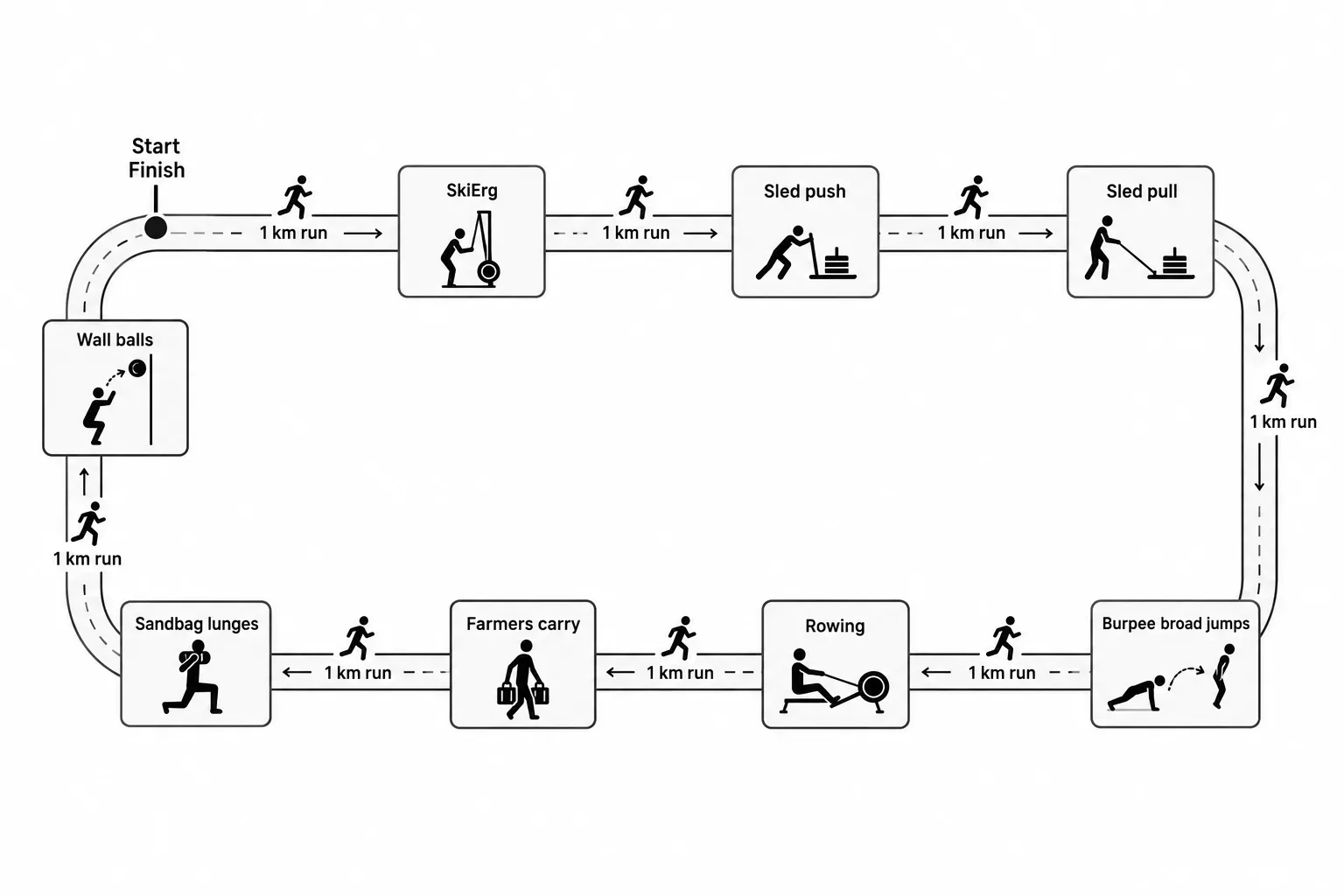
Here are the stations in race order, with distances and open division weights:
The eight HYROX stations
| Order | Station, after a 1 km (0.62 mi) run | Distance or reps | Women, open | Men, open |
|---|---|---|---|---|
| 1 | SkiErg | 1 km (0.6 mi) | No added load | No added load |
| 2 | Sled push2 lengths of 25 m, weight includes the sled | 50 m (55 yd) | 102 kg (225 lb) | 152 kg (335 lb) |
| 3 | Sled pull2 lengths of 25 m, weight includes the sled | 50 m (55 yd) | 78 kg (172 lb) | 103 kg (227 lb) |
| 4 | Burpee broad jumps | 80 m (87 yd) | Body weight | Body weight |
| 5 | Rowing | 1 km (0.6 mi) | No added load | No added load |
| 6 | Farmers carrytwo kettlebells, weight per hand | 200 m (219 yd) | 16 kg (35 lb) | 24 kg (53 lb) |
| 7 | Sandbag lunges | 100 m (109 yd) | 10 kg (22 lb) | 20 kg (44 lb) |
| 8 | Wall balls | 100 reps | 4 kg (9 lb) | 6 kg (13 lb) |
HYROX is a race format. Raceblock is not affiliated with HYROX.
Source: HYROX: race format, stations, weights and distances. Checked 2026-10-13.
The station list follows the official HYROX race format (checked October 13, 2026). It shows open division weights for women and men; pro divisions use heavier loads, and doubles teams share the work. Check your own division on the race website before you train with specific loads. For a station-by-station breakdown with technique notes, see our guide to the 8 HYROX stations in order.
One rule runs through every plan here: station work is listed separately and is never converted into running distance. A sled session cannot go into the kilometer or mile column as if it were another run. Keep the two apart and you can see the real load of each week.
HYROX training schedule: placing sessions in your week
The beginner plan uses three runs and one strength and stations day each week:
| Day | Session | Why it sits there |
|---|---|---|
| Monday | Rest | Recovery after the Sunday long run |
| Tuesday | Easy run | Aerobic base at a conversational pace |
| Wednesday | Rest | Space before the midweek run |
| Thursday | Easy or compromised run | Becomes a compromised run in some build and peak weeks |
| Friday | Strength + stations | Technique with manageable loads |
| Saturday | Rest | A full day between the gym and the long run |
| Sunday | Long run | The longest run of the week |
This is a HYROX workout plan built around running, because running makes up most of the race. Station sessions practice technique with manageable loads; they are not meant to leave you too sore to run on Sunday. If you already lift on several days, compare those sessions with this week before adding more.

What is a compromised run?
A compromised run is a run done straight after light station work, at a controlled effort. It trains the exact feeling of the race: heavy legs from the sled or the lunges, then 1 km (0.62 mi) to run anyway. Keep the station block short. If the run after it turns into a struggle, shorten the station part next time, not the run.
For session-level options, choose one of these HYROX workouts for running, stations or transitions rather than turning every gym visit into a full simulation.
A worked sample: 10 weeks, 4 runs a week, intermediate
The beginner plan is not the only shape. If you already run three or more times a week, a higher level adds harder running sessions while keeping the station day. Here is a 10-week, 4-runs-a-week intermediate block built from a 26:00 5k and a starting week of 20 to 40 km (12 to 25 mi), so you can see how the build changes when the running base is bigger and the race is closer.
- Base weeks 1 to 2
- Build weeks 3 to 6
- Peak weeks 7 to 8
- Taper weeks 9 to 10
- Lighter weeks 4 and 8
10-week HYROX training plan
Every distance is in km and miles; every pace is per km and per mile. Lighter weeks are marked under the week number.
| Week | Mon | Tue | Wed | Thu | Fri | Sat | Sun | Total |
|---|---|---|---|---|---|---|---|---|
| Week 1Base | MonEasy4.4 km (2.7 mi)6:30 to 7:01 /km (10:28 to 11:18 /mi) | TueEasy4.4 km (2.7 mi)6:30 to 7:01 /km (10:28 to 11:18 /mi) | WedRest | ThuEasy4.4 km (2.7 mi)6:30 to 7:01 /km (10:28 to 11:18 /mi) | FriStrength + stations | SatRest | SunLong9.7 km (6 mi)6:30 to 7:01 /km (10:28 to 11:18 /mi) | Week total22.9 km (14.2 mi) |
| Week 2Base | MonEasy4.8 km (3 mi)6:30 to 7:01 /km (10:28 to 11:18 /mi) | TueEasy4.8 km (3 mi)6:30 to 7:01 /km (10:28 to 11:18 /mi) | WedRest | ThuEasy4.7 km (2.9 mi)6:30 to 7:01 /km (10:28 to 11:18 /mi) | FriStrength + stations | SatRest | SunLong10.6 km (6.6 mi)6:30 to 7:01 /km (10:28 to 11:18 /mi) | Week total24.9 km (15.5 mi) |
| Week 3Build | MonEasy5.2 km (3.2 mi)6:30 to 7:01 /km (10:28 to 11:18 /mi) | TueEasy5.2 km (3.2 mi)6:30 to 7:01 /km (10:28 to 11:18 /mi) | WedRest | ThuCompromised run5.2 km (3.2 mi)5:24 to 5:37 /km (8:42 to 9:02 /mi) | FriStrength + stations | SatRest | SunLong11.6 km (7.2 mi)6:30 to 7:01 /km (10:28 to 11:18 /mi) | Week total27.2 km (16.9 mi) |
| Week 4Build, lighter week | MonEasy4.7 km (2.9 mi)6:30 to 7:01 /km (10:28 to 11:18 /mi) | TueEasy4.7 km (2.9 mi)6:30 to 7:01 /km (10:28 to 11:18 /mi) | WedRest | ThuEasy4.6 km (2.9 mi)6:30 to 7:01 /km (10:28 to 11:18 /mi) | FriStrength + stations | SatRest | SunLong10.4 km (6.5 mi)6:30 to 7:01 /km (10:28 to 11:18 /mi) | Week total24.4 km (15.2 mi) |
| Week 5Build | MonEasy5.1 km (3.2 mi)6:30 to 7:01 /km (10:28 to 11:18 /mi) | TueEasy5.1 km (3.2 mi)6:30 to 7:01 /km (10:28 to 11:18 /mi) | WedRest | ThuEasy5.1 km (3.2 mi)6:30 to 7:01 /km (10:28 to 11:18 /mi) | FriStrength + stations | SatRest | SunLong11.4 km (7.1 mi)6:30 to 7:01 /km (10:28 to 11:18 /mi) | Week total26.7 km (16.6 mi) |
| Week 6Build | MonEasy5.6 km (3.5 mi)6:30 to 7:01 /km (10:28 to 11:18 /mi) | TueEasy5.6 km (3.5 mi)6:30 to 7:01 /km (10:28 to 11:18 /mi) | WedRest | ThuCompromised run5.5 km (3.4 mi)5:24 to 5:37 /km (8:42 to 9:02 /mi) | FriStrength + stations | SatRest | SunLong12.4 km (7.7 mi)6:30 to 7:01 /km (10:28 to 11:18 /mi) | Week total29.1 km (18.1 mi) |
| Week 7Peak | MonEasy6.1 km (3.8 mi)6:30 to 7:01 /km (10:28 to 11:18 /mi) | TueEasy6.1 km (3.8 mi)6:30 to 7:01 /km (10:28 to 11:18 /mi) | WedRest | ThuCompromised run6 km (3.7 mi)5:24 to 5:37 /km (8:42 to 9:02 /mi) | FriStrength + stations | SatRest | SunLong13.5 km (8.4 mi)6:30 to 7:01 /km (10:28 to 11:18 /mi) | Week total31.7 km (19.7 mi) |
| Week 8Peak, lighter week | MonEasy5.5 km (3.4 mi)6:30 to 7:01 /km (10:28 to 11:18 /mi) | TueEasy5.5 km (3.4 mi)6:30 to 7:01 /km (10:28 to 11:18 /mi) | WedRest | ThuEasy5.4 km (3.4 mi)6:30 to 7:01 /km (10:28 to 11:18 /mi) | FriStrength + stations | SatRest | SunLong12.1 km (7.5 mi)6:30 to 7:01 /km (10:28 to 11:18 /mi) | Week total28.5 km (17.7 mi) |
| Week 9Taper | MonEasy4.1 km (2.5 mi)6:30 to 7:01 /km (10:28 to 11:18 /mi) | TueEasy4.1 km (2.5 mi)6:30 to 7:01 /km (10:28 to 11:18 /mi) | WedRest | ThuEasy4.1 km (2.5 mi)6:30 to 7:01 /km (10:28 to 11:18 /mi) | FriStrength + stations | SatRest | SunLong9.1 km (5.7 mi)6:30 to 7:01 /km (10:28 to 11:18 /mi) | Week total21.4 km (13.3 mi) |
| Week 10Taper, race week | MonEasy3.1 km (1.9 mi)6:30 to 7:01 /km (10:28 to 11:18 /mi) | TueEasy3.1 km (1.9 mi)6:30 to 7:01 /km (10:28 to 11:18 /mi) | WedRest | ThuEasy3 km (1.9 mi)6:30 to 7:01 /km (10:28 to 11:18 /mi) | FriStrength + stations | SatRest | SunLong6.8 km (4.2 mi)6:30 to 7:01 /km (10:28 to 11:18 /mi) | Week total16 km (9.9 mi) |
Race week. Keep the final week light. Start conservatively and adjust to conditions. Goal pace is a target, not a promised finish time.
- Easy
- Build aerobic endurance at a conversational effort.
- Rest
- Absorb training and recover for the next session.
- Strength + stations
- Practice station technique with manageable loads and full recovery.
- Long
- Build time on your feet without racing the session.
- Compromised run
- Practice running after light station work, keeping effort controlled.
General training guidance, not medical advice. Check with a doctor before increasing training if you have symptoms or a health condition.
General training guidance, not medical advice. Check with a doctor before increasing training if you have symptoms or a health condition.
What to notice: the extra run is a fourth easy or quality session, not a second station day. Even at intermediate level, one dedicated station day a week is enough when the runs around it are done well.
| Beginner, 12 weeks | Intermediate sample, 10 weeks | |
|---|---|---|
| Runs a week | 3 | 4 |
| Station days a week | 1 | 1 |
| Sample 5k | 28:00 | 26:00 |
| Who it is for | A first race, open division | Runners already doing 3 or more runs a week |
| Taper | 2 weeks | 2 weeks |
Best HYROX training program: compare the starting assumptions
The best HYROX training program is the one you can repeat for twelve weeks. If you are new to the format, start with the beginner plan and focus on finishing every station with good form. If you already run three or more times a week, pick a higher level.

Your paces come from a recent race. If you do not have a recent 5k, estimate one from another distance with the race time predictor. It predicts road-race times only; it does not estimate a HYROX finish with stations included. If you also run road races, the marathon pace chart and half marathon pace chart turn a goal time into per km and per mile splits.
HYROX training plan for women
The plans are the same for women and men. The running, the session types and the weeks do not change. What changes is the station weights for your division:
| Station | Women, open | Men, open |
|---|---|---|
| Sled push | 102 kg (225 lb) | 152 kg (335 lb) |
| Sled pull | 78 kg (172 lb) | 103 kg (227 lb) |
| Farmers carry, per hand | 16 kg (35 lb) | 24 kg (53 lb) |
| Sandbag lunges | 10 kg (22 lb) | 20 kg (44 lb) |
| Wall balls | 4 kg (9 lb) | 6 kg (13 lb) |
Sled weights include the sled. Train below race weight early in the plan and build toward it.


HYROX training plan PDF
Every plan table has a print button that turns the full schedule into a clean printout or PDF. When you save one, keep the session labels, not only the distance columns: a printout with just the running numbers would miss the Friday stations day entirely.
When your week does not match the plan
Everything above works without an app. Pick the plan, print it, follow it.

The problem shows up around week 4. A printed plan does not move when your week does. A work trip eats your station day, a cold takes a Sunday long run, or the race date moves. The table stays the same, and you are left deciding alone whether to cram, skip or start over. (Our guide to a missed long run covers that decision for the long run.)
Free training plan
Build your free plan for your race date.
Pick your race and race date. Every week from today to race day is planned for you, with distances in km and miles.
Build your free plan for your race date. On the Coach plan, next week re-plans itself when you miss a run. It is built for Garmin and Apple Watch runners. You can see how Free and Coach compare before you pick.
Pick your plan and put the station day in the diary
Start with the 12-week beginner plan if this is your first race. Book the station day as firmly as the Sunday long run, keep easy runs easy, and taper the last two weeks the way you would for a road race (our taper guide explains why less training in the last weeks helps). If you want a running-only goal after your race, a half marathon plan uses a similar weekly rhythm.
When your weeks stop matching the printout, build your free plan for your race date. On the Coach plan, next week re-plans itself when you miss a run.
Frequently asked questions
Enough to run 8 km (5 mi) in 1 km (0.62 mi) pieces and complete eight stations in between. The beginner plan does that with three runs and one strength and stations day a week for 12 weeks, starting at 16.2 km (10.1 mi) of running in week 1. Station work is listed separately and does not count toward the running total.
About 12 weeks for a first race in the open division, if you can already run around 16 km (10 mi) a week. If you are starting from less running, add a few weeks of easy runs first. Whether 12 weeks is enough depends on the running and gym work you already do, not only on the date.
Run, and practice the bodyweight parts: lunges, burpee broad jumps and squats as a stand-in for wall balls. Sled, rowing and SkiErg work need equipment, so book a few gym sessions before race day.
They are different formats, so there is no fair ranking. HYROX is the same fixed race everywhere: eight 1 km (0.62 mi) runs, each followed by a set station. That makes it far more of a running event than most people expect, and running fitness is what most beginners need to build first.
SkiErg, sled push, sled pull, burpee broad jumps, rowing, farmers carry, sandbag lunges and wall balls, always in that order, each after a 1 km (0.62 mi) run. The station table above lists the distances and open division weights.
Age groups and divisions are set by the race organizer and can change between seasons, so check the official race information for your event when you enter. A training plan does not change by age group; your division only changes the station weights.
Free training plan
Build your free plan for your race date.
On the Coach plan, next week re-plans itself when you miss a run.
Share article
About the author
More running training guides

HYROX guides · 10 min
HYROX Workout: 5 Sessions for the Gym, Home and Running
Choose a HYROX workout for easy running, station practice or transitions, with five scalable sessions for the gym and home.

HYROX guides · 12 min
HYROX Training Plan for Beginners: Free 12-Week Schedule
A 12-week HYROX training plan for beginners: three runs and a strength and stations day each week, compromised runs, lighter weeks, a two-week taper and paces per km and per mile.

HYROX guides · 9 min
HYROX Stations: All 8 in Order, With Weights and Distances
The 8 HYROX stations in race order with distances, reps and the loads for open and pro, women and men, in kg and lb, and how to plan the running around them.