
Running in the Heat: 9 Tips to Train Safely All Summer
Raceblock team November 13, 2026 10 min read
Free training plan for your race date
Free training plan for your race date
Build my free planIn this article
The best running in the heat tips come down to three moves: run early or late, run by effort instead of pace, and drink and cool down on purpose. Do those and most summer runs go fine. Ignore them and a normal easy run turns into a slog that leaves you wiped out for two days.
The one most runners resist is slowing down. In the heat the same pace costs you more, so your watch says "slow" while your body says "hard". The effort is the workout, not the number. A slower easy run in July builds the same fitness, and it is the one you can repeat tomorrow.
Why running in the heat feels so much harder
Your body cools itself mostly by sweating. Blood goes to the skin to shed heat, so less of it is left for your working muscles. Your heart beats faster to cover both jobs, which is why your heart rate climbs at a pace that felt easy in spring.
Humidity makes it worse. Sweat only cools you when it evaporates, and in sticky air it drips off instead. That is why 27 °C (80 °F) with high humidity can feel as hard as a dry 32 °C (90 °F). If your weather app shows the dew point, it is a better guide than the temperature alone: the higher it is, the less your sweat can do.
None of this means you are less fit. It means the same run now costs more, and your plan has to account for it.
9 running in the heat tips that actually work
These are ordered by how much difference they make. The first three matter more than everything else combined.
1. Run early, or after the sun goes down
The coolest part of a summer day is usually around sunrise. By late afternoon the roads and pavements have soaked up heat all day and give it back. If mornings are impossible, go after sunset rather than at 5 pm.
2. Pick shaded routes and short loops
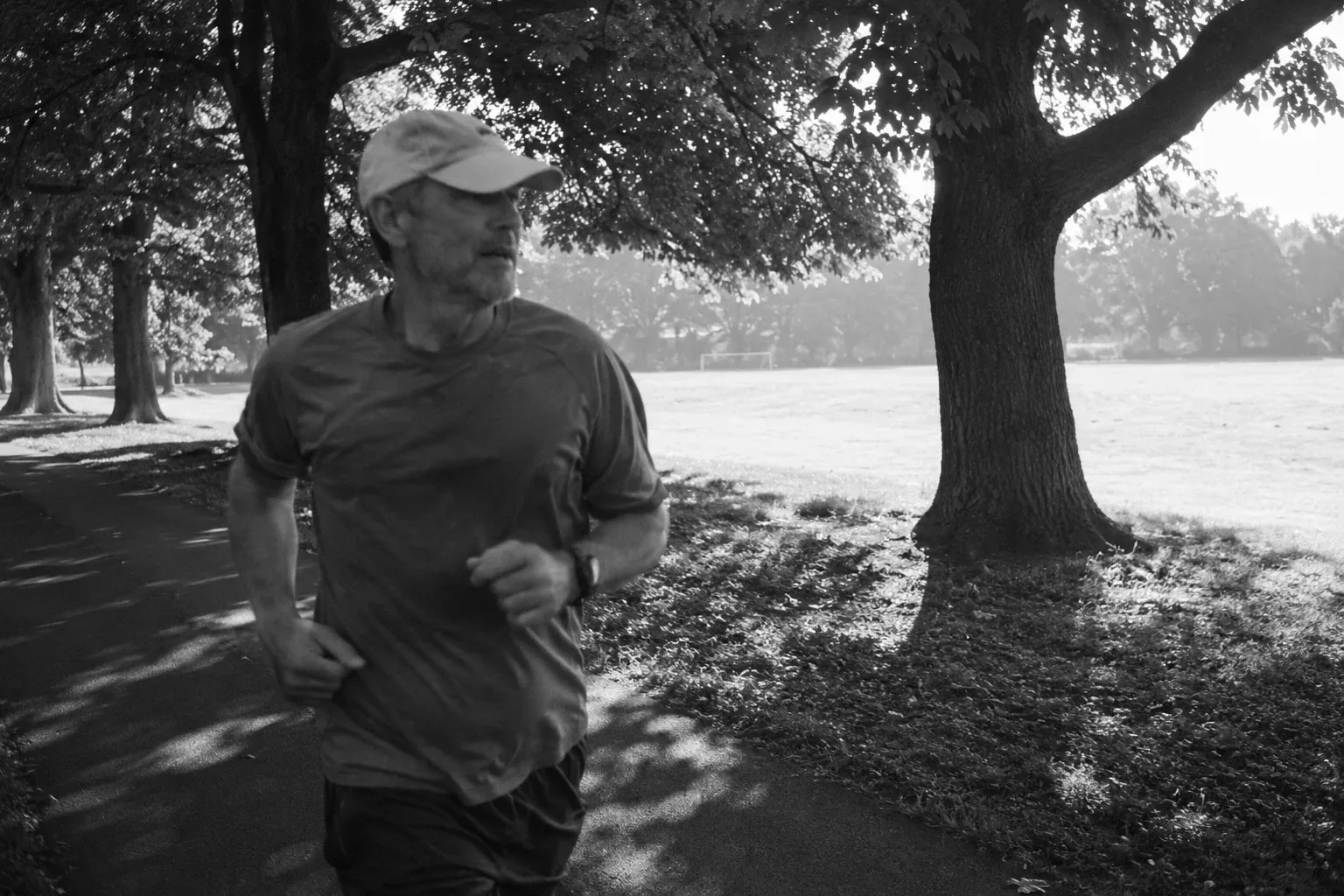
Tree-lined park paths and trails feel noticeably cooler than open roads. Loops of 2 to 3 km (1.2 to 1.9 mi) past your house or car let you pick up water and cut the run short without a long walk home if it goes badly.
3. Run by effort, not pace
This is the tip that matters most. Use the talk test on easy runs: you should be able to speak in full sentences. If you train with heart rate, keep your usual easy zone and let the pace fall wherever it falls. Our guide to pace when running explains why easy should feel easy, and that matters double in summer.
Hard sessions need the same honesty. Run intervals by effort, take longer recoveries, or move them to the coolest day of the week.
4. Wear less, lighter and looser
Light-colored, loose technical fabric that dries fast. A light cap or visor keeps the sun off your face, and sunglasses help you relax. Skip cotton: it soaks up sweat and stays heavy. Put on sunscreen before morning runs too, because the sun is already strong by 9 am in midsummer.

5. Drink before, during and after
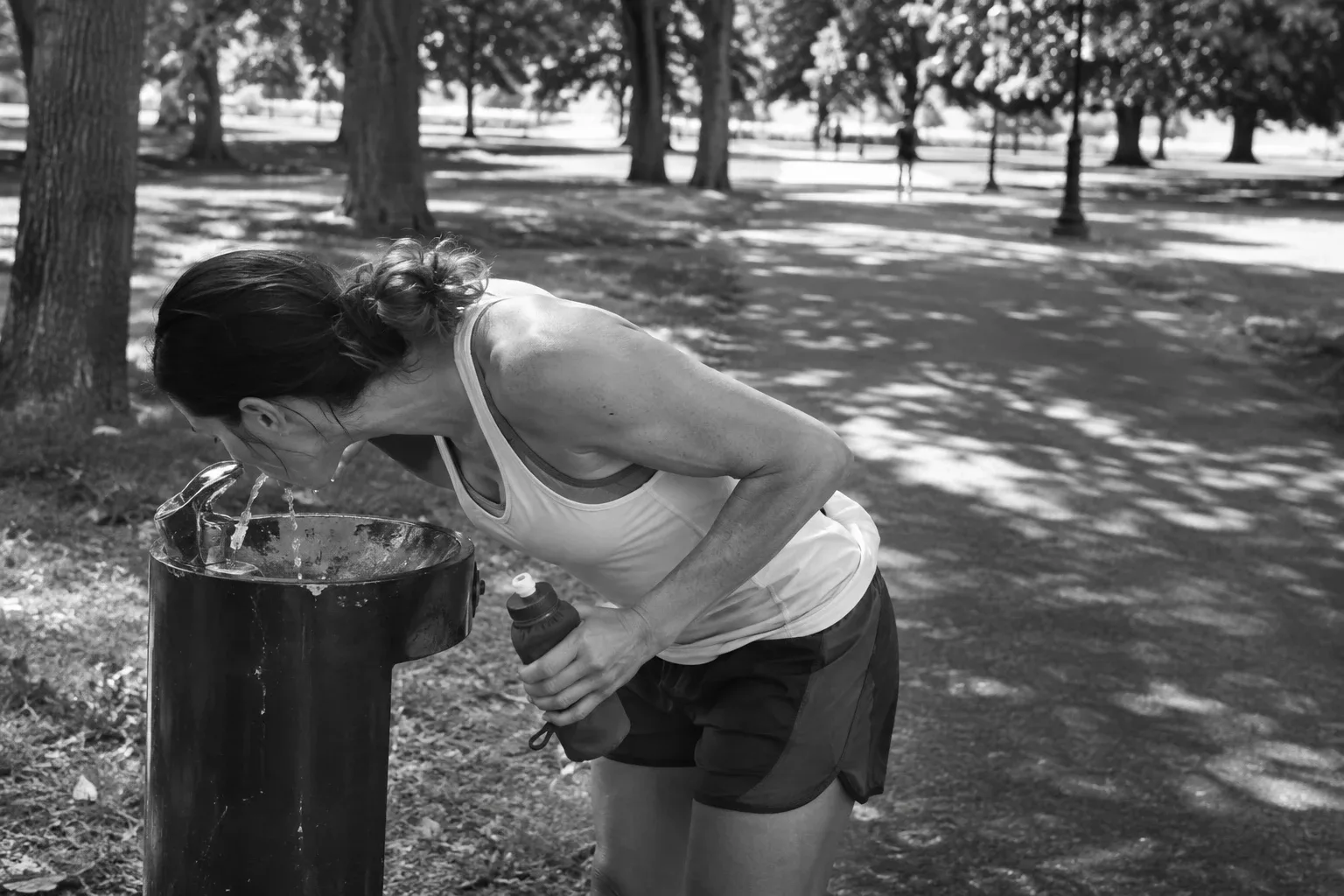
Start the run hydrated: drink normally through the day and have a glass of water in the hour before. For runs under an hour, most runners are fine drinking afterwards. For anything longer, carry fluid or plan a route past water fountains. Drink to thirst and don't force down large amounts: overdrinking plain water is a risk of its own.
A simple check is to weigh yourself before and after a long summer run. Each kilogram lost is roughly a liter of sweat (about a pound per pint) that you did not replace. Use it to plan how much to carry next time.
6. Add salt on long, sweaty runs
Sweat carries sodium as well as water. On long runs, especially if you finish with white salt marks on your cap or shirt, use a sports drink or electrolyte tablets instead of plain water. Eat a normal salty meal afterwards. What you eat beforehand matters too: see what to eat before a run.
7. Take walk breaks before you need them
Planned walk breaks, for example one minute every kilometer or mile, keep your heart rate and core temperature from creeping up. Walking early is a choice. Walking because you have overheated at 16 km (10 mi) is damage control.
8. Give yourself 10 to 14 days to adapt
Your body does adapt to heat: you start sweating earlier, sweat more, and your heart rate settles at a given effort. Most of that change happens in the first one to two weeks of regular running in the heat. Use those weeks to keep runs shorter and easier, then build back up. A heat wave after a cool spell resets the clock, so treat the first hot days with care even in August.
9. Cool down fast after the run
Get into the shade, drink, and pour cold water over your head and neck or hold a cold wet towel there. Have a cold drink waiting in the fridge or the car. A cool shower beats a long stretch in the sun. Our recovery after running guide covers the rest of the first hour.
What to change for each run in your week
Not every run needs the same treatment. Easy runs just get slower. Long runs and hard sessions need moving, shortening or splitting.
| Run | What to change in the heat | When to move it |
|---|---|---|
| Easy run | Keep the effort, let the pace drop, shade and early start | Rarely: just slow down |
| Long run | Start at sunrise, loops past water, salt, walk breaks | Split it in two or swap with a cooler day |
| Tempo or intervals | Run by effort, longer recoveries, fewer reps | Move to the coolest morning, a track at dusk or a treadmill |
| Race in the heat | Drop your goal pace and start conservative | Change your goal, not your effort |
For a long run, splitting it is fair game on a very hot day: 16 km (10 mi) at sunrise and another 8 km (5 mi) in the evening still trains your legs, with far less heat stress than 24 km (15 mi) in one go. If you have to skip one, a missed long run is easier to absorb than you think.
When to stop: heat exhaustion warning signs
Stop running, get into the shade and cool down straight away if you notice any of these: a headache, dizziness, feeling sick, cramps, chills or goosebumps in the heat, a fast pulse, or you suddenly feel confused or clumsy. Feeling cold while running in the heat is a warning, not relief.
The NHS guide to heat exhaustion and heatstroke lists the signs and what to do. If someone does not feel better within 30 minutes of cooling, or is confused, stops sweating while hot, faints or has a seizure, call emergency services. Heat, heart conditions, pregnancy and some medications all raise the risk, so check with a doctor before training hard in hot weather if any of those apply to you.
Common mistakes when running in the heat
- Chasing spring paces. You run the session too hard, the next two days are wasted, and your training week falls apart.
- Skipping water on "only" an hour. An hour in July is not an hour in March. Carry something.
- Drinking only plain water on long runs. Large amounts of water with no salt can leave you feeling worse, not better.
- Running at 5 pm because it is the usual slot. Late afternoon is often the hottest part of the day.
- Going hard on the first hot day. You have not adapted yet. Give it 10 to 14 days.
- Ignoring how you breathe. If you can't settle your breathing, you are working too hard: our guide on how to breathe while running helps you find a rhythm at easy effort.
Training for an autumn marathon through summer
Most autumn marathon plans put the biggest weeks in July and August, which is exactly when the heat peaks. A good marathon training plan already has easy days and a long run each week. The free method is above: early starts, effort over pace, fluid and salt, and moving the hard sessions to cooler days. A 16-week marathon training plan started in June puts your longest runs right in the hottest weeks, so plan your long-run routes around water now.
The wall comes when the weather does not care about the paper. A heat wave lands on your long-run weekend, you cut a run short, or you move the intervals and two hard days end up back to back. The plan doesn't move when your week does, so you either skip the session or run it tired. Learning how to run longer without getting tired helps, but the schedule still has to bend.
Build your free plan for your race date. On the Coach plan, next week re-plans itself when you miss a run.
Free training plan
Build your free plan for your race date.
Pick your race and race date. Every week from today to race day is planned for you, with distances in km and miles.
General training guidance, not medical advice. Check with a doctor before increasing training if you have symptoms or a health condition.
Running in the heat is mostly about accepting a slower pace. Go early or late, choose shade, run by effort, drink and add salt on long runs, and give yourself two weeks to adapt. Move or split the hard runs, and stop at the first sign of heat exhaustion.
When a hot week throws your long run off, build your free plan for your race date and let the next week adjust around it.
Frequently asked questions
Slow down as much as it takes to keep your usual effort, rather than by a fixed number. On easy runs that means you can still talk in full sentences, or your heart rate stays in its normal easy range. On hot, humid days that can be a big drop, and that is fine.
Most of the adaptation happens in the first 10 to 14 days of regular running in hot weather. Keep runs shorter and easier during that time. A cool spell followed by a heat wave means starting the process again.
Early morning is usually best, because it is the coolest time of day and the roads have cooled overnight. Late evening after sunset is the next best choice. Late afternoon is often the hottest part of the day, even when the sun looks lower.
Free training plan
Build your free plan for your race date.
On the Coach plan, next week re-plans itself when you miss a run.
Share article
About the author
More running training guides

Running basics · 12 min
What Is a Recovery Run? Pace, Length and When to Skip It
A recovery run is a short, very easy run you do the day after a long run or hard session. Here is how slow to run it, how long, how it differs from an easy run and a rest day, where it fits in a half or marathon week, and when to skip it.
Running basics · 10 min
10K Beginner Training Schedule: 10 Weeks From Run-Walk
A 10k beginner training schedule for runners starting from run-walk: 10 weeks, three timed sessions a week, a long session that grows to about 70 minutes, the paces behind common finish times and how to adjust the plan to your week.
Running basics · 11 min
10K Training Routine: 3 Runs a Week for 8 Weeks
A 10k training routine is three runs a week on fixed days: one easy run, one faster session and a long run that builds to the full 10 km (6.2 mi) at an easy pace. Here is the weekly layout, the 8-week schedule, the paces and the mistakes that break it.

Running basics · 11 min
5K Training Routine: The Weekly Schedule to Repeat
A good 5K training routine is three or four runs a week on fixed days: one key session, one longer easy run and easy running in between. Here are both weekly layouts, your paces, an 8-week schedule and the mistakes that stall it.
Running basics · 11 min
Interval Training Plan for Running: 8 Weeks With Paces
A simple 8-week interval training plan for running: one session a week at 5 km to 10 km effort, with paces per km and per mile, jog recoveries, a sample week and how to adjust it for a half marathon, a marathon or a comeback.
Running basics · 11 min
Side Stitch When Running: What Causes It and How to Stop It
A side stitch when running is a sharp pain under the ribs that eases when you slow down. How to get rid of one mid-run in five steps, what causes it, and the four habits that prevent the next one, starting with what you eat 2 hours before.