
Strength Training for Long Distance Runners: 6 Moves, 2 Days a Week
Raceblock team Updated November 19, 2026 10 min read
Free training plan for your race date

Free training plan for your race date
Build my free planIn this article
Strength training for long distance runners works best as two short, heavy sessions a week: about 30 to 40 minutes each, five or six exercises, 3 sets of 4 to 8 reps, plus a few minutes of hops. Put them on the same days as your hard runs, keep your easy days easy, and cut back to one light session in the last weeks before a race.
The idea this guide turns on: the gym is not where you build endurance. Your running already does that, every week. Sets of 20 light reps just add more of the same tiredness. What runners lack is force and stiffness: the ability to push hard into the ground and bounce off it with less wasted effort. That comes from fewer reps with weight that feels genuinely heavy, and from small, quick jumps.
Does strength training make distance runners faster?
It can help, and it rarely hurts. A 2018 systematic review in Sports Medicine of 24 studies on trained middle and long distance runners found that adding strength work generally improved running economy by 2 to 8% compared with running alone, and time trials from 1.5 to 10 km (about 1 to 6 mi) tended to improve too. Running economy is how much oxygen you use at a given pace: better economy means the same pace costs you less.
The same review found the results were not consistent across every study, and that body composition was not negatively affected. So the fear of "bulking up" from two sessions a week is not supported. A 2016 meta-analysis of highly trained runners found a large benefit to economy from programs of 2 to 4 lower-body exercises plus jumps, done 2 to 3 times a week for 8 to 12 weeks.
What the research does not do is promise you a faster race. Strength work makes your running a little cheaper. The running itself still has to happen. If your weekly distance is the gap, read how many miles a week you should run first.
Heavy or light: how to pick the weight
Pick a weight you can lift for the target reps with about 2 reps still in the tank. If 3 sets of 6 feel easy on the last rep, add weight next session. If your form breaks down before rep 6, go lighter.
That is the whole rule, and it is where most runners go wrong. They pick a weight they could lift 20 times and stop at 12. It feels like work, but it trains the same quality the long run already trains.

Here is how the two approaches compare:
| Light and many reps | Heavy and few reps | |
|---|---|---|
| Reps per set | 15 to 25 | 4 to 8 |
| Effort on the last rep | Burning, tired | Hard, 2 reps left |
| What it trains | Muscle endurance (your runs already do this) | Force and tendon stiffness |
| Leg fatigue the next day | Often high | Usually low once you are used to it |
| Time per session | 45 to 60 min | 30 to 40 min |
| Best for | A first 2 to 3 weeks to learn the moves | Everything after that |
If you have never lifted, spend the first two or three weeks at the light end to learn each move with a weight you control. Then move to the heavy column. A home setup works fine at first: a backpack loaded with books, a pair of dumbbells or a single kettlebell covers every move below.
The 6 moves that cover most runners
These six cover the jobs running asks of your legs: single-leg strength, the back of the thigh, the calf, hip control and a springy ankle. Do them in this order, freshest first.
1. Rear-foot elevated split squat
Back foot on a bench or sofa, front foot far enough forward that your front shin stays fairly upright as you lower. Go down until your back knee is just above the floor. 3 sets of 6 per leg. This is the single most useful move here, because running is one leg at a time.
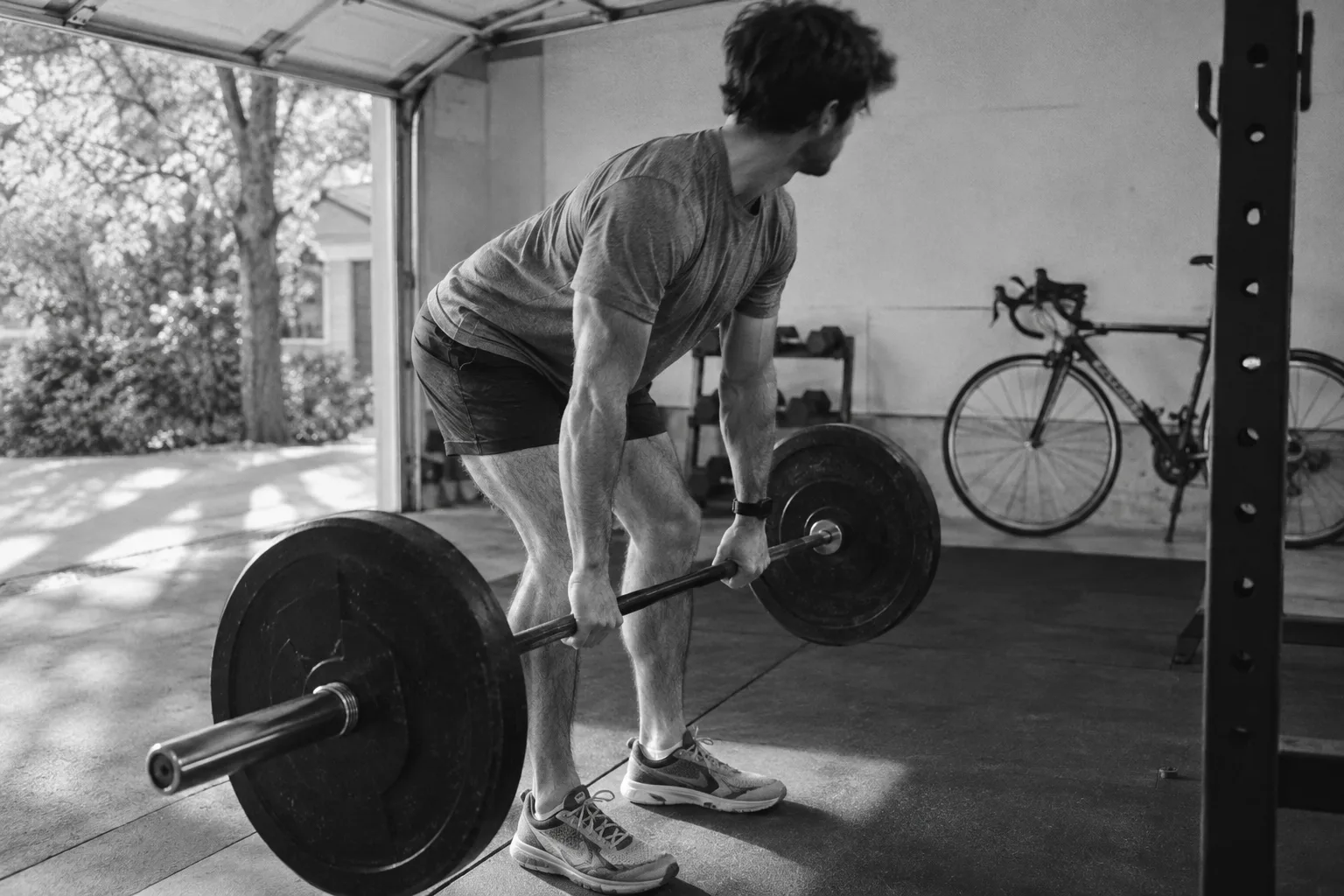
2. Romanian deadlift
Hold a barbell or two dumbbells, soft knees, and push your hips back until you feel a strong pull in your hamstrings, with your back flat. Stand up by driving your hips forward. 3 sets of 6. Start with something like 20 to 30 kg (45 to 65 lb) total and build from there.
3. Single-leg calf raise
Stand on the edge of a step on one foot, lower your heel below the step, then rise as high as you can. Hold a dumbbell once body weight gets easy. 3 sets of 8 to 12 per leg, slow on the way down. Your calves and Achilles absorb a large share of every landing, so they earn the extra reps.

4. Step-up
A box or bench at about knee height. Step up with one leg, drive through that heel and stand tall without pushing off the back foot. 3 sets of 6 per leg, holding dumbbells once it is easy. The way down counts too: lower yourself slowly off the step on the working leg rather than dropping.

5. Side plank
On one forearm, body straight from head to heels. 3 holds of 30 to 45 seconds per side. It trains the hip muscles that stop your pelvis dropping on every stride, which ties straight into proper running form.

6. Pogo hops
Small, quick two-footed hops in place, ankles stiff, heels barely touching down. 3 sets of 15 to 20 hops. These are the plyometric part of the session: they teach your ankles and calves to act like a spring. Do them on a firm, flat surface and only when you feel fresh.

Where strength sessions go in your running week
Lift on the same day as your hard run, after it or at least six hours later. Never the day before your long run. This keeps your easy days truly easy, which is where most of your fitness is built.
| Day | Run | Strength |
|---|---|---|
| Monday | Rest or easy | None |
| Tuesday | Intervals or tempo | Session A, later the same day |
| Wednesday | Easy | None |
| Thursday | Easy or steady | None |
| Friday | Hard run or easy | Session B, later the same day |
| Saturday | Easy or rest | None |
| Sunday | Long run | None |
Session A: split squat, Romanian deadlift, calf raise, hops. Session B: step-up, calf raise, side plank, hops, plus a lighter set of split squats. If you only run three days a week, put both sessions on non-running days and keep at least one full day before the long run.
Always warm up first: 5 minutes of easy movement and one light set of each lift. Our guide on how to warm up before running has a drill routine that doubles as a gym warm-up.
How strength work changes across a training block
Strength work should follow your running, not compete with it. As weekly distance rises toward the peak, the gym gets shorter.
| Phase | Sessions per week | What changes |
|---|---|---|
| Base | 2 | Build the weight up week to week |
| Build | 2 | Hold the weight, keep reps at 4 to 6 |
| Peak | 1 to 2 | Same weight, fewer sets |
| Taper | 1 light | About half the sets, nothing new |
| Race week | 0 | Short hops at most, no lifting |
The taper rule matters most. A new exercise or a heavy session ten days out leaves sore legs at the worst time. The marathon taper guide covers the running side of those last weeks.
Common mistakes and what they cost
- Lifting light and long. You add fatigue without adding force. Pick heavier weight and fewer reps.
- Lifting on easy days. Two hard-ish days in a row become five, and your easy runs stop being easy. Stack hard on hard.
- Lifting the day before the long run. Heavy legs for your most important run of the week.
- Adding a new move in the taper. Sore legs on race morning. Freeze the routine in the last three weeks.
- Stopping completely in the peak weeks. Gains fade within a few weeks. One short session keeps them.
- Training through pain. Mild muscle tiredness is normal. Sharp pain, swelling or pain that changes your stride means stop and see a doctor or physio.
The plan has to move when your week does
Two sessions a week sounds easy to keep. It is harder inside a real training block. A sick week, a work trip or a missed long run, and the plan on your fridge doesn't move when your week does. The strength session gets dropped, or crammed into the day before your long run, which is exactly the mistake above.
Build your free plan for your race date. On the Coach plan, next week re-plans itself when you miss a run. Training for a shorter race? Start from a half marathon training plan instead.
Free training plan
Build your free plan for your race date.
Pick your race and race date. Every week from today to race day is planned for you, with distances in km and miles.
General training guidance, not medical advice. Check with a doctor before increasing training if you have symptoms or a health condition.
Strength training for long distance runners is short and heavy: two sessions a week, six moves, 3 sets of 4 to 8 reps, on the same days as your hard runs. Taper it with your running and stop lifting in race week. The gym makes your running a little cheaper; the running still does the heavy lifting for endurance. For the rest of the week, sleep, food and easy days matter as much: see recovery after running.
Then slot it into a full block: pick a marathon training plan or build your free plan for your race date and add sessions A and B to your hard days.
Frequently asked questions
Two days a week suits most distance runners. Research on trained runners used two to three sessions a week, and two sessions of 30 to 40 minutes fit around four or five runs without crowding them. Drop to one light session in the taper and none in race week.
Yes. Split squats, step-ups, single-leg calf raises, side planks and hops need only a step, a chair and the floor. Add load with a pair of dumbbells, a kettlebell or a backpack with books in it. Once body weight gets easy for 8 reps, you need the extra load to keep training force.
Yes, once you have learned the moves. Heavy here means a weight you can lift 4 to 8 times with about 2 reps left, not a maximal lift. A 2018 review found strength work did not harm body composition in distance runners, so two heavy sessions a week will not bulk you up.
Free training plan
Build your free plan for your race date.
On the Coach plan, next week re-plans itself when you miss a run.
Share article
About the author
More running training guides

Running basics · 12 min
What Is a Recovery Run? Pace, Length and When to Skip It
A recovery run is a short, very easy run you do the day after a long run or hard session. Here is how slow to run it, how long, how it differs from an easy run and a rest day, where it fits in a half or marathon week, and when to skip it.

Running basics · 10 min
10K Beginner Training Schedule: 10 Weeks From Run-Walk
A 10k beginner training schedule for runners starting from run-walk: 10 weeks, three timed sessions a week, a long session that grows to about 70 minutes, the paces behind common finish times and how to adjust the plan to your week.

Running basics · 11 min
10K Training Routine: 3 Runs a Week for 8 Weeks
A 10k training routine is three runs a week on fixed days: one easy run, one faster session and a long run that builds to the full 10 km (6.2 mi) at an easy pace. Here is the weekly layout, the 8-week schedule, the paces and the mistakes that break it.

Running basics · 11 min
5K Training Routine: The Weekly Schedule to Repeat
A good 5K training routine is three or four runs a week on fixed days: one key session, one longer easy run and easy running in between. Here are both weekly layouts, your paces, an 8-week schedule and the mistakes that stall it.

Running basics · 11 min
Interval Training Plan for Running: 8 Weeks With Paces
A simple 8-week interval training plan for running: one session a week at 5 km to 10 km effort, with paces per km and per mile, jog recoveries, a sample week and how to adjust it for a half marathon, a marathon or a comeback.

Running basics · 10 min
Running in the Heat: 9 Tips to Train Safely All Summer
Running in the heat tips that work: run early, run by effort instead of pace, drink and add salt on long runs, adapt over two weeks, and know the warning signs that mean stop.