
Race Time Predictor: Marathon and Half From a Recent Race
Raceblock team Updated November 15, 2026 10 min read
Free marathon plan for your race date
Free marathon plan for your race date
Build my free planIn this article
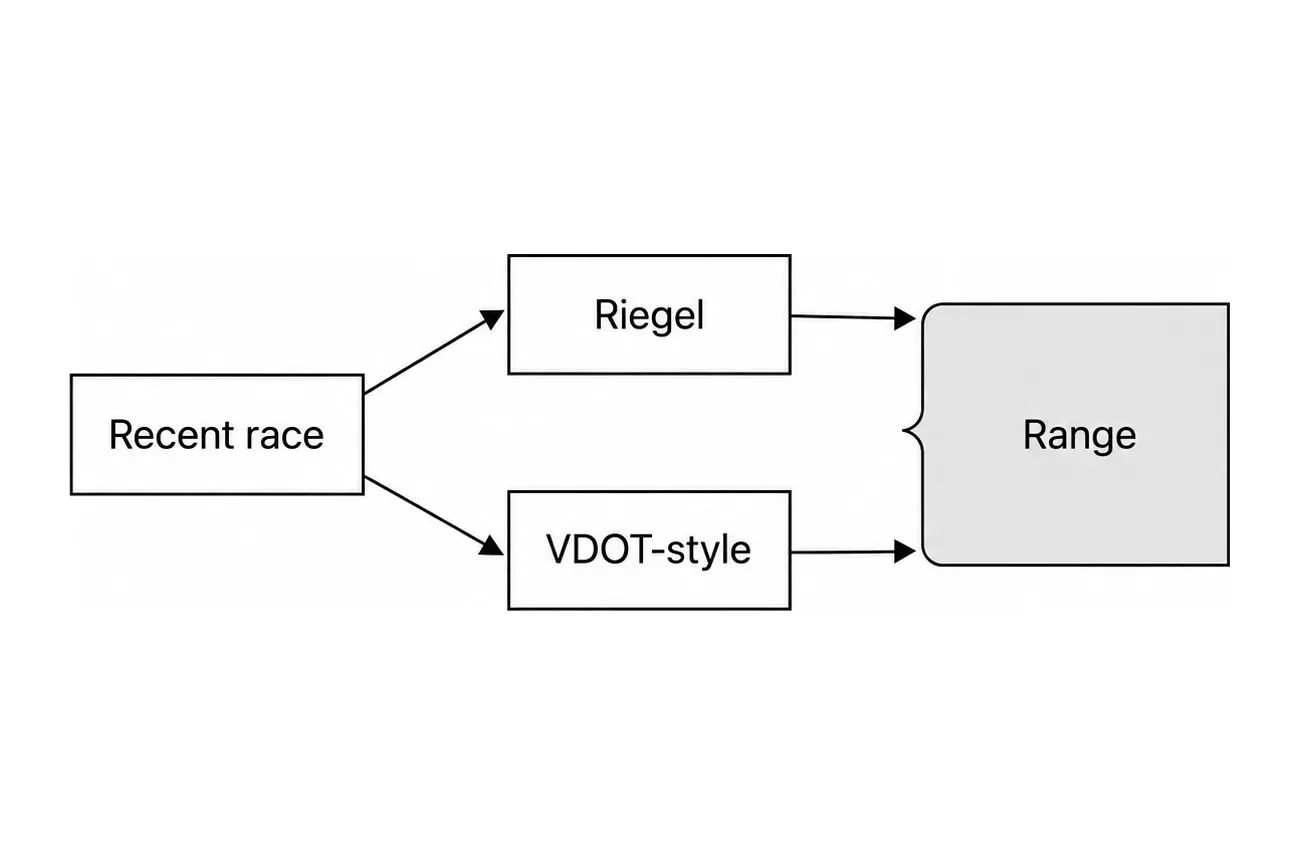
A race time predictor turns one recent result into estimated times for other distances: a 25:00 5K, for example, points to about 52 minutes for 10K (6.2 mi), 1:55 for the half marathon and 3:58 to 4:00 for the marathon. The predictor below uses two methods, Riegel's formula and a VDOT-style model based on Daniels and Gilbert, and shows the answer as a range, because no single formula knows how you trained.
The part most calculators leave out: the further you predict, the more the answer depends on training the formula cannot see. A 5K to 10K estimate is usually close. A 5K to marathon estimate is a ceiling, not a target.
Race time predictor: enter a recent result
Choose the distance you raced (5K, 10K, half marathon, marathon or a custom distance), enter your finish time, and the predictor estimates the other races with both methods plus matching training paces. It runs in your browser and needs no account.
Race time predictor: enter a recent result
Estimates from a 25:00 5K
| Race | Riegel | VDOT-style | Estimated range | Pace range |
|---|---|---|---|---|
| 5K 5 km (3.1 mi) | 25:00 | 25:00 | 25:00 | 5:00 /km (8:03 /mi) |
| 10K 10 km (6.2 mi) | 52:07 | 51:53 | 51:53 to 52:07 | 5:11 to 5:13 /km (8:21 to 8:23 /mi) |
| Half marathon 21.1 km (13.1 mi) | 1:55:00 | 1:55:04 | 1:55:00 to 1:55:04 | 5:27 /km (8:46 to 8:47 /mi) |
| Marathon 42.2 km (26.2 mi) | 3:59:47 | 3:57:55 | 3:57:55 to 3:59:47 | 5:38 to 5:41 /km (9:04 to 9:09 /mi) |
Predictions for the marathon run optimistic for runners without marathon-specific training. Treat the faster end as a ceiling, not a target.
Training paces from your 5K equivalent (25:00)
- Easy
- 6:15 to 6:45 /km (10:04 to 10:52 /mi)
- Steady
- 5:30 to 5:45 /km (8:51 to 9:15 /mi)
- Tempo
- 5:12 to 5:24 /km (8:22 to 8:41 /mi)
- Intervals
- 4:54 to 5:06 /km (7:53 to 8:12 /mi)
Paces are general training guidance, not medical advice. Check with a doctor before starting a new training plan, and stop if you feel pain, chest pain or dizziness.
Predicted times from 5K results
| 5K time 5 km (3.1 mi) | 10K 10 km (6.2 mi) | Half marathon 21.1 km (13.1 mi) | Marathon 42.2 km (26.2 mi) |
|---|---|---|---|
| 18:00 | 37:20 to 37:32 | 1:22:33 to 1:22:48 | 2:52:25 to 2:52:38 |
| 19:00 | 39:24 to 39:37 | 1:27:11 to 1:27:24 | 3:01:52 to 3:02:14 |
| 20:00 | 41:28 to 41:42 | 1:31:50 to 1:32:00 | 3:11:17 to 3:11:49 |
| 21:00 | 43:32 to 43:47 | 1:36:28 to 1:36:36 | 3:20:41 to 3:21:25 |
| 22:00 | 45:37 to 45:52 | 1:41:07 to 1:41:12 | 3:30:03 to 3:31:00 |
| 23:00 | 47:42 to 47:57 | 1:45:46 to 1:45:48 | 3:39:22 to 3:40:36 |
| 24:00 | 49:48 to 50:02 | 1:50:24 to 1:50:25 | 3:48:40 to 3:50:11 |
| 25:00 | 51:53 to 52:07 | 1:55:00 to 1:55:04 | 3:57:55 to 3:59:47 |
| 26:00 | 53:59 to 54:12 | 1:59:36 to 1:59:42 | 4:07:08 to 4:09:22 |
| 27:00 | 56:05 to 56:18 | 2:04:12 to 2:04:20 | 4:16:19 to 4:18:58 |
| 28:00 | 58:11 to 58:23 | 2:08:48 to 2:08:57 | 4:25:28 to 4:28:33 |
| 29:00 | 1:00:17 to 1:00:28 | 2:13:24 to 2:13:34 | 4:34:35 to 4:38:09 |
| 30:00 | 1:02:23 to 1:02:33 | 2:18:00 to 2:18:10 | 4:43:39 to 4:47:44 |
| 31:00 | 1:04:29 to 1:04:38 | 2:22:36 to 2:22:45 | 4:52:41 to 4:57:19 |
| 32:00 | 1:06:35 to 1:06:43 | 2:27:12 to 2:27:20 | 5:01:42 to 5:06:55 |
| 33:00 | 1:08:41 to 1:08:48 | 2:31:48 to 2:31:53 | 5:10:40 to 5:16:30 |
| 34:00 | 1:10:47 to 1:10:53 | 2:36:24 to 2:36:26 | 5:19:36 to 5:26:06 |
| 35:00 | 1:12:53 to 1:12:58 | 2:40:59 to 2:41:00 | 5:28:30 to 5:35:41 |
| 36:00 | 1:14:59 to 1:15:03 | 2:45:30 to 2:45:36 | 5:37:22 to 5:45:17 |
| 37:00 | 1:17:05 to 1:17:09 | 2:50:01 to 2:50:12 | 5:46:13 to 5:54:52 |
| 38:00 | 1:19:11 to 1:19:14 | 2:54:30 to 2:54:48 | 5:55:01 to 6:04:28 |
| 39:00 | 1:21:17 to 1:21:19 | 2:58:59 to 2:59:24 | 6:03:48 to 6:14:03 |
| 40:00 | 1:23:22 to 1:23:24 | 3:03:27 to 3:04:00 | 6:12:33 to 6:23:39 |
Sources
- Peter Riegel (Wikipedia): race time prediction formula Checked Oct 12, 2026
- Jack Daniels (Wikipedia): VDOT and training intensities Checked Oct 12, 2026
Here is what it returns for a 25:00 5K, the default example:
| Race | Riegel | VDOT-style | Estimated range | Pace range |
|---|---|---|---|---|
| 5K, 5 km (3.1 mi) | 25:00 | 25:00 | 25:00 | 5:00 /km (8:03 /mi) |
| 10K, 10 km (6.2 mi) | 52:07 | 51:53 | 51:53 to 52:07 | 5:11 to 5:13 /km (8:21 to 8:23 /mi) |
| Half marathon, 21.1 km (13.1 mi) | 1:55:00 | 1:55:04 | 1:55:00 to 1:55:04 | 5:27 /km (8:46 to 8:47 /mi) |
| Marathon, 42.2 km (26.2 mi) | 3:59:47 | 3:57:55 | 3:57:55 to 3:59:47 | 5:38 to 5:41 /km (9:04 to 9:09 /mi) |
Notice how the two methods agree closely up to the half and then drift apart for the marathon. That gap is the honest part of the answer.
Race time predictions from 5K times
The table converts 5K results from 18:00 to 40:00 into estimated 10K, half marathon and marathon times. Each cell shows the faster and slower of the two methods. Find your 5K on the left and read across.
| 5K time, 5 km (3.1 mi) | 10K, 10 km (6.2 mi) | Half marathon, 21.1 km (13.1 mi) | Marathon, 42.2 km (26.2 mi) |
|---|---|---|---|
| 18:00 | 37:20 to 37:32 | 1:22:33 to 1:22:48 | 2:52:25 to 2:52:38 |
| 19:00 | 39:24 to 39:37 | 1:27:11 to 1:27:24 | 3:01:52 to 3:02:14 |
| 20:00 | 41:28 to 41:42 | 1:31:50 to 1:32:00 | 3:11:17 to 3:11:49 |
| 21:00 | 43:32 to 43:47 | 1:36:28 to 1:36:36 | 3:20:41 to 3:21:25 |
| 22:00 | 45:37 to 45:52 | 1:41:07 to 1:41:12 | 3:30:03 to 3:31:00 |
| 23:00 | 47:42 to 47:57 | 1:45:46 to 1:45:48 | 3:39:22 to 3:40:36 |
| 24:00 | 49:48 to 50:02 | 1:50:24 to 1:50:25 | 3:48:40 to 3:50:11 |
| 25:00 | 51:53 to 52:07 | 1:55:00 to 1:55:04 | 3:57:55 to 3:59:47 |
| 26:00 | 53:59 to 54:12 | 1:59:36 to 1:59:42 | 4:07:08 to 4:09:22 |
| 27:00 | 56:05 to 56:18 | 2:04:12 to 2:04:20 | 4:16:19 to 4:18:58 |
| 28:00 | 58:11 to 58:23 | 2:08:48 to 2:08:57 | 4:25:28 to 4:28:33 |
| 29:00 | 1:00:17 to 1:00:28 | 2:13:24 to 2:13:34 | 4:34:35 to 4:38:09 |
| 30:00 | 1:02:23 to 1:02:33 | 2:18:00 to 2:18:10 | 4:43:39 to 4:47:44 |
| 31:00 | 1:04:29 to 1:04:38 | 2:22:36 to 2:22:45 | 4:52:41 to 4:57:19 |
| 32:00 | 1:06:35 to 1:06:43 | 2:27:12 to 2:27:20 | 5:01:42 to 5:06:55 |
| 33:00 | 1:08:41 to 1:08:48 | 2:31:48 to 2:31:53 | 5:10:40 to 5:16:30 |
| 34:00 | 1:10:47 to 1:10:53 | 2:36:24 to 2:36:26 | 5:19:36 to 5:26:06 |
| 35:00 | 1:12:53 to 1:12:58 | 2:40:59 to 2:41:00 | 5:28:30 to 5:35:41 |
| 36:00 | 1:14:59 to 1:15:03 | 2:45:30 to 2:45:36 | 5:37:22 to 5:45:17 |
| 37:00 | 1:17:05 to 1:17:09 | 2:50:01 to 2:50:12 | 5:46:13 to 5:54:52 |
| 38:00 | 1:19:11 to 1:19:14 | 2:54:30 to 2:54:48 | 5:55:01 to 6:04:28 |
| 39:00 | 1:21:17 to 1:21:19 | 2:58:59 to 2:59:24 | 6:03:48 to 6:14:03 |
| 40:00 | 1:23:22 to 1:23:24 | 3:03:27 to 3:04:00 | 6:12:33 to 6:23:39 |
The marathon column is the least reliable, for the reasons below. Once you have a range you like, the marathon pace chart and the half marathon pace chart turn it into checkpoint splits and a printable band.
How the race time calculator works
Two models, one input. Where they agree, the range is narrow; where they disagree, the gap shows how much the estimate depends on the model rather than on you.
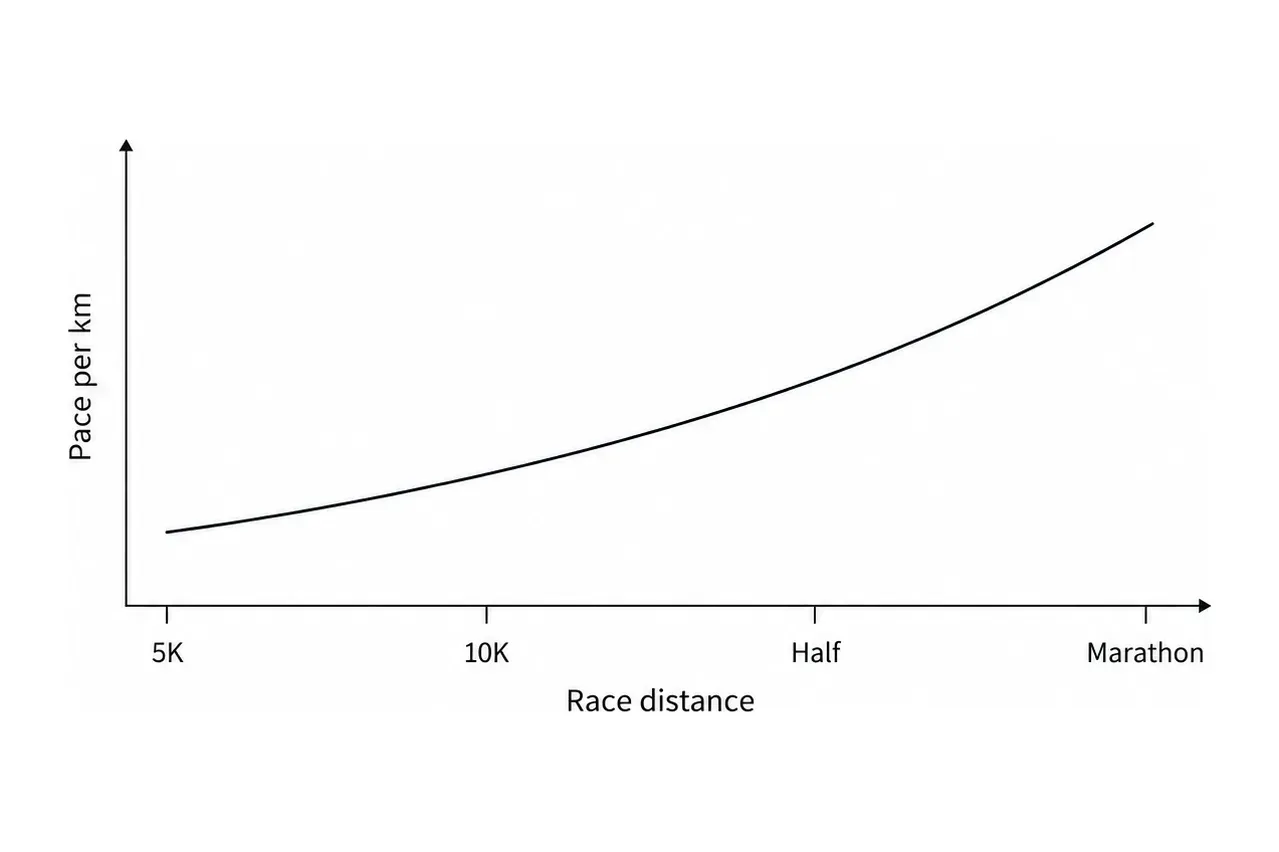
Riegel's formula. Published by Peter Riegel in Runner's World in 1977 and expanded in American Scientist in 1981, it predicts a new time as T2 = T1 x (D2 / D1)^1.06. The exponent of 1.06 means each doubling of distance costs a little more than double the time, because pace slows as an effort gets longer.
The VDOT-style model. It follows the approach Jack Daniels and Jimmy Gilbert built from the performances of elite middle and long distance runners. It turns your result into a fitness score from the oxygen cost of your pace and the share of your maximum you can sustain for that long, then finds the time at another distance that matches the same score.
Why marathon time predictions run optimistic
Marathon predictions run optimistic for runners without marathon-specific training. Both formulas assume you are as well trained for the longer race as for the one you ran.
A 5K or 10K tests speed and short endurance. A marathon also tests weekly volume, long runs, fueling and how your legs hold up after 30 km (18.6 mi). Riegel described his formula for efforts lasting roughly 3.5 to 230 minutes, and some calculators change the 1.06 exponent because it can produce marathon times that look out of reach.
So treat the faster end of the range as a ceiling, plan your early race pace from the slower end, and update the estimate with a half marathon result if you have one. To move the estimate itself, retest after 6 to 8 weeks of mostly easy running with one or two fast sessions a week; this 8 week plan to get faster lays them out.
Which result should you enter?
The best input is a recent, full-effort race over a measured distance, as close as possible to the race you are predicting.
| Your target race | Best input | Fine input | Weak input |
|---|---|---|---|
| 10K, 10 km (6.2 mi) | A 5K or 8 km (5 mi) race | A parkrun-style timed 5K | A training run |
| Half marathon, 21.1 km (13.1 mi) | A 10K or 15K | A 5K | A result older than 3 months |
| Marathon, 42.2 km (26.2 mi) | A half marathon | A 10K | A 5K with no long runs behind it |
Half marathon time predictor: the most useful input
A half marathon result is the closest common distance to a marathon, which makes it the most useful input for a marathon estimate. Predicting a half from a 10K also stays well inside the range where both formulas behave. If your only recent result is a 5K, running a half as a tune-up race gives you a better marathon input later. Whichever race you use, run it as a real effort: a light breakfast 2 to 3 hours before a 5K and a proper warm-up give you a truer number to enter.
Use any distance, in km or miles
Not every recent result is a standard distance. Choose Custom to enter any distance from 1 to 50 km (0.6 to 31 mi) in kilometers or miles, such as a 5 mile (8 km) road race or a 15K (9.3 mi). Efforts shorter than about 3.5 minutes or longer than about 4 hours sit outside the range the formulas were built for.
How to predict your race time
- Pick a recent race
Use a full-effort result from the last 6 to 8 weeks over a measured course, ideally the distance closest to your target.
- Enter the distance and finish time
Select 5K, 10K, half, marathon or Custom, then type the time as mm:ss or h:mm:ss.
- Read the range, not one number
Look at both columns. Plan your opening pace from the slower end, especially for the marathon.
- Turn it into training paces
Use the easy, steady, tempo and interval paces shown under the result for your next weeks of training.
Turn a race predictor result into training paces
The predictor also shows easy, steady, tempo and interval paces from your 5K equivalent, the same way Raceblock plans set paces. For the 25:00 5K example:
| Pace type | Per km | Per mile | How it should feel |
|---|---|---|---|
| Easy | 6:15 to 6:45 /km | 10:04 to 10:52 /mi | Conversational; most of your weekly distance |
| Steady | 5:30 to 5:45 /km | 8:51 to 9:15 /mi | Comfortably firm, still in control |
| Tempo | 5:12 to 5:24 /km | 8:22 to 8:41 /mi | Hard but sustainable for 20 to 30 minutes |
| Intervals | 4:54 to 5:06 /km | 7:53 to 8:12 /mi | Short repeats with recovery between them |
The plan engine sets the same pace bands for a 16-week marathon plan built from that 25:00 5K:
Training paces per km and per mile
- Easy
- 6:15 to 6:45 /km (10:04 to 10:52 /mi)
- Steady
- 5:30 to 5:45 /km (8:51 to 9:15 /mi)
- Tempo
- 5:12 to 5:24 /km (8:22 to 8:41 /mi)
- Intervals
- 4:54 to 5:06 /km (7:53 to 8:12 /mi)
- Long
- 6:15 to 6:45 /km (10:04 to 10:52 /mi)
- Goal
- 5:36 to 5:48 /km (9:01 to 9:20 /mi)
| Recent 5k | Easy conversational | Steady comfortably steady | Tempo comfortably hard | Intervals controlled hard efforts | Race effort controlled |
|---|---|---|---|---|---|
| 20:00 | 5:00 to 5:24 /km (8:03 to 8:41 /mi) | 4:24 to 4:36 /km (7:05 to 7:24 /mi) | 4:10 to 4:19 /km (6:42 to 6:57 /mi) | 3:55 to 4:05 /km (6:19 to 6:34 /mi) | 4:29 to 4:38 /km (7:13 to 7:28 /mi) |
| 23:00 | 5:45 to 6:13 /km (9:15 to 10:00 /mi) | 5:04 to 5:17 /km (8:09 to 8:31 /mi) | 4:47 to 4:58 /km (7:42 to 8:00 /mi) | 4:30 to 4:42 /km (7:15 to 7:33 /mi) | 5:09 to 5:20 /km (8:17 to 8:35 /mi) |
| 25:00pace used in the table | 6:15 to 6:45 /km (10:04 to 10:52 /mi) | 5:30 to 5:45 /km (8:51 to 9:15 /mi) | 5:12 to 5:24 /km (8:22 to 8:41 /mi) | 4:54 to 5:06 /km (7:53 to 8:12 /mi) | 5:36 to 5:48 /km (9:01 to 9:20 /mi) |
| 26:00 | 6:30 to 7:01 /km (10:28 to 11:18 /mi) | 5:43 to 5:59 /km (9:12 to 9:37 /mi) | 5:24 to 5:37 /km (8:42 to 9:02 /mi) | 5:06 to 5:18 /km (8:12 to 8:32 /mi) | 5:49 to 6:02 /km (9:22 to 9:42 /mi) |
| 29:00 | 7:15 to 7:50 /km (11:40 to 12:36 /mi) | 6:23 to 6:40 /km (10:16 to 10:44 /mi) | 6:02 to 6:16 /km (9:42 to 10:05 /mi) | 5:41 to 5:55 /km (9:09 to 9:31 /mi) | 6:30 to 6:44 /km (10:27 to 10:50 /mi) |
| 32:00 | 8:00 to 8:38 /km (12:52 to 13:54 /mi) | 7:02 to 7:22 /km (11:20 to 11:51 /mi) | 6:39 to 6:55 /km (10:43 to 11:07 /mi) | 6:16 to 6:32 /km (10:06 to 10:30 /mi) | 7:10 to 7:25 /km (11:32 to 11:57 /mi) |
| 35:00 | 8:45 to 9:27 /km (14:05 to 15:12 /mi) | 7:42 to 8:03 /km (12:24 to 12:57 /mi) | 7:17 to 7:34 /km (11:43 to 12:10 /mi) | 6:52 to 7:08 /km (11:02 to 11:29 /mi) | 7:50 to 8:07 /km (12:37 to 13:04 /mi) |
General training guidance, not medical advice. Check with a doctor before increasing training if you have symptoms or a health condition.
Paces are a starting point: heat, hills and tired legs change them, and effort matters more than the number on a hot day. General training guidance, not medical advice. Check with a doctor before increasing training if you have symptoms or a health condition.
From a predicted time to a plan that holds up
Everything so far is free and works without signing up: enter a result, read the range, take the paces. The trouble starts after you pick a goal. A predicted 3:58 to 4:00 marathon tells you nothing about how to get from today to race day, and a fixed plan built around that number has the usual weak spot. It doesn't move when your week does. One missed long run or a sick week, and the plan behind your goal is already out of date.
The fix is a plan that starts from your race date and your predicted time. Build your free plan for your race date. On the Coach plan, next week re-plans itself when you miss a run.
Free training plan
Build your free plan for your race date.
Pick your race and race date. Every week from today to race day is planned for you, with distances in km and miles.
If the range points at 4:00, the sub-4 hour marathon training plan shows a full 16 weeks built around that goal. For a half, the 12-week half marathon plan is the common starting point. Comparing apps first? Here is how Raceblock stacks up as a Runna alternative, and how Free and Coach compare.
Put the race time predictor on your site
Running club, race organizer or coach? Embed the predictor on your own page with one snippet.
Use this race time predictor on your site
Copy the code to add the tool to a club site, race page or coaching blog. Keep the credit link so readers can find the full guide.
Embed code
<iframe src="https://myraceblock.com/embed/race-time-predictor" title="Race time predictor" width="100%" height="640" style="border:0" loading="lazy"></iframe> <p>Free <a href="https://myraceblock.com/blog/race-time-predictor">race time predictor</a> by Raceblock</p>Full guide: Race time predictor.
A race time predictor is most useful when you treat it as a range: trust it for nearby distances, treat marathon estimates from a 5K as a ceiling, and refresh it with a half marathon result when you have one. A predicted time is a starting point for a goal, not a promise.
When you have a number, the marathon training plan guide and the half marathon training plan guide compare every plan length, or you can build a free plan for your race date that uses your recent result to set its paces.

Frequently asked questions
Use a recent race result over a measured distance, run at full effort, and enter it in the predictor to see Riegel and VDOT-style estimates for other distances. The closer the input distance is to your target, the more useful the estimate.
Enter the 5K result in the predictor. For a 25:00 5K, the two methods estimate 3:57:55 to 3:59:47. Read that as an optimistic ceiling unless your training includes regular long runs.
Yes. Select 10K and enter its finish time. The same two formulas compute estimates for the other distances. Use a recent result that reflects your current training, then treat the results as a range.
No formula is accurate for everyone. Riegel's formula and VDOT-style models both assume you are equally trained for both distances. Using a result from a distance close to your target, and reading the predictions as a range, gives a more honest estimate than any single number.
Multiply your pace by the distance: at 6:00 per km (9:39 per mile), 10 km (6.2 mi) takes 60 minutes. Our guide to how long a 10k takes has the same math for every pace from 40 to 90 minutes. For a distance you have not raced, enter a recent result in the predictor and read the range for the distance you are targeting.
No. A 7:00:00 marathon is 9:57 per km (16:01 per mile) and still means covering 42.2 km (26.2 mi). The limit that matters is your race's published cutoff time, so check it before choosing a run/walk strategy.
Free training plan
Build your free plan for your race date.
On the Coach plan, next week re-plans itself when you miss a run.
Share article
About the author
More running training guides
Pacing and race day · 11 min
10K Running Pace Chart: Every Time From 35 to 75 Minutes
A 10K running pace chart for every finish time from 35:00 to 1:15:00: pace per km and per mile, 5 km halfway splits, 400 m laps, treadmill speeds, and what your 10K says about a half or marathon.
Pacing and race day · 10 min
How Long Does It Take to Run a Mile? Times by Age and Pace
Most people run a mile in 9 to 13 minutes at an easy pace and 6 to 8 minutes at race effort. See mile times by age, pace per km and how to get faster.
Pacing and race day · 9 min
How Long to Run a 10K: Finish Times, Miles and Training
A 10k run is 10 km (6.21 mi) and takes about 60 minutes at 6:00 /km (9:39 /mi). See finish times at every pace, how long to train for one and how to pace your first race.
Pacing and race day · 10 min
5K Running Pace Chart: Every Time From 15 to 45 Minutes
A 5K running pace chart for every finish time from 15:00 to 45:00: pace per km and per mile, 400 m lap times, treadmill speeds, and what your 5K says about a half or marathon.
Pacing and race day · 10 min
Average 5K Time by Age for Men and Women (20 to 80)
The average 5K time by age is about 22:41 for men and 27:19 for women in their 20s, slowing by about a minute every five years after 35. Here are the age tables, the race field median of 34:37, and how to find your own time.
Pacing and race day · 10 min
Running Pace Conversion Chart: Km, Mile and Treadmill
Convert any running pace between minutes per km and minutes per mile, and treadmill mph or km/h into pace, with marathon and half marathon finish times in the same charts.