
Pace When Running: What It Means and How to Set Yours
Raceblock team Updated November 19, 2026 10 min read
Free training plan for your race date
Free training plan for your race date
Build my free planIn this article
Pace when running is how long it takes you to cover one kilometer or one mile, written as minutes and seconds, for example 6:00 /km (9:39 /mi). It is the speed number runners actually use, and the right pace is not one number: it depends on the job of the run, so your easy days should be much slower than your race pace.
That is the part most runners get wrong. Pace is a result of effort, terrain and weather, not a setting you pick on the watch. Run by effort first, check pace second, and almost every pacing problem goes away.
What is pace in running?
Pace in running is the time you take per unit of distance: minutes per kilometer or minutes per mile. A 6:00 /km pace means each kilometer takes six minutes, so 10 km (6.2 mi) takes one hour. Speed is the same thing turned around, in km/h or mph.
Runners use pace instead of speed because it maps straight onto a race. If you know your pace and the distance, you know your finish time. A 5 km (3.1 mi) run at 6:00 /km (9:39 /mi) is 30 minutes. A marathon of 42.2 km (26.2 mi) at the same pace is 4:13.
To convert, multiply a per km pace by 1.609 to get the per mile pace, or divide a per mile pace by 1.609 to go back. The table does it for the paces most runners use, and the full running pace conversion chart covers every pace from 3:00 to 8:00 /km plus treadmill speeds.
| Pace per km | Pace per mile | Speed (km/h) | Speed (mph) |
|---|---|---|---|
| 4:00 /km | 6:26 /mi | 15.0 | 9.3 |
| 4:30 /km | 7:15 /mi | 13.3 | 8.3 |
| 5:00 /km | 8:03 /mi | 12.0 | 7.5 |
| 5:30 /km | 8:51 /mi | 10.9 | 6.8 |
| 6:00 /km | 9:39 /mi | 10.0 | 6.2 |
| 6:30 /km | 10:28 /mi | 9.2 | 5.7 |
| 7:00 /km | 11:16 /mi | 8.6 | 5.3 |
| 7:30 /km | 12:04 /mi | 8.0 | 5.0 |
What is a good running pace?
A good running pace is the one that matches the job of the run. For an easy run that means slow enough to talk in full sentences. For a race it means a pace you can hold to the finish without fading. There is no single good number, because a 7:00 /km (11:16 /mi) easy run and a 5:00 /km (8:03 /mi) 10 km race can belong to the same runner on the same week.
The mistake is judging every run by one pace. Runners who chase a "good" pace on every outing end up running the easy days too hard and the hard days too tired. If you want to know what finish time your current fitness points to, put a recent race into the race time predictor and work back from there.
Running pace by type of run
Each run in a training week has its own pace, set by effort. The talk test is the simplest guide: the point where talking first gets hard sits close to the ventilatory threshold, the effort where your breathing changes gear (Persinger et al., 2004). Below it is easy running. Above it is hard running. Speed play, better known as fartlek running, is the simplest way to practice moving between the two by feel.
| Run type | Effort | Talk test | Share of a typical week |
|---|---|---|---|
| Easy run | Relaxed, could go on for a long time | Full sentences | Most of your running |
| Long run | Easy, a touch steadier late on | Full sentences | One run a week |
| Marathon pace | Steady, controlled | Short sentences | Short blocks inside long runs |
| Tempo or threshold | Comfortably hard | A few words at a time | One session a week at most |
| Intervals | Hard, repeats with rests | Single words | Short reps, in some weeks |
The pace for each zone is personal. Your marathon goal sets your marathon pace: the marathon pace chart lists the per km and per mile pace for every goal time, and the half marathon pace chart does the same for 21.1 km (13.1 mi). Easy pace then sits clearly slower than that, usually by a minute or more per km.
Pace and effort can also split apart for reasons that have nothing to do with fitness. Your breathing tells you the truth faster than the watch: if you are gasping at a pace that felt easy last week, slow down until your breathing settles, then let the pace follow.
How to pace yourself when running
Pacing yourself means spending your effort evenly, so the last part of the run feels like the first. These steps work for a 30 minute jog and a marathon alike.
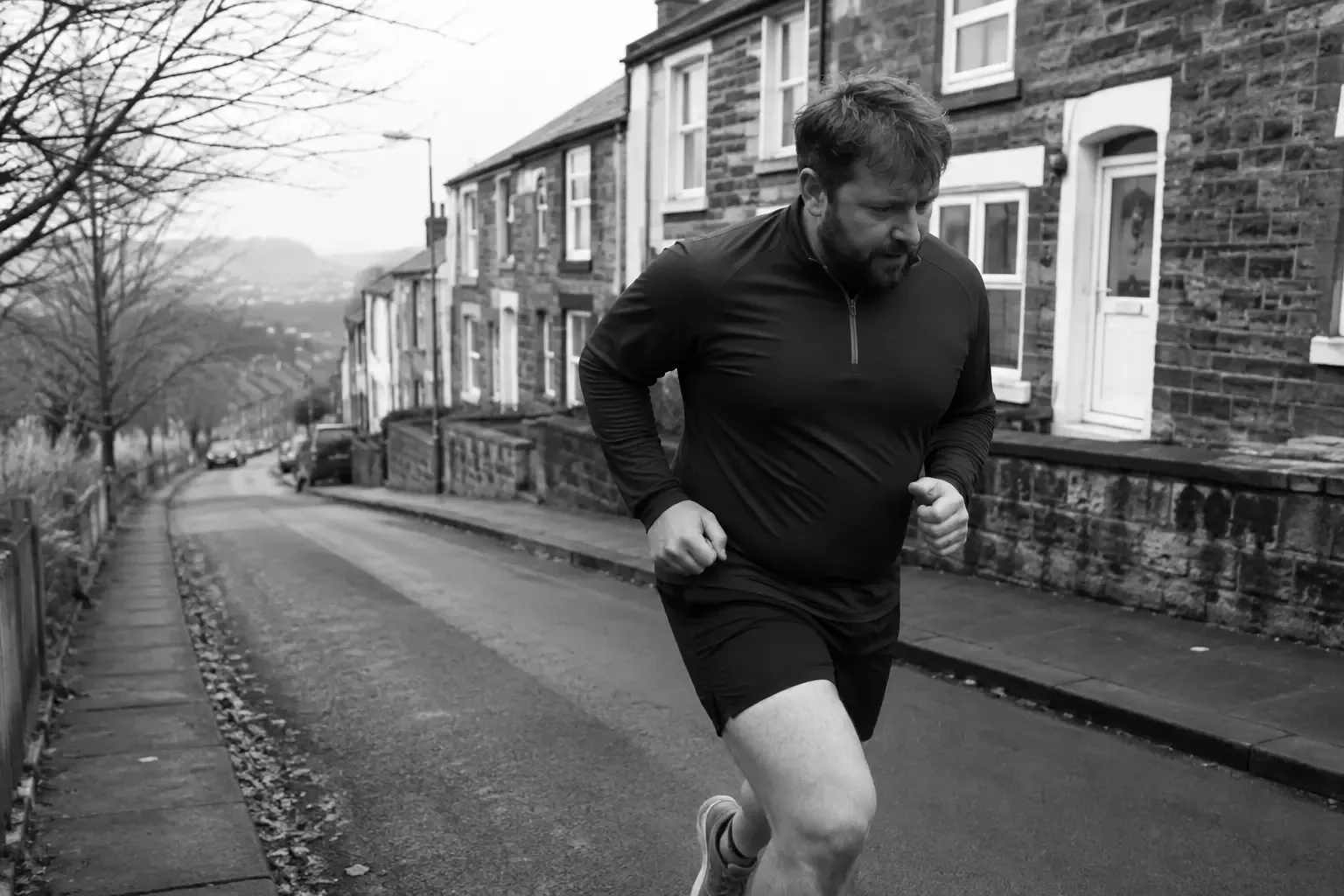
How to pace yourself when running
- Start slower than feels right
The first 10 minutes always feel easy because your body has not caught up yet. Hold back until you are warm. A short warm up before running helps the first kilometer feel less like a shock.
- Run by effort, then check the pace
Settle into the effort the run calls for, using the talk test, and only then glance at your pace. If the two disagree, trust the effort on easy days. The day after a long run, go slower still: a recovery run sits 30 to 60 seconds per km slower than your easy pace.
- Check splits, not every second
Look at your pace once per kilometer or mile, not constantly. GPS pace jumps around under trees and between buildings, and chasing it makes you surge and slow.
- Hold effort on hills, not pace
Uphill, shorten your step and let the pace slow while the effort stays the same. Downhill, let it come back. Trying to hold a flat pace up a hill costs more than it gains.
- Adjust for heat and wind
Hot days, humid days and headwinds all make the same pace cost more. Slow down to keep the effort where it belongs instead of forcing the number. Our guide to running in the heat covers how to plan a whole summer week around that.
- Finish a little faster than you started
If you have something left in the last part of the run, use it. Running the second half slightly faster than the first is a negative split, and it is the surest sign you paced it well.
If your problem is that you run out of breath or legs before the run is done, starting slower fixes most of it.
General training guidance, not medical advice. Check with a doctor before increasing training if you have symptoms or a health condition. Pain, chest pain, swelling or feeling faint means stop and see a doctor or physio.
Treadmill pace and mph
Treadmills show speed in mph or km/h, not pace, so you have to convert. Divide 60 by the mph setting to get minutes per mile. At 7.0 mph that is 8:34 /mi, which is 5:20 /km.

| Treadmill speed | Pace per mile | Pace per km |
|---|---|---|
| 5.0 mph (8.0 km/h) | 12:00 /mi | 7:27 /km |
| 6.0 mph (9.7 km/h) | 10:00 /mi | 6:13 /km |
| 7.0 mph (11.3 km/h) | 8:34 /mi | 5:20 /km |
| 8.0 mph (12.9 km/h) | 7:30 /mi | 4:40 /km |
| 10.0 mph (16.1 km/h) | 6:00 /mi | 3:44 /km |
The belt does part of the work for you, so many runners set a small incline, around 1%, to make treadmill effort feel closer to running outside. Use effort here too: the console number is only a guide.
Pacing mistakes and what they cost
- Running every easy day at a "good" pace. You arrive at the hard sessions tired and run them slower than you could. The cost is the very fitness you were chasing.
- Going out too fast. The first kilometers feel easy, so you bank time. You pay it back with interest in the second half, which is the most common way a race goes wrong.
- Chasing the watch up hills. Holding flat pace on a climb spikes your effort and leaves you spent on the flat that follows.
- Ignoring the weather. The same pace on a hot day is a harder run. Forcing the number turns an easy day into a hard one.
- Comparing your pace with other runners. Their easy pace is not yours. Compare your pace only with your own at the same effort.
If you want your race pace to rise over time, that comes from consistent easy running plus a little faster work, not from racing every run. The guide on how to run faster shows how to add it.
When your week stops matching the plan
You can do all of this alone: learn the talk test, run most of the week easy, set your marathon pace from the chart and practice it inside your long runs. A marathon training plan tells you which day gets which pace.
The wall comes when your week stops matching the plan. A cold takes out three runs, a work trip eats the long run, and now the pace session is in the wrong place. A written plan does not move when your week does. If that has happened already, here is what to do after a missed long run.
That is the part Raceblock handles. Build your free plan for your race date. On the Coach plan, next week re-plans itself when you miss a run.
Free training plan
Build your free plan for your race date.
Pick your race and race date. Every week from today to race day is planned for you, with distances in km and miles.
Running pace in one line
Pace is time per km or per mile, and the right one is set by the job of the run: slow and chatty on most days, steady at marathon pace in small doses, and hard only when the plan says so.
Pace yourself by effort, check the number at each split, and let hills, heat and wind move it. Build your free plan for your race date and every run in your week comes with the pace it needs.
Frequently asked questions
Pace means the time you take to run one kilometer or one mile, written as minutes and seconds. A pace of 6:00 /km means each kilometer takes six minutes, which is 9:39 per mile. A lower number is a faster pace.
A treadmill set to 7.0 mph is a pace of 8:34 per mile, or 5:20 per km. To work out any setting, divide 60 by the mph number to get minutes per mile, then divide that by 1.609 to get minutes per km.
Yes. 20 mph is a pace of 3:00 per mile, or 1:52 per km, which is sprint speed that a runner can only hold for a few seconds. It is faster than the men's world record mile pace of 3:43.13, set by Hicham El Guerrouj in 1999.
Free training plan
Build your free plan for your race date.
On the Coach plan, next week re-plans itself when you miss a run.
Share article
About the author
More running training guides

Running basics · 12 min
What Is a Recovery Run? Pace, Length and When to Skip It
A recovery run is a short, very easy run you do the day after a long run or hard session. Here is how slow to run it, how long, how it differs from an easy run and a rest day, where it fits in a half or marathon week, and when to skip it.
Running basics · 10 min
10K Beginner Training Schedule: 10 Weeks From Run-Walk
A 10k beginner training schedule for runners starting from run-walk: 10 weeks, three timed sessions a week, a long session that grows to about 70 minutes, the paces behind common finish times and how to adjust the plan to your week.

Running basics · 11 min
10K Training Routine: 3 Runs a Week for 8 Weeks
A 10k training routine is three runs a week on fixed days: one easy run, one faster session and a long run that builds to the full 10 km (6.2 mi) at an easy pace. Here is the weekly layout, the 8-week schedule, the paces and the mistakes that break it.

Running basics · 11 min
5K Training Routine: The Weekly Schedule to Repeat
A good 5K training routine is three or four runs a week on fixed days: one key session, one longer easy run and easy running in between. Here are both weekly layouts, your paces, an 8-week schedule and the mistakes that stall it.
Running basics · 11 min
Interval Training Plan for Running: 8 Weeks With Paces
A simple 8-week interval training plan for running: one session a week at 5 km to 10 km effort, with paces per km and per mile, jog recoveries, a sample week and how to adjust it for a half marathon, a marathon or a comeback.
Running basics · 10 min
Running in the Heat: 9 Tips to Train Safely All Summer
Running in the heat tips that work: run early, run by effort instead of pace, drink and add salt on long runs, adapt over two weeks, and know the warning signs that mean stop.