
HYROX Training Plan for Beginners: Free 12-Week Schedule
Raceblock team October 17, 2026 12 min read
Free HYROX plan for your race date

Free HYROX plan for your race date
Build my free planIn this article
This 12-week HYROX training plan for beginners gives you three runs and one strength and stations day a week. Your running builds from 16.2 km (10.1 mi) in week 1 to 24 km (14.9 mi) in week 10, with compromised runs in the build and peak phases and a two-week taper before your first race in the open division.
The thing most beginners get wrong is treating HYROX as a gym event with some jogging attached. It is the other way round: you run 8 km (5 mi) in 1 km (0.62 mi) pieces, and the eight stations sit between those runs. So this plan protects the running first and fits the station practice around it.
- Weeks
- 12
- Runs a week
- 3 + station day
- Peak week
- 24 km (14.9 mi)
- Longest run
- 12 km (7.5 mi)
- Taper
- 2 weeks
Is this beginner HYROX plan right for you now?
It is right if you can already run about 16 km (10 mi) a week over three runs and your longest run is around 8 km (5 mi). Week one asks for exactly that: 16.2 km (10.1 mi) of running over 3 runs, plus one strength and stations session. If three runs a week is new to you, run easy three times a week for a few weeks first, then start week 1.
For the station day, use these five scalable HYROX workout options to choose a clear purpose without adding another hard session to the week.

| This plan fits you if | Pick something else if |
|---|---|
| Your first HYROX race is about 12 weeks away | Your race is 6 to 8 weeks out (enter the date in the builder for a shorter block) |
| You run 2 or 3 times a week already | You do not run at all yet: build easy runs first |
| You can get to a gym with a sled, rower or SkiErg once a week | You already lift 4 or more days a week and cannot drop a session |
| You want to finish the open division well | You are racing pro or chasing a podium: you need a higher level |
The paces in the tables below come from a sample 28:00 5k. If your recent 5k is faster or slower, use the pace table further down to find your row.
The 12-week beginner HYROX training schedule
Here is the full plan. Every week has the same shape, so you can see at a glance where the distance goes up, where the lighter weeks sit and where the taper starts.
- Base weeks 1 to 3
- Build weeks 4 to 8
- Peak weeks 9 to 10
- Taper weeks 11 to 12
- Lighter weeks 4 and 8
The four phases do different jobs:
- Base, weeks 1 to 3. Follow the easy runs and rest days. Every run is easy so the routine settles in. Check that the opening load fits your current training.
- Build, weeks 4 to 8. The runs get longer and the Thursday run becomes a compromised run in weeks 6 and 7. Weeks 4 and 8 are lighter: keep them lighter instead of making up missed runs.
- Peak, weeks 9 to 10. The biggest running weeks, with the longest Sunday run of 12 km (7.5 mi) in week 10. Easy days stay easy.
- Taper, weeks 11 to 12. Shorter runs and a light race week. Reduce training as shown rather than adding one last long run.
12-week HYROX training plan
Every distance is in km and miles; every pace is per km and per mile. Lighter weeks are marked under the week number.
| Week | Mon | Tue | Wed | Thu | Fri | Sat | Sun | Total |
|---|---|---|---|---|---|---|---|---|
| Week 1Base | MonRest | TueEasy4.1 km (2.5 mi)7:00 to 7:34 /km (11:16 to 12:10 /mi) | WedRest | ThuEasy4 km (2.5 mi)7:00 to 7:34 /km (11:16 to 12:10 /mi) | FriStrength + stations | SatRest | SunLong8.1 km (5 mi)7:00 to 7:34 /km (11:16 to 12:10 /mi) | Week total16.2 km (10.1 mi) |
| Week 2Base | MonRest | TueEasy4.4 km (2.7 mi)7:00 to 7:34 /km (11:16 to 12:10 /mi) | WedRest | ThuEasy4.4 km (2.7 mi)7:00 to 7:34 /km (11:16 to 12:10 /mi) | FriStrength + stations | SatRest | SunLong8.8 km (5.5 mi)7:00 to 7:34 /km (11:16 to 12:10 /mi) | Week total17.6 km (10.9 mi) |
| Week 3Base | MonRest | TueEasy4.8 km (3 mi)7:00 to 7:34 /km (11:16 to 12:10 /mi) | WedRest | ThuEasy4.8 km (3 mi)7:00 to 7:34 /km (11:16 to 12:10 /mi) | FriStrength + stations | SatRest | SunLong9.6 km (6 mi)7:00 to 7:34 /km (11:16 to 12:10 /mi) | Week total19.2 km (11.9 mi) |
| Week 4Build, lighter week | MonRest | TueEasy4.3 km (2.7 mi)7:00 to 7:34 /km (11:16 to 12:10 /mi) | WedRest | ThuEasy4.3 km (2.7 mi)7:00 to 7:34 /km (11:16 to 12:10 /mi) | FriStrength + stations | SatRest | SunLong8.7 km (5.4 mi)7:00 to 7:34 /km (11:16 to 12:10 /mi) | Week total17.3 km (10.7 mi) |
| Week 5Build | MonRest | TueEasy4.7 km (2.9 mi)7:00 to 7:34 /km (11:16 to 12:10 /mi) | WedRest | ThuEasy4.7 km (2.9 mi)7:00 to 7:34 /km (11:16 to 12:10 /mi) | FriStrength + stations | SatRest | SunLong9.4 km (5.8 mi)7:00 to 7:34 /km (11:16 to 12:10 /mi) | Week total18.8 km (11.7 mi) |
| Week 6Build | MonRest | TueEasy5.1 km (3.2 mi)7:00 to 7:34 /km (11:16 to 12:10 /mi) | WedRest | ThuCompromised run5.1 km (3.2 mi)6:10 to 6:26 /km (9:55 to 10:22 /mi) | FriStrength + stations | SatRest | SunLong10.3 km (6.4 mi)7:00 to 7:34 /km (11:16 to 12:10 /mi) | Week total20.5 km (12.7 mi) |
| Week 7Build | MonRest | TueEasy5.6 km (3.5 mi)7:00 to 7:34 /km (11:16 to 12:10 /mi) | WedRest | ThuCompromised run5.6 km (3.5 mi)6:10 to 6:26 /km (9:55 to 10:22 /mi) | FriStrength + stations | SatRest | SunLong11.2 km (7 mi)7:00 to 7:34 /km (11:16 to 12:10 /mi) | Week total22.4 km (13.9 mi) |
| Week 8Build, lighter week | MonRest | TueEasy5.1 km (3.2 mi)7:00 to 7:34 /km (11:16 to 12:10 /mi) | WedRest | ThuEasy5 km (3.1 mi)7:00 to 7:34 /km (11:16 to 12:10 /mi) | FriStrength + stations | SatRest | SunLong10.1 km (6.3 mi)7:00 to 7:34 /km (11:16 to 12:10 /mi) | Week total20.2 km (12.6 mi) |
| Week 9Peak | MonRest | TueEasy5.5 km (3.4 mi)7:00 to 7:34 /km (11:16 to 12:10 /mi) | WedRest | ThuEasy5.5 km (3.4 mi)7:00 to 7:34 /km (11:16 to 12:10 /mi) | FriStrength + stations | SatRest | SunLong11 km (6.8 mi)7:00 to 7:34 /km (11:16 to 12:10 /mi) | Week total22 km (13.7 mi) |
| Week 10Peak | MonRest | TueEasy6 km (3.7 mi)7:00 to 7:34 /km (11:16 to 12:10 /mi) | WedRest | ThuCompromised run6 km (3.7 mi)6:10 to 6:26 /km (9:55 to 10:22 /mi) | FriStrength + stations | SatRest | SunLong12 km (7.5 mi)7:00 to 7:34 /km (11:16 to 12:10 /mi) | Week total24 km (14.9 mi) |
| Week 11Taper | MonRest | TueEasy4.5 km (2.8 mi)7:00 to 7:34 /km (11:16 to 12:10 /mi) | WedRest | ThuEasy4.5 km (2.8 mi)7:00 to 7:34 /km (11:16 to 12:10 /mi) | FriStrength + stations | SatRest | SunLong9 km (5.6 mi)7:00 to 7:34 /km (11:16 to 12:10 /mi) | Week total18 km (11.2 mi) |
| Week 12Taper, race week | MonRest | TueEasy3.4 km (2.1 mi)7:00 to 7:34 /km (11:16 to 12:10 /mi) | WedRest | ThuEasy3.3 km (2.1 mi)7:00 to 7:34 /km (11:16 to 12:10 /mi) | FriStrength + stations | SatRest | SunLong6.8 km (4.2 mi)7:00 to 7:34 /km (11:16 to 12:10 /mi) | Week total13.5 km (8.4 mi) |
Race week. Keep the final week light. Start conservatively and adjust to conditions. Goal pace is a target, not a promised finish time.
- Rest
- Absorb training and recover for the next session.
- Easy
- Build aerobic endurance at a conversational effort.
- Strength + stations
- Practice station technique with manageable loads and full recovery.
- Long
- Build time on your feet without racing the session.
- Compromised run
- Practice running after light station work, keeping effort controlled.
General training guidance, not medical advice. Check with a doctor before increasing training if you have symptoms or a health condition.
The running total across all 12 weeks is 229.7 km (142.7 mi). The Friday strength and stations day is not in that number, and it should not be: a gym session is not a run, and adding it to the distance column hides the real load of the week.
Weekly distance climbs from 16.2 km (10.1 mi) to 24 km (14.9 mi) in week 10, dips in weeks 4 and 8, then drops to 13.5 km (8.4 mi) in race week.
Week 1 vs the peak week
The fastest way to judge a plan is to put its first and biggest weeks side by side.
| Day | Week 1 (base) | Week 10 (peak) |
|---|---|---|
| Tuesday | Easy 4.1 km (2.5 mi) | Easy 6 km (3.7 mi) |
| Thursday | Easy 4 km (2.5 mi) | Compromised run 6 km (3.7 mi) |
| Friday | Strength + stations | Strength + stations |
| Sunday | Long 8.1 km (5 mi) | Long 12 km (7.5 mi) |
| Running total | 16.2 km (10.1 mi) | 24 km (14.9 mi) |
The peak week is about 50% more running than week 1, spread over ten weeks. Monday, Wednesday and Saturday stay rest days the whole way through.


HYROX training program for beginners: the weekly structure
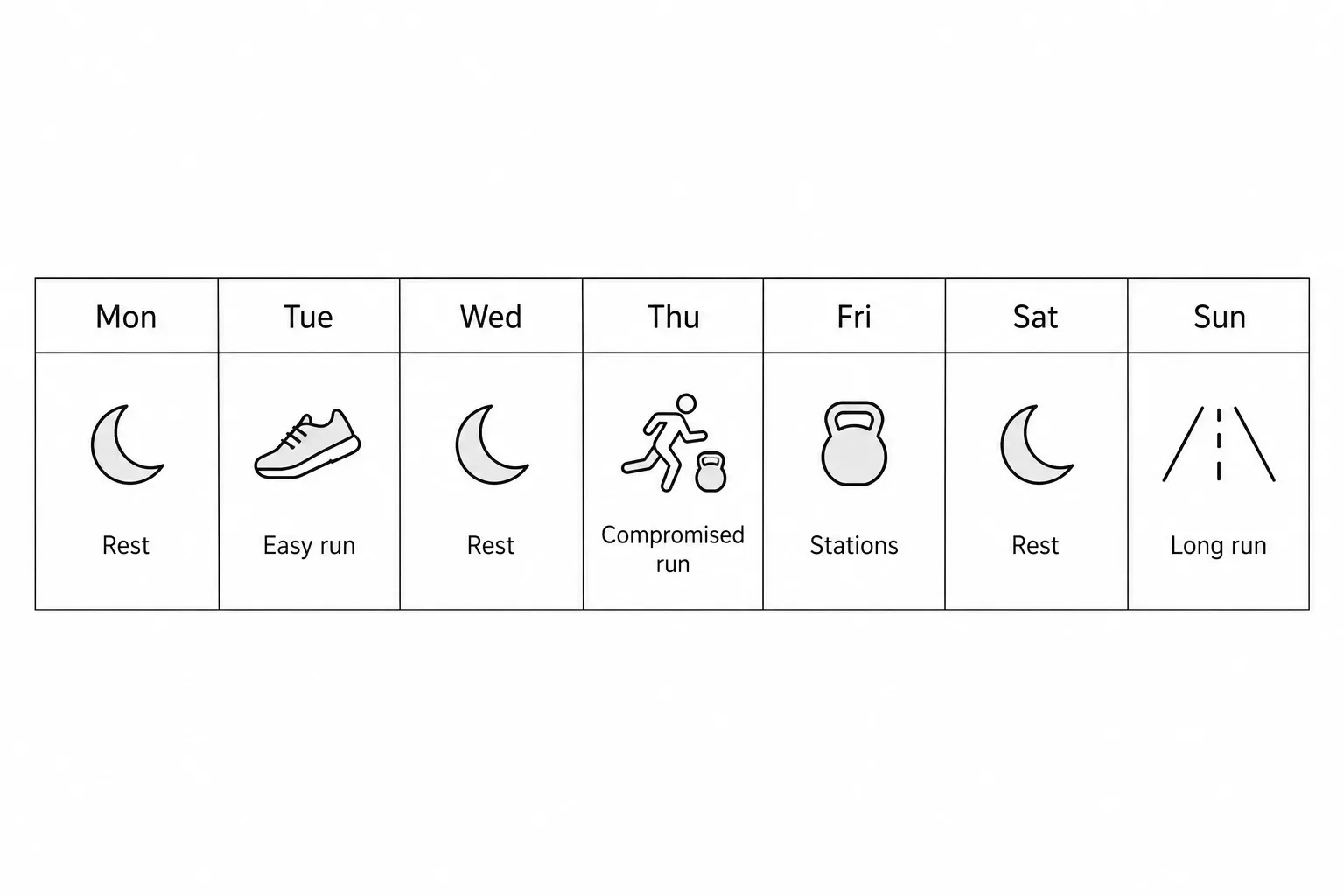
Each week has the same skeleton:
- Tuesday, easy run. At 7:00 to 7:34 /km (11:16 to 12:10 /mi) for the sample 28:00 5k. You should be able to talk in full sentences.
- Thursday, easy or compromised. Easy in the base phase, a compromised run in weeks 6, 7 and 10.
- Friday, strength and stations. Technique practice with manageable loads and full recovery between efforts.
- Sunday, long run. The longest run of the week, from 8.1 km (5 mi) in week 1 to 12 km (7.5 mi) in week 10.
That order is deliberate. The station day sits two days after the Thursday run and two days before the Sunday long run, so a hard sled session does not wreck the run that matters most. If you already lift on several days, compare those sessions with this week before adding more.
Session types and paces
| Session | What it is for | Pace for a 28:00 5k |
|---|---|---|
| Rest | Absorb training and recover for the next session | n/a |
| Easy | Aerobic endurance at a conversational effort | 7:00 to 7:34 /km (11:16 to 12:10 /mi) |
| Long | Time on your feet without racing the session | 7:00 to 7:34 /km (11:16 to 12:10 /mi) |
| Compromised run | Running after light station work, effort controlled | 6:10 to 6:26 /km (9:55 to 10:22 /mi) |
| Strength + stations | Station technique with manageable loads, full recovery | n/a |
HYROX running paces by 5k time
Find your most recent 5k in the left column. The row shows the pace range for each kind of run, per km and per mile. Without a recent 5k, run easy days at a pace where you can talk in full sentences, and estimate one from another race with the race time predictor.
Training paces per km and per mile
- Easy
- 7:00 to 7:34 /km (11:16 to 12:10 /mi)
- Steady
- 6:10 to 6:26 /km (9:55 to 10:22 /mi)
- Tempo
- 5:49 to 6:03 /km (9:22 to 9:44 /mi)
- Intervals
- 5:29 to 5:43 /km (8:50 to 9:12 /mi)
- Long
- 7:00 to 7:34 /km (11:16 to 12:10 /mi)
- Goal
- 6:16 to 6:30 /km (10:06 to 10:27 /mi)
| Recent 5k | Easy conversational | Steady comfortably steady | Tempo comfortably hard | Intervals controlled hard efforts | Race effort controlled |
|---|---|---|---|---|---|
| 20:00 | 5:00 to 5:24 /km (8:03 to 8:41 /mi) | 4:24 to 4:36 /km (7:05 to 7:24 /mi) | 4:10 to 4:19 /km (6:42 to 6:57 /mi) | 3:55 to 4:05 /km (6:19 to 6:34 /mi) | 4:29 to 4:38 /km (7:13 to 7:28 /mi) |
| 23:00 | 5:45 to 6:13 /km (9:15 to 10:00 /mi) | 5:04 to 5:17 /km (8:09 to 8:31 /mi) | 4:47 to 4:58 /km (7:42 to 8:00 /mi) | 4:30 to 4:42 /km (7:15 to 7:33 /mi) | 5:09 to 5:20 /km (8:17 to 8:35 /mi) |
| 26:00 | 6:30 to 7:01 /km (10:28 to 11:18 /mi) | 5:43 to 5:59 /km (9:12 to 9:37 /mi) | 5:24 to 5:37 /km (8:42 to 9:02 /mi) | 5:06 to 5:18 /km (8:12 to 8:32 /mi) | 5:49 to 6:02 /km (9:22 to 9:42 /mi) |
| 28:00pace used in the table | 7:00 to 7:34 /km (11:16 to 12:10 /mi) | 6:10 to 6:26 /km (9:55 to 10:22 /mi) | 5:49 to 6:03 /km (9:22 to 9:44 /mi) | 5:29 to 5:43 /km (8:50 to 9:12 /mi) | 6:16 to 6:30 /km (10:06 to 10:27 /mi) |
| 29:00 | 7:15 to 7:50 /km (11:40 to 12:36 /mi) | 6:23 to 6:40 /km (10:16 to 10:44 /mi) | 6:02 to 6:16 /km (9:42 to 10:05 /mi) | 5:41 to 5:55 /km (9:09 to 9:31 /mi) | 6:30 to 6:44 /km (10:27 to 10:50 /mi) |
| 32:00 | 8:00 to 8:38 /km (12:52 to 13:54 /mi) | 7:02 to 7:22 /km (11:20 to 11:51 /mi) | 6:39 to 6:55 /km (10:43 to 11:07 /mi) | 6:16 to 6:32 /km (10:06 to 10:30 /mi) | 7:10 to 7:25 /km (11:32 to 11:57 /mi) |
| 35:00 | 8:45 to 9:27 /km (14:05 to 15:12 /mi) | 7:42 to 8:03 /km (12:24 to 12:57 /mi) | 7:17 to 7:34 /km (11:43 to 12:10 /mi) | 6:52 to 7:08 /km (11:02 to 11:29 /mi) | 7:50 to 8:07 /km (12:37 to 13:04 /mi) |
General training guidance, not medical advice. Check with a doctor before increasing training if you have symptoms or a health condition.
General training guidance, not medical advice. Check with a doctor before increasing training if you have symptoms or a health condition.
12 week HYROX training plan: compromised running
A compromised run is a run done straight after station work. It trains the moment every HYROX athlete knows: legs full from the sled, and 1 km (0.62 mi) of running to do anyway.
Keep it simple. Do a short block of light station practice, such as lunges, wall balls or a few minutes on a rower, then go straight into the run at a controlled effort. The distance in the table is the running part only.

Keep the station block short. The point is the transition, not another hard workout. If the run after the stations turns into a struggle, shorten the station part next time, not the run.
The Friday stations day: what to practice
Friday covers the eight stations, which you can see with their race distances and open division weights below. Start below race weight for the sleds and carries and build up across the plan as your technique settles. Wall balls, lunges and burpee broad jumps can be practiced in sets well short of the race totals.
The eight HYROX stations
| Order | Station, after a 1 km (0.62 mi) run | Distance or reps | Women, open | Men, open |
|---|---|---|---|---|
| 1 | SkiErg | 1 km (0.6 mi) | No added load | No added load |
| 2 | Sled push2 lengths of 25 m, weight includes the sled | 50 m (55 yd) | 102 kg (225 lb) | 152 kg (335 lb) |
| 3 | Sled pull2 lengths of 25 m, weight includes the sled | 50 m (55 yd) | 78 kg (172 lb) | 103 kg (227 lb) |
| 4 | Burpee broad jumps | 80 m (87 yd) | Body weight | Body weight |
| 5 | Rowing | 1 km (0.6 mi) | No added load | No added load |
| 6 | Farmers carrytwo kettlebells, weight per hand | 200 m (219 yd) | 16 kg (35 lb) | 24 kg (53 lb) |
| 7 | Sandbag lunges | 100 m (109 yd) | 10 kg (22 lb) | 20 kg (44 lb) |
| 8 | Wall balls | 100 reps | 4 kg (9 lb) | 6 kg (13 lb) |
HYROX is a race format. Raceblock is not affiliated with HYROX.
Source: HYROX: race format, stations, weights and distances. Checked 2026-10-13.
The loads are the open division weights from the official HYROX race format (checked October 13, 2026). Pro divisions are heavier and doubles teams share the work, so check your own division before you train with race loads. Our guide to all 8 HYROX stations covers each one in race order, with technique notes.

A sensible way to spread the station work across the phases:
| Phase | Weeks | Friday focus |
|---|---|---|
| Base | 1 to 3 | Learn each movement; light sleds, light carries, short sets |
| Build | 4 to 8 | Move closer to race weight on the stations you find hardest |
| Peak | 9 to 10 | Link 2 or 3 stations back to back with short runs between |
| Taper | 11 to 12 | Short, light technique only; finish feeling fresh |
Do you need a gym for this HYROX plan?
For the sleds, rowing and SkiErg, yes. Lunges, burpee broad jumps and squats can be done anywhere. Check your equipment access before you pick a Friday, and if the gym has no sled, book a few sessions somewhere that does before race day.
How to start the 12-week HYROX plan
- Check the entry week
Make sure 16.2 km (10.1 mi) over three runs, with an 8.1 km (5 mi) long run, is close to what you already do.
- Find your paces
Look up your recent 5k in the pace table and note your easy and compromised run paces, per km and per mile.
- Book the stations day
Put a weekly gym slot in your diary for Friday, or any day that leaves a full rest day before the long run.
- Count back from race day
Week 12 is race week. If your race is more than 12 weeks away, run easy and practice the stations until it is 12 weeks out, then start week 1.
- Keep the lighter weeks light
Weeks 4 and 8 drop back on purpose. Do not use them to catch up on missed runs.
When the plan does not fit your week
The table above is a complete plan. You can print it, follow it and race well off it.
Here is where it breaks. A printed plan does not move when your week does. Miss the Friday station day because of work, lose a Sunday long run to a cold, or find out your race is two weeks earlier than you thought, and the table just sits there. Most people then do one of two things: cram the missed session into the next day, or quietly skip ahead. Both make the next week harder than it needs to be. (If it is a long run you lost, our guide to a missed long run walks through when to move it and when to let it go.)
Free training plan
Build your free plan for your race date.
Pick your race and race date. Every week from today to race day is planned for you, with distances in km and miles.
Build your free plan for your race date. On the Coach plan, next week re-plans itself when you miss a run. It is built for Garmin and Apple Watch runners, and you can see how Free and Coach compare before you pick. If you are weighing apps, here is how Raceblock stacks up as a Runna alternative.
Race week: keep it light
Week 12 is 13.5 km (8.4 mi) of easy running plus a short station session. Start the race conservatively, settle into your first 1 km (0.62 mi) run and adjust to conditions. The two-week taper works the same way as a road race taper, which our marathon taper guide explains in more detail.
Where to go from here
If this plan fits, start week 1 on the right Monday and treat the Friday stations day as fixed as the Sunday long run. If you want to see the other HYROX plan lengths and the full race format first, start at the HYROX training plan guide. And if you also want a pure running goal later, the 12-week half marathon training plan uses the same three-run rhythm.
When your week changes, and it will, build your free plan for your race date. On the Coach plan, next week re-plans itself when you miss a run.
Frequently asked questions
One that builds running and station practice together without stacking hard days. This plan uses three runs and one strength and stations day a week for 12 weeks, with lighter weeks 4 and 8. The first running week totals 16.2 km (10.1 mi), so check that starting load together with the gym session before you begin.
Easy running early in the week, a compromised or quality run midweek, a station day with a rest day before the weekend and a longer run on Sunday. That is the shape of this plan. The long run starts at 8.1 km (5 mi) and reaches 12 km (7.5 mi) in week 10.
It depends on your running and gym background, so no plan can score it for you. What makes it hard for most beginners is the running on tired legs, not any single station. Compare this plan's opening week of 16.2 km (10.1 mi) over 3 runs plus a station day with what you do now.
This beginner plan runs 12 weeks, including a 2-week taper. That works if you can already run about 16 km (10 mi) a week. If you are starting from less running, add a few weeks of easy runs before week 1.
For the sled push, sled pull, rowing and SkiErg, yes. Lunges, burpee broad jumps and squats can be practiced at home or in a park. The running sessions need nothing but shoes.
Yes. The print button on the plan table turns the full schedule into a clean printout or PDF. Check that the Friday strength and stations day is visible, because it is not part of the 229.7 km (142.7 mi) running total.
Free training plan
Build your free plan for your race date.
On the Coach plan, next week re-plans itself when you miss a run.
Share article
About the author
More running training guides

HYROX guides · 10 min
HYROX Workout: 5 Sessions for the Gym, Home and Running
Choose a HYROX workout for easy running, station practice or transitions, with five scalable sessions for the gym and home.

HYROX guides · 11 min
HYROX Training Plan: Free Running and Station Plans
A HYROX training plan that puts runs, compromised runs and a strength and stations day into one week, with the 8 stations, open division weights, plan lengths by race date and a worked 10-week sample.

HYROX guides · 9 min
HYROX Stations: All 8 in Order, With Weights and Distances
The 8 HYROX stations in race order with distances, reps and the loads for open and pro, women and men, in kg and lb, and how to plan the running around them.