
8 Week Half Marathon Training Plan: Full Schedule
Raceblock team October 17, 2026 11 min read
Free half marathon plan for your race date

Free half marathon plan for your race date
Build my free planIn this article
This 8-week half marathon training plan is a short block for runners who already run about four days a week: it starts at 30 km (18.6 mi) and peaks at 38.1 km (23.7 mi) with a 16.2 km (10.1 mi) long run. Check the entry test below before you start; if week one is a jump for you, a longer plan is the safer choice.
Eight weeks is enough time to sharpen fitness you already have. It is not enough time to build it from scratch, and that is the whole decision this post helps you make.
- Weeks
- 8
- Runs a week
- 4
- Peak week
- 38.1 km (23.7 mi)
- Longest run
- 16.2 km (10.1 mi)
- Taper
- 2 weeks
Is 8 weeks enough to train for a half marathon?
Yes, if you already run about 30 km (18.6 mi) a week with a long run near 12.8 km (8 mi). That is where this plan starts, so it only works as a sharpening block on top of a routine you already have.
If your current week is well below that, 8 weeks is a squeeze. The plan does not ease you in: week one is already a full week of running. The fix is not to cut the first weeks shorter, it is to pick a plan with a lower starting point, like the 12-week beginner half marathon plan, which opens at 21.6 km (13.4 mi).
Entry check: is this plan right for you now?
Week one asks for 30 km (18.6 mi) over 4 runs, including a 12.8 km (8 mi) long run. If you ran close to that last week without strain, this plan fits. If not, switch to a longer plan.
| You, right now | Verdict | Better pick |
|---|---|---|
| 4 runs a week, about 30 km (18.6 mi), long run 12 to 13 km (7.5 to 8 mi) | This plan fits | Start week one as written |
| 4 runs a week, about 25 km (15.5 mi), long run near 11 km (6.8 mi) | A stretch | The 10-week half marathon plan, which opens at 27.1 km (16.8 mi) |
| 3 runs a week, about 20 km (12.4 mi) | Too big a jump | The 12-week beginner plan, three runs a week |
| Under 15 km (9.3 mi) a week, or new to running | Too big a jump | The 16-week half marathon plan, which starts at 18.5 km (11.5 mi) |

8 week half marathon training plan for beginners
If you are a beginner with only eight weeks before your race, ask first whether a later race is possible. The long run in week one, 12.8 km (8 mi), is longer than many new runners have ever run, and four days a week is a real commitment on top of work and family.
If a later race is not an option, build a plan from your own weekly distance instead of copying the sample. It starts from what you run now, not from the 30 km (18.6 mi) week shown here. Having enough calendar weeks and having enough repeatable run days are separate questions; this plan needs both.
The 8-week half marathon schedule
Here is every week. Paces are worked out from a sample 27:00 time over 5 km (3.1 mi). Every distance is in km and miles and every pace is per km and per mile; lighter weeks are marked under the week number, and the print button saves the table as a PDF.
8-week half marathon training plan
Every distance is in km and miles; every pace is per km and per mile. Lighter weeks are marked under the week number.
| Week | Mon | Tue | Wed | Thu | Fri | Sat | Sun | Total |
|---|---|---|---|---|---|---|---|---|
| Week 1Base | MonEasy5.8 km (3.6 mi)6:45 to 7:17 /km (10:52 to 11:44 /mi) | TueEasy5.7 km (3.5 mi)6:45 to 7:17 /km (10:52 to 11:44 /mi) | WedRest | ThuEasy5.7 km (3.5 mi)6:45 to 7:17 /km (10:52 to 11:44 /mi) | FriRest | SatRest | SunLong12.8 km (8 mi)6:45 to 7:17 /km (10:52 to 11:44 /mi) | Week total30 km (18.6 mi) |
| Week 2Base | MonEasy6.3 km (3.9 mi)6:45 to 7:17 /km (10:52 to 11:44 /mi) | TueEasy6.3 km (3.9 mi)6:45 to 7:17 /km (10:52 to 11:44 /mi) | WedRest | ThuEasy6.2 km (3.9 mi)6:45 to 7:17 /km (10:52 to 11:44 /mi) | FriRest | SatRest | SunLong13.9 km (8.6 mi)6:45 to 7:17 /km (10:52 to 11:44 /mi) | Week total32.7 km (20.3 mi) |
| Week 3Build | MonEasy6.9 km (4.3 mi)6:45 to 7:17 /km (10:52 to 11:44 /mi) | TueEasy6.8 km (4.2 mi)6:45 to 7:17 /km (10:52 to 11:44 /mi) | WedRest | ThuTempo6.8 km (4.2 mi)5:37 to 5:50 /km (9:02 to 9:23 /mi) | FriRest | SatRest | SunLong15.1 km (9.4 mi)6:45 to 7:17 /km (10:52 to 11:44 /mi) | Week total35.6 km (22.1 mi) |
| Week 4Build, lighter week | MonEasy6.2 km (3.9 mi)6:45 to 7:17 /km (10:52 to 11:44 /mi) | TueEasy6.1 km (3.8 mi)6:45 to 7:17 /km (10:52 to 11:44 /mi) | WedRest | ThuEasy6.1 km (3.8 mi)6:45 to 7:17 /km (10:52 to 11:44 /mi) | FriRest | SatRest | SunLong13.6 km (8.5 mi)6:45 to 7:17 /km (10:52 to 11:44 /mi) | Week total32 km (19.9 mi) |
| Week 5Build | MonEasy6.7 km (4.2 mi)6:45 to 7:17 /km (10:52 to 11:44 /mi) | TueEasy6.7 km (4.2 mi)6:45 to 7:17 /km (10:52 to 11:44 /mi) | WedRest | ThuEasy6.6 km (4.1 mi)6:45 to 7:17 /km (10:52 to 11:44 /mi) | FriRest | SatRest | SunLong14.9 km (9.3 mi)6:45 to 7:17 /km (10:52 to 11:44 /mi) | Week total34.9 km (21.7 mi) |
| Week 6Peak | MonEasy7.3 km (4.5 mi)6:45 to 7:17 /km (10:52 to 11:44 /mi) | TueEasy7.3 km (4.5 mi)6:45 to 7:17 /km (10:52 to 11:44 /mi) | WedRest | ThuTempo7.3 km (4.5 mi)5:37 to 5:50 /km (9:02 to 9:23 /mi) | FriRest | SatRest | SunLong16.2 km (10.1 mi)6:45 to 7:17 /km (10:52 to 11:44 /mi) | Week total38.1 km (23.7 mi) |
| Week 7Taper | MonEasy5.5 km (3.4 mi)6:45 to 7:17 /km (10:52 to 11:44 /mi) | TueEasy5.5 km (3.4 mi)6:45 to 7:17 /km (10:52 to 11:44 /mi) | WedRest | ThuEasy5.4 km (3.4 mi)6:45 to 7:17 /km (10:52 to 11:44 /mi) | FriRest | SatRest | SunLong12.1 km (7.5 mi)6:45 to 7:17 /km (10:52 to 11:44 /mi) | Week total28.5 km (17.7 mi) |
| Week 8Taper, race week | MonEasy4.1 km (2.5 mi)6:45 to 7:17 /km (10:52 to 11:44 /mi) | TueEasy4.1 km (2.5 mi)6:45 to 7:17 /km (10:52 to 11:44 /mi) | WedRest | ThuEasy4.1 km (2.5 mi)6:45 to 7:17 /km (10:52 to 11:44 /mi) | FriRest | SatRest | SunLong9.1 km (5.7 mi)6:45 to 7:17 /km (10:52 to 11:44 /mi) | Week total21.4 km (13.3 mi) |
Race week. Keep the final week light. Start conservatively and adjust to conditions. Goal pace is a target, not a promised finish time.
- Easy
- Build aerobic endurance at a conversational effort.
- Rest
- Absorb training and recover for the next session.
- Long
- Build time on your feet without racing the session.
- Tempo
- Practice controlled quality with easy warm-up and cooldown.
General training guidance, not medical advice. Check with a doctor before increasing training if you have symptoms or a health condition.
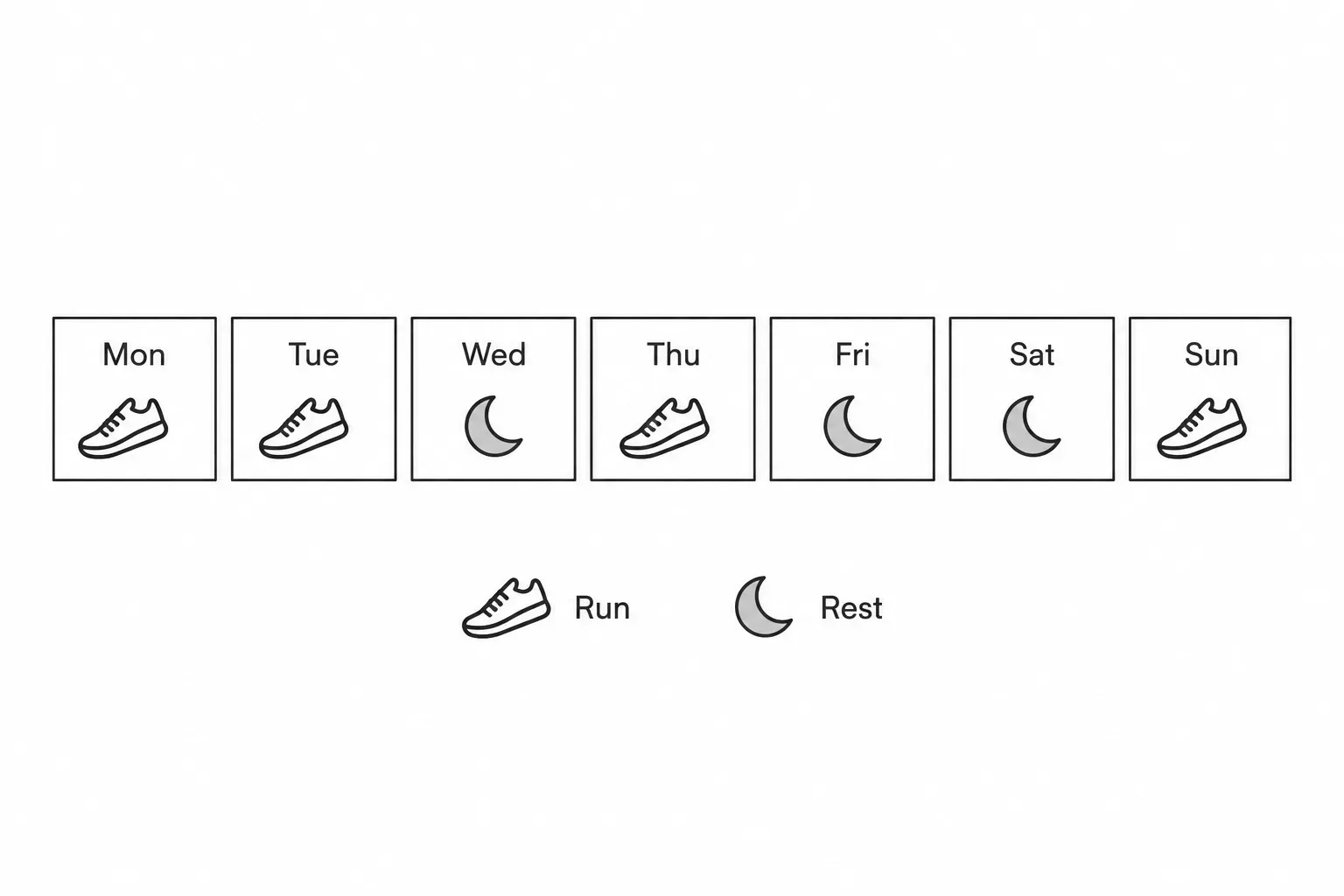
The weekly pattern never changes: easy runs on Monday and Tuesday, rest on Wednesday, an easy or tempo run on Thursday, rest on Friday and Saturday, and the long run on Sunday.
General training guidance, not medical advice. Check with a doctor before increasing training if you have symptoms or a health condition.
How the 8 weeks build
The block moves through base, build, peak and taper in eight weeks, so each phase is short.
- Base weeks 1 to 2
- Build weeks 3 to 5
- Peak week 6
- Taper weeks 7 to 8
- Lighter week 4
- Base, weeks 1 to 2. Four easy runs with the long run on Sunday: 30 km (18.6 mi), then 32.7 km (20.3 mi). Check that the opening load fits your current training.
- Build, weeks 3 to 5. Week 3 adds the first tempo Thursday and a 15.1 km (9.4 mi) long run. Week 4 is the lighter week at 32 km (19.9 mi), so the next push starts from a recovered week. Week 5 climbs again to 34.9 km (21.7 mi).
- Peak, week 6. The biggest week, 38.1 km (23.7 mi), with the second tempo Thursday and the longest run of the plan, 16.2 km (10.1 mi).
- Taper, weeks 7 to 8. The runs keep their rhythm but shrink: 28.5 km (17.7 mi), then a race week of 21.4 km (13.3 mi).
| Week 1 | Peak, week 6 | Race week, week 8 | |
|---|---|---|---|
| Weekly distance | 30 km (18.6 mi) | 38.1 km (23.7 mi) | 21.4 km (13.3 mi) |
| Long run | 12.8 km (8 mi) | 16.2 km (10.1 mi) | 9.1 km (5.7 mi) on the schedule |
| Thursday | Easy 5.7 km (3.5 mi) | Tempo 7.3 km (4.5 mi) | Easy 4.1 km (2.5 mi) |
| Share of peak week | 79% | 100% | 56% |
Read that last row. The plan only grows about a fifth from week one to its peak. That is why the entry check matters so much: there is very little ramp, so week one has to already feel normal.
The whole block adds up to 253.2 km (157.3 mi). Neither that total nor the peak week is a number to squeeze into fewer sessions if a weekend goes missing.
Tempo runs in the 8-week plan
Because this is the intermediate version, the quicker sessions are tempo runs rather than steady runs. There are two of them, on the Thursdays of weeks 3 and 6; every other Thursday is easy.
Tempo means comfortably hard: you could say a few words but would not want to hold a conversation. Warm up with easy running first and cool down after.

| Session | What it is | Sample pace for a 27:00 5 km (3.1 mi) | How often |
|---|---|---|---|
| Easy | Conversational running that builds aerobic endurance | 6:45 to 7:17 /km (10:52 to 11:44 /mi) | 3 times most weeks |
| Long | Time on your feet, at easy effort, never raced | 6:45 to 7:17 /km (10:52 to 11:44 /mi) | Every Sunday |
| Tempo | Controlled quality with an easy warm-up and cooldown | 5:37 to 5:50 /km (9:02 to 9:23 /mi) | Weeks 3 and 6 |
| Rest | Absorb training and recover for the next session | No running | Wednesday, Friday, Saturday |
That makes 30 of the 32 runs easy or long. The plan is mostly easy on purpose, and the two tempo days only work if the easy days around them really are easy.
If a tempo day lands after poor sleep or a long workday, run it easy instead. One swapped session will not decide your race.

Training paces by 5k time
Find your most recent 5 km (3.1 mi) time in the left column. The row shows the pace range for each kind of run in this plan, per km and per mile. Without a recent time, run easy days at a pace where you can talk in full sentences.
Training paces per km and per mile
- Easy
- 6:45 to 7:17 /km (10:52 to 11:44 /mi)
- Steady
- 5:56 to 6:13 /km (9:34 to 10:00 /mi)
- Tempo
- 5:37 to 5:50 /km (9:02 to 9:23 /mi)
- Intervals
- 5:18 to 5:30 /km (8:31 to 8:52 /mi)
- Long
- 6:45 to 7:17 /km (10:52 to 11:44 /mi)
- Goal
- 6:03 to 6:16 /km (9:44 to 10:05 /mi)
| Recent 5k | Easy conversational | Steady comfortably steady | Tempo comfortably hard | Intervals controlled hard efforts | Race effort controlled |
|---|---|---|---|---|---|
| 21:00 | 5:15 to 5:40 /km (8:27 to 9:07 /mi) | 4:37 to 4:50 /km (7:26 to 7:46 /mi) | 4:22 to 4:32 /km (7:02 to 7:18 /mi) | 4:07 to 4:17 /km (6:37 to 6:54 /mi) | 4:42 to 4:52 /km (7:34 to 7:50 /mi) |
| 24:00 | 6:00 to 6:29 /km (9:39 to 10:26 /mi) | 5:17 to 5:31 /km (8:30 to 8:53 /mi) | 5:00 to 5:11 /km (8:02 to 8:21 /mi) | 4:42 to 4:54 /km (7:34 to 7:53 /mi) | 5:23 to 5:34 /km (8:39 to 8:58 /mi) |
| 27:00pace used in the table | 6:45 to 7:17 /km (10:52 to 11:44 /mi) | 5:56 to 6:13 /km (9:34 to 10:00 /mi) | 5:37 to 5:50 /km (9:02 to 9:23 /mi) | 5:18 to 5:30 /km (8:31 to 8:52 /mi) | 6:03 to 6:16 /km (9:44 to 10:05 /mi) |
| 30:00 | 7:30 to 8:06 /km (12:04 to 13:02 /mi) | 6:36 to 6:54 /km (10:37 to 11:06 /mi) | 6:14 to 6:29 /km (10:03 to 10:26 /mi) | 5:53 to 6:07 /km (9:28 to 9:51 /mi) | 6:43 to 6:58 /km (10:49 to 11:12 /mi) |
| 33:00 | 8:15 to 8:55 /km (13:17 to 14:20 /mi) | 7:16 to 7:35 /km (11:41 to 12:13 /mi) | 6:52 to 7:08 /km (11:03 to 11:28 /mi) | 6:28 to 6:44 /km (10:25 to 10:50 /mi) | 7:24 to 7:39 /km (11:54 to 12:19 /mi) |
| 36:00 | 9:00 to 9:43 /km (14:29 to 15:39 /mi) | 7:55 to 8:17 /km (12:45 to 13:20 /mi) | 7:29 to 7:47 /km (12:03 to 12:31 /mi) | 7:03 to 7:21 /km (11:21 to 11:49 /mi) | 8:04 to 8:21 /km (12:59 to 13:26 /mi) |
General training guidance, not medical advice. Check with a doctor before increasing training if you have symptoms or a health condition.
The 27:00 row is the sample runner. It does not set your own training pace, and the faster tempo label is not a reason to speed up the easy days. For race-day checkpoints for a chosen finish time, use the half marathon pace chart; its finish-time input serves a different purpose from a recent result. To turn a recent race into a realistic half marathon range, try the race time predictor.
How to run the 8-week half marathon plan
- Run the entry check
Compare last week with week one: 30 km (18.6 mi) over 4 runs and a 12.8 km (8 mi) long run. If it is a jump, pick a longer plan.
- Fix your four run days
Put Monday, Tuesday, Thursday and Sunday in your calendar, or move Monday to Wednesday if back-to-back days do not suit you.
- Keep the tempo Thursdays controlled
In weeks 3 and 6, warm up easy, run the tempo section comfortably hard, then cool down.
- Run week 4 light
The lighter week is part of the plan. Do not use it to make up missed distance.
- Taper for the last 2 weeks
Keep the same days, run shorter and easier, and add nothing new in race week.
When the 8 weeks don't go to plan
An 8-week plan has almost no slack. Lose week 3 to a cold and the first tempo run, the first lighter week and half the build are all gone, and the printed table just keeps counting down. That is the wall every fixed plan hits: it doesn't move when your week does. You end up guessing whether to repeat a week, skip one, or squeeze two long runs into one weekend, and the last option is the one that gets runners hurt.
The fix is a plan built from your race date and the distance you actually ran. Build your free plan for your race date. On the Coach plan, next week re-plans itself when you miss a run.
Free training plan
Build your free plan for your race date.
Pick your race and race date. Every week from today to race day is planned for you, with distances in km and miles.
Curious how Free and Coach differ? Here is how the two compare.
Race week and the taper
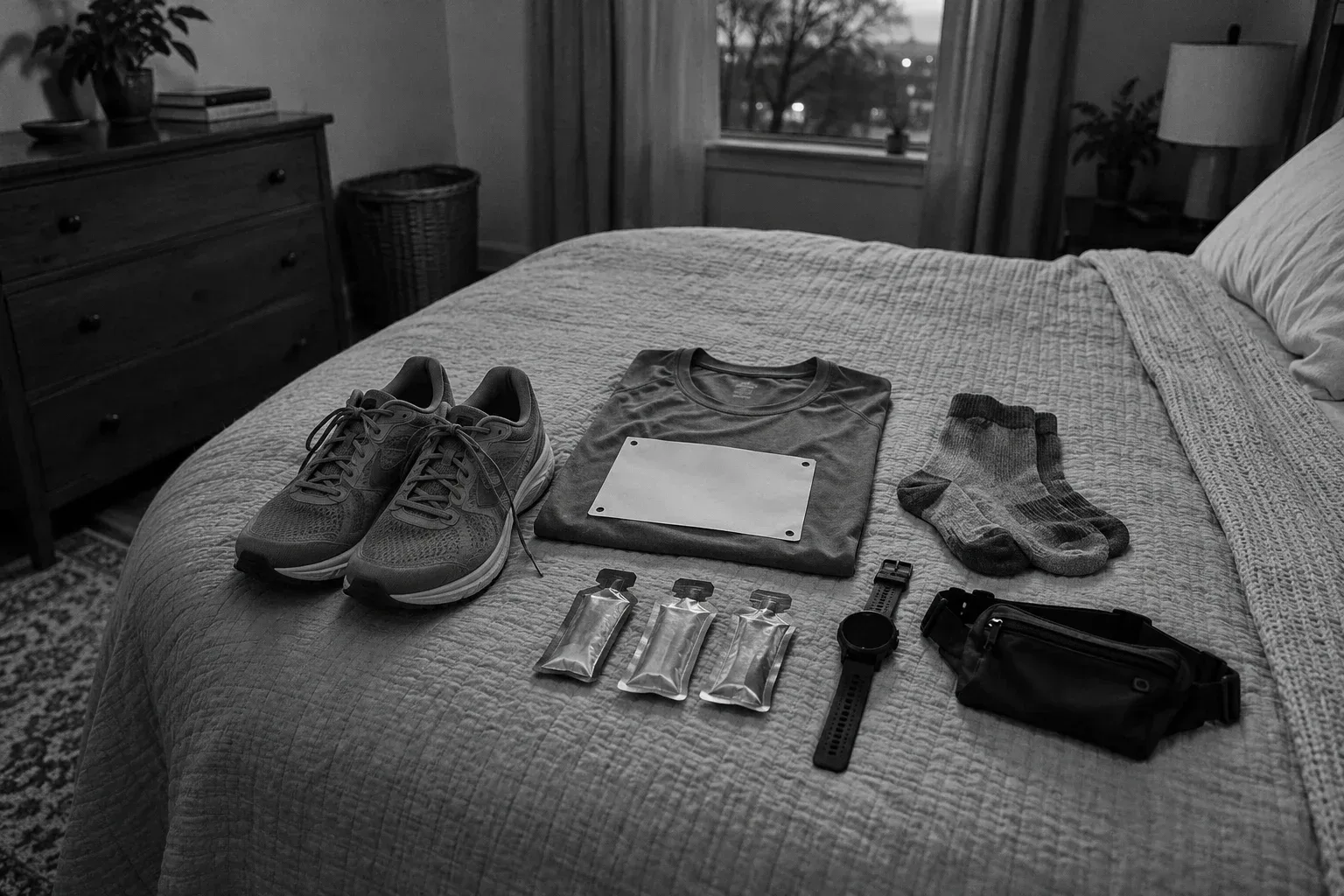
The last 2 weeks are the taper. Week 7 drops to 28.5 km (17.7 mi), about 75% of the peak week, with a 12.1 km (7.5 mi) long run. Race week totals 21.4 km (13.3 mi) on the schedule, about 56% of the peak.
Keep the taper runs easy even when your legs feel fresh: the work is already done, and the goal of these weeks is to arrive at the start line rested. Start the race conservatively and adjust to conditions on the day. Goal pace is a target, not a promised finish time.

Mistakes that cost you in an 8-week block
- Starting below week one. If 30 km (18.6 mi) is a jump, the whole block becomes a stretch with no room to recover.
- Turning easy days into tempo days. Two tempo runs in eight weeks is enough. More quality crowds out the long run.
- Skipping week 4. The lighter week is what lets week 6 happen.
- Adding a missed long run in the taper. If week 6 went wrong, the 16.2 km (10.1 mi) run is gone. Do not try it 2 weeks out.
- Ignoring pain. Sharp pain, pain that changes how you run, or swelling means stop and see a doctor or physio.
The 8-week half marathon plan is a sharp, short block: 30 km (18.6 mi) in week one, a 38.1 km (23.7 mi) peak, two tempo Thursdays and a 2-week taper. It works for runners already close to week one and asks too much of anyone who is not.
If it is a stretch, the half marathon training plan guide compares all four lengths side by side, so you can see the gentler options before you commit. If it fits, date it to your race and let the plan move with your weeks: build your free plan, and on the Coach plan next week re-plans itself when you miss a run. You can also see how this compares with other apps in our Runna alternative breakdown.
Distances follow the official half marathon of 21.0975 km (13.1094 mi) set by World Athletics.
Frequently asked questions
For a runner who already covers about 30 km (18.6 mi) a week with a 12.8 km (8 mi) long run, yes. If that is above your current running, pick a longer schedule with a lower first week.
You should comfortably cover the week-one long run of 12.8 km (8 mi) at an easy, conversational effort. The full opening week totals 30 km (18.6 mi), so the shorter runs count toward the check too.
Stop and switch rather than push through. Rebuild the plan from your current weekly distance, or move to the 10-week or 12-week schedule if your race date allows it.
Yes. The final 2 weeks are lighter, ending with a race week of 21.4 km (13.3 mi). The peak long run of 16.2 km (10.1 mi) sits in week 6, before the taper starts.
The sample uses a recent 27:00 for 5 km (3.1 mi), which gives a tempo range of 5:37 to 5:50 per km (9:02 to 9:23 per mile). Enter your own recent time in the builder to get your own pace table.
Yes. The print control turns the full week table into a paper copy or a browser PDF. Write your start date beside week one, because the table uses numbered weeks rather than your race calendar.
Free training plan
Build your free plan for your race date.
On the Coach plan, next week re-plans itself when you miss a run.
Share article
About the author
More running training guides

Half marathon training · 12 min
Half Marathon Training Routine: The Week to Repeat
A good half marathon training routine fixes the long run, keeps almost every other run easy, and repeats the same 3 or 4 running days from week one to race day. Here is the weekly layout, where strength and rest go, and how to fit it around work.

Half marathon training · 11 min
Average Half Marathon Time by Age and Gender (2:15 Median)
The average half marathon time is about 2:15: the median man runs 1:59:48 and the median woman 2:24:03. Here are the percentiles, times by age, what 2:00 to 3:00 means, and how to predict your own time.

Half marathon training · 9 min
How Long Is a Half Marathon? Distance in Km and Miles
A half marathon is 21.0975 km (13.1094 mi). See the exact distance, pace math, walking and cutoff checks, and how to choose a preparation plan.

Half marathon training · 10 min
16 Week Half Marathon Training Plan: Gentle 3-Day Build
A 16 week half marathon training plan with 3 runs a week, a 4-week easy base, lighter weeks every fourth week and a 2-week taper. Every week, in km and miles, with paces per km and per mile.

Half marathon training · 12 min
Half Marathon Training Plan: Free 8 to 16 Week Plans
Four half marathon training plans compared: week one, peak week, long run and run days for the 8, 10, 12 and 16 week plans, plus a worked 14-week sample and how to pick the right length.

Half marathon training · 10 min
10 Week Half Marathon Training Plan: Week by Week
Four runs a week, mostly easy: the 10-week half marathon plan from a 27.1 km (16.8 mi) first week to a 16 km (9.9 mi) long run, with steady Thursdays, two lighter weeks and a 2-week taper.