
Cadence When Running: Why 180 Is the Wrong Target
Raceblock team Updated November 9, 2026 11 min read
Free training plan for your race date
Free training plan for your race date
Build my free planIn this article
Cadence when running is your number of steps per minute, counting both feet. There is no single right number: cadence rises as you run faster, so the 180 you have heard about is a fast-running number, and most recreational runners sit well below it on easy runs. If you want to change yours, raise your own easy-pace cadence by about 5% and stop there.
That is the whole idea of this guide. Your cadence is not a score to hit. It is a dial that moves with your pace, your height and the hill you are on, so the only fair comparison is you against yourself at the same pace.
What is cadence in running?
Cadence is how many steps you take in one minute of running, left and right foot combined. Watches show it as spm (steps per minute). A runner taking 82 right-foot steps a minute has a cadence of about 164.
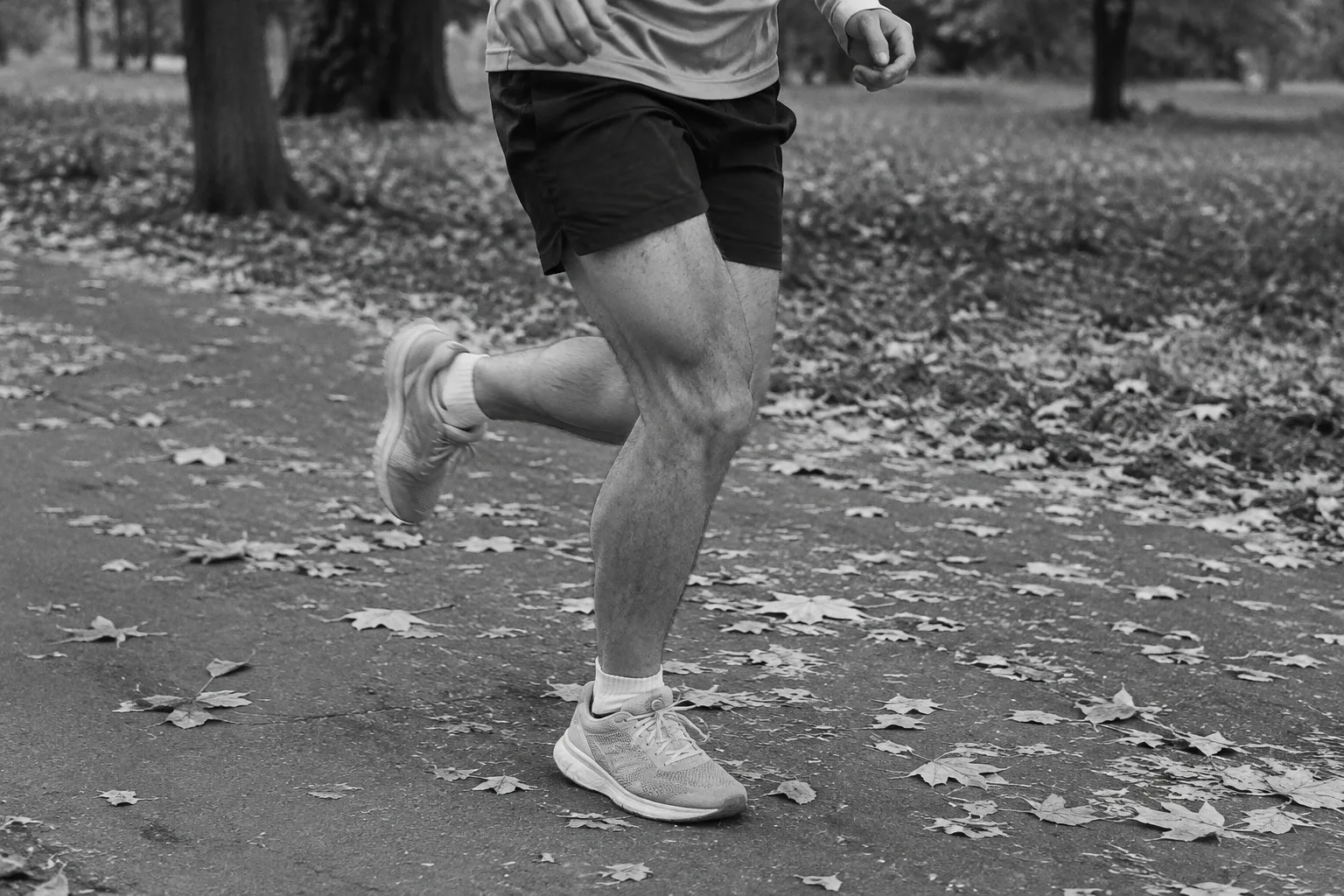
Cadence matters because of one simple equation: speed = cadence x step length. To run at a given pace you either take more steps or longer ones. Take an easy pace of 6:00 per km (9:39 per mi):
- At 165 steps per minute, each step covers about 1.01 m (3 ft 4 in)
- At 173 steps per minute, each step covers about 0.96 m (3 ft 2 in)
Same speed, steps about 5 cm (2 in) shorter. That small change is what "raise your cadence" really means: a slightly shorter step that lands closer to under your body, not running faster or shuffling. It ties straight into proper form when running, where the foot landing under the hips is one of the five fixes.
What is the average cadence while running?
There is no useful average, because it depends on pace and on the runner. In one data set of 49 runners published by the biomechanics blog Running Writings, cadence at the same 5:00 per km (about 8:00 per mi) pace ranged from about 145 to 195 steps per minute (see the data). Same speed, a 50 step spread.
Three things move your number:
| What changes | What happens to cadence | What it means for you |
|---|---|---|
| You run faster | Goes up for every runner | Compare easy runs with easy runs, never with intervals |
| You are taller, with longer legs | Tends to be lower | Explains only part of the gap, so it is not an excuse to ignore a very low number |
| You run uphill | Goes up as steps shorten | Do not judge your cadence on a hilly route |
| You get tired late in a long run | Often drops as you start to shuffle or overstride | Check the last third of a long run, not the first km (0.6 mi) |
| You run on a treadmill | Can differ from the road | Measure on the surface you race on |
So the question "is my cadence good?" has no answer on its own. The better question is: "is my easy-pace cadence low for me, and do my steps land far out in front of my body?"
Why 180 is the wrong target
The 180 figure goes back to coach Jack Daniels, who noticed that runners at the Olympics took about 180 steps per minute or more. Those were elite runners racing at speeds most of us never touch. Asking a recreational runner to hold 180 at an easy 6:30 per km (10:28 per mi) means tiny, choppy steps that feel awful and cost more energy.
Use 180 as a fact about fast running, not as a goal. When you run strides or the last 2 km (1.2 mi) of a fast 5 km (3.1 mi) race, you may well get there on your own.
Is faster cadence better?
A slightly faster cadence than your natural one is usually better, a much faster one is not. In a lab study of 45 recreational runners, raising step rate by 5% at the same speed cut the energy the knee absorbed on landing, and at 10% the hip absorbed less too. Steps got shorter, the body bounced less and braking dropped (Heiderscheit et al., 2011).
The catch: runners naturally settle near their most economical cadence, and pushing it far above that makes running cost more oxygen. That is why every sensible cadence plan stays in the 5 to 10% band. Faster is better only in small steps.
Is 150 or 170 a good cadence?
It depends on how fast you are going and how tall you are. Use this to read your own number:
| Your situation | Verdict | What to do |
|---|---|---|
| 150 to 155 on an easy run, foot landing well in front of the knee | Probably low for you | Try 5% more over a few weeks |
| 150 to 155 on a very easy run, foot landing under you, no pain | Fine | Leave it alone and check it on faster runs |
| 160 to 170 on an easy run | Normal for many recreational runners | Change it only if you overstride |
| 170 to 180 at tempo or race pace | Normal | Nothing to fix |
| Over 180 only in strides or fast reps | Normal | Nothing to fix |
Is 150 too low? Not automatically. A tall runner jogging very slowly can sit at 150 and land fine. But if your foot lands far ahead of your knee and you hear a loud slap on each step, 150 is likely part of the problem.
Is 170 good? For most runners on an easy run, yes. 170 is a healthy everyday cadence. You do not need to chase 180 from there.
How to measure your cadence
The simplest method needs no gadget. On an easy run, on flat ground, once you are warm, count every time your right foot lands for 30 seconds. Multiply by 4. Do it twice and take the average.
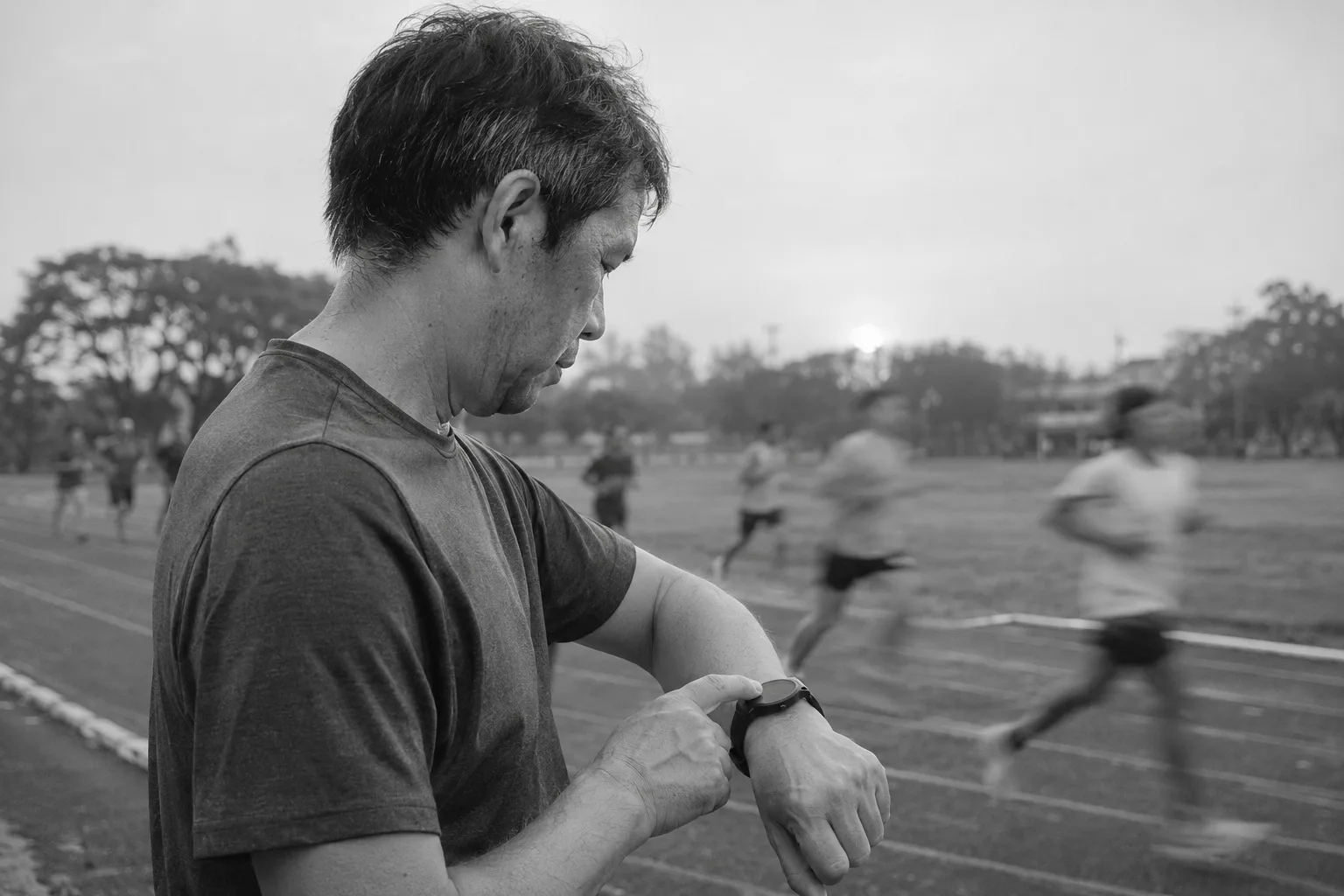
Most running watches show cadence too, and the step count from the wrist is accurate on normal runs. Add a data screen with pace and cadence side by side, because a cadence number without the pace next to it tells you very little.
Write down three numbers: your easy pace, your cadence at that pace and how your feet land. That is your baseline. If you are not sure what your easy pace should be, start with what pace means when running.
How to increase your running cadence
Increasing cadence takes about a month of short practice blocks inside runs you already do. You do not need extra sessions.
How to increase your running cadence
- Find your easy-pace baseline
Measure your cadence on two or three flat easy runs at your normal easy pace. Use the average, for example 160.
- Set a target 5% higher
Multiply by 1.05 and round. From 160, the target is 168. Use the table below and do not go past 10%.
- Practice in short blocks
In the middle of an easy run, run 1 to 2 minutes at the new cadence, then 2 minutes as normal. Repeat 4 to 6 times. Keep the same pace: the steps get shorter, not faster.
- Use a cue for the rhythm
Watch the cadence field, or play a metronome or a playlist at your target beats per minute for the first few runs.
- Add strides twice a week
After an easy run, do 4 to 6 relaxed 20 second strides with quick light steps and full recovery walks. They teach a quick turnover without forcing it.
- Fade the cue, then retest
After two to three weeks, check the watch less often. After four weeks, measure again at the same easy pace. If the new number holds without thinking about it, keep it.
Here is the target math, worked out so you do not have to:
| Current cadence | +5% (start here) | +10% (upper limit) |
|---|---|---|
| 150 | 158 | 165 |
| 155 | 163 | 171 |
| 160 | 168 | 176 |
| 165 | 173 | 182 |
| 170 | 179 | 187 |

Strides are the easiest way to make a quicker step feel normal. Do them after a short jog as part of your warm-up before running, or at the end of an easy run. Our guide on how to run faster shows where strides and hills fit into a training week. If the new rhythm makes you breathless, slow the pace a little and check how to breathe while running.
General training guidance, not medical advice. Check with a doctor before increasing training if you have symptoms or a health condition. Pain, swelling, chest pain or feeling faint means stop and see a doctor or physio.
Cadence mistakes and what they cost
- Chasing 180 on easy runs. You end up taking choppy steps that feel forced, and your easy runs stop feeling easy.
- Comparing cadence across paces. Your interval cadence will always beat your easy-run cadence. Comparing them tells you nothing.
- Jumping more than 10% at once. Running gets harder for the same pace, and the change rarely sticks.
- Measuring on hills or in traffic. Hills raise your cadence and stop-start runs scramble it. Use flat, steady stretches.
- Changing cadence in race week. A month out is the latest time to work on it. Race day is not the place for a new stride.
- Shortening the step but still reaching. More steps with the foot still landing far ahead of you misses the point. The goal is the foot landing closer to under your body.
When your week stops matching the plan
You can do all of this on your own: measure your easy cadence, add 5%, practice in short blocks and add strides twice a week. If you have a race coming, a marathon training plan or a half marathon training plan gives you the easy runs to practice in, and the marathon pace chart tells you which pace is easy for your goal.
The wall comes when your week stops matching the plan. A cold wipes out three runs, a work trip eats your long run, and the cadence work is the first thing you drop. A written plan does not move when your week does. If that has happened already, here is what to do after a missed long run.
That is the part Raceblock handles. Build your free plan for your race date. On the Coach plan, next week re-plans itself when you miss a run.
Free training plan
Build your free plan for your race date.
Pick your race and race date. Every week from today to race day is planned for you, with distances in km and miles.
Running cadence in one line
Count your steps at easy pace, compare yourself only with yourself at the same pace, and if your foot lands far out in front, add 5% and give it a month. Leave 180 to fast running.
Cadence is one small part of running well. Easy weeks, steady long runs and a plan that bends around real life matter more. Build your free plan for your race date and fit the cadence blocks into the easy runs you already have.
Frequently asked questions
Only a little faster. Raising your natural cadence by 5 to 10% at the same pace shortens your step and lowers the load on your knees on landing. Going much higher than that makes running cost more energy, so faster is not better without limit.
There is no single average, because cadence rises with speed and varies between runners. In one group of 49 runners at the same 5:00 per km (about 8:00 per mi) pace, cadence ranged from about 145 to 195 steps per minute. Compare your own easy runs with each other instead.
Not by itself. At a very easy pace, especially for a tall runner, 150 can be fine. It is worth raising by about 5% if your foot lands well in front of your knee, you hear a heavy slap on each step or you bounce a lot.
Yes, for most runners on an easy run 170 is a good cadence. There is no need to push it to 180. If you overstride at 170, a 5% increase to about 179 is the most to aim for.
Free training plan
Build your free plan for your race date.
On the Coach plan, next week re-plans itself when you miss a run.
Share article
About the author
More running training guides

Running basics · 12 min
What Is a Recovery Run? Pace, Length and When to Skip It
A recovery run is a short, very easy run you do the day after a long run or hard session. Here is how slow to run it, how long, how it differs from an easy run and a rest day, where it fits in a half or marathon week, and when to skip it.
Running basics · 10 min
10K Beginner Training Schedule: 10 Weeks From Run-Walk
A 10k beginner training schedule for runners starting from run-walk: 10 weeks, three timed sessions a week, a long session that grows to about 70 minutes, the paces behind common finish times and how to adjust the plan to your week.
Running basics · 11 min
10K Training Routine: 3 Runs a Week for 8 Weeks
A 10k training routine is three runs a week on fixed days: one easy run, one faster session and a long run that builds to the full 10 km (6.2 mi) at an easy pace. Here is the weekly layout, the 8-week schedule, the paces and the mistakes that break it.

Running basics · 11 min
5K Training Routine: The Weekly Schedule to Repeat
A good 5K training routine is three or four runs a week on fixed days: one key session, one longer easy run and easy running in between. Here are both weekly layouts, your paces, an 8-week schedule and the mistakes that stall it.
Running basics · 11 min
Interval Training Plan for Running: 8 Weeks With Paces
A simple 8-week interval training plan for running: one session a week at 5 km to 10 km effort, with paces per km and per mile, jog recoveries, a sample week and how to adjust it for a half marathon, a marathon or a comeback.
Running basics · 10 min
Running in the Heat: 9 Tips to Train Safely All Summer
Running in the heat tips that work: run early, run by effort instead of pace, drink and add salt on long runs, adapt over two weeks, and know the warning signs that mean stop.