
Recovery After Running: What to Do in the First Hour and the Next 3 Days
Raceblock team Updated November 19, 2026 12 min read
Free training plan for your race date

Free training plan for your race date
Build my free planIn this article
Recovery after running comes down to four things: walk for 5 to 10 minutes, eat a meal with carbs and some protein within a couple of hours, drink to thirst, and sleep well. Then make the next day easy. An easy run needs about a day, a long run or hard workout two to three days, and a marathon several weeks.
The part most runners get wrong is not the first hour. It is the next run. Foam rollers and ice baths get the attention, but the run you do the day after a hard one decides whether you recover or just pile on more tiredness.
How long does recovery after running take?
Most runners need about 24 hours after an easy run, 48 to 72 hours after a long run or a hard workout, and several weeks after a marathon before the next hard effort. Easy running in between is usually fine. It is the next hard session that needs to wait.
These are coaching rules of thumb, not lab numbers. Age, sleep, stress and how fit you are all shift them. A runner in their 50s, or anyone sleeping badly, should plan for the longer end.
| Run you just did | Example | Before your next hard session | The day after |
|---|---|---|---|
| Easy run | 5 to 10 km (3 to 6 mi) at talking pace | About 24 hours | Another easy run is fine |
| Tempo or intervals | 20 minutes at tempo, or 6 x 800 m | About 48 hours | Easy run or rest |
| Long run | 20 to 32 km (12 to 20 mi) | 48 to 72 hours | Rest or a very easy short run |
| Half marathon race | 21.1 km (13.1 mi) | About 1 to 2 weeks | Rest or walk |
| Marathon race | 42.2 km (26.2 mi) | About 3 to 4 weeks | Rest or walk |
An old coaching rule says one easy day for every mile you raced before you race hard again. For a marathon that is 26 days, which lands close to the 3 to 4 weeks above. It is a rough guide, not a law, but it stops the most common mistake: racing again too soon because your legs stopped hurting.
The first hour after a run
The first hour is simple, and you don't need any gear for it. Keep moving for a few minutes, get some food and fluid in, and get out of wet clothes.
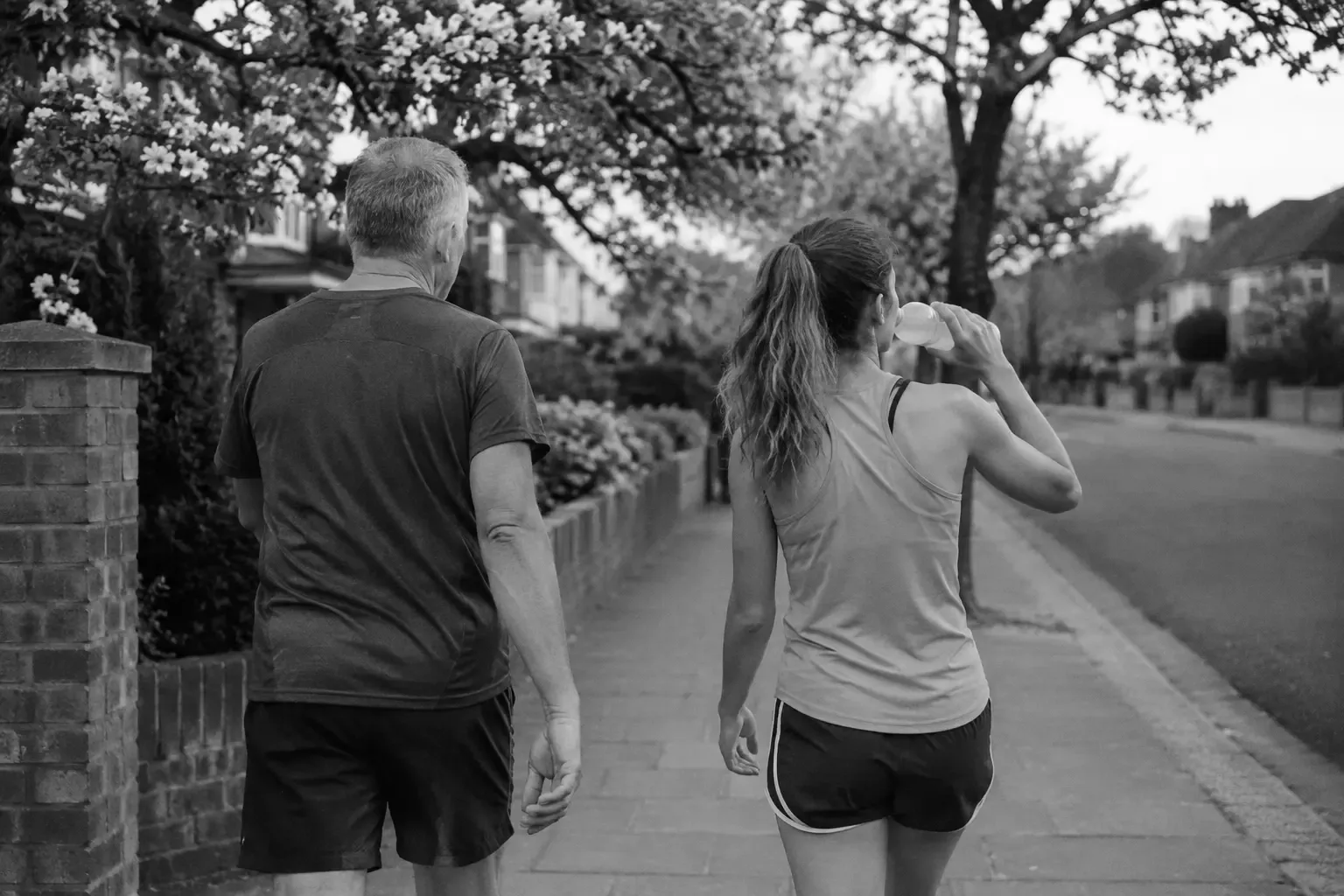
How to recover after a run
- Walk or jog very easy for 5 to 10 minutes
Don't stop dead at your front door. A short walk lets your heart rate and breathing come down gradually and keeps you from feeling light-headed.
- Change out of wet clothes
Cold, wet kit makes you shiver and feel worse, especially after a long run in winter. Dry layers first, then a few easy stretches later if you want them.
- Drink to thirst
Sip water, or a sports drink after a long or hot run. You don't need to force down litres. In summer, cooling off in the shade first is part of it too: see our tips for running in the heat. If your urine is pale over the next few hours, you are fine.
- Eat a meal with carbs and protein within 2 hours
A normal meal does the job: rice, pasta, bread, potatoes or oats with eggs, yogurt, fish, meat or beans. After a long or hard run, aim for about 20 g of protein.
- Plan an easy day tomorrow
Check your plan. If the next session is hard and today was hard too, swap it for an easy run or a rest day.
What to eat after running
What you eat after a run matters more the harder the run was and the sooner you run again. After a short easy run, your next normal meal is enough. After a long run, or when you train twice in a day, it is worth being deliberate.
The sports nutrition position stand from the American College of Sports Medicine and two dietitian bodies recommends about 0.3 g of protein per kg of body weight after key sessions, and when you have less than 8 hours before the next hard session, 1.0 to 1.2 g of carbohydrate per kg per hour for the first 4 hours (Thomas, Erdman and Burke, 2016).
Here is that math for a 70 kg (154 lb) runner:
| Situation | Carbs | Protein | What it looks like |
|---|---|---|---|
| Easy run under an hour, next run tomorrow | Your normal meals | Your normal meals | Usual breakfast or dinner |
| Long or hard run, next run tomorrow | A carb-rich meal within 2 hours | About 21 g (0.3 g/kg) | Pasta with chicken, or oats with Greek yogurt |
| Two hard sessions less than 8 hours apart | 70 to 84 g per hour for 4 hours (1.0 to 1.2 g/kg) | About 21 g (0.3 g/kg) | Banana, bagel and a milk drink, then a full meal |
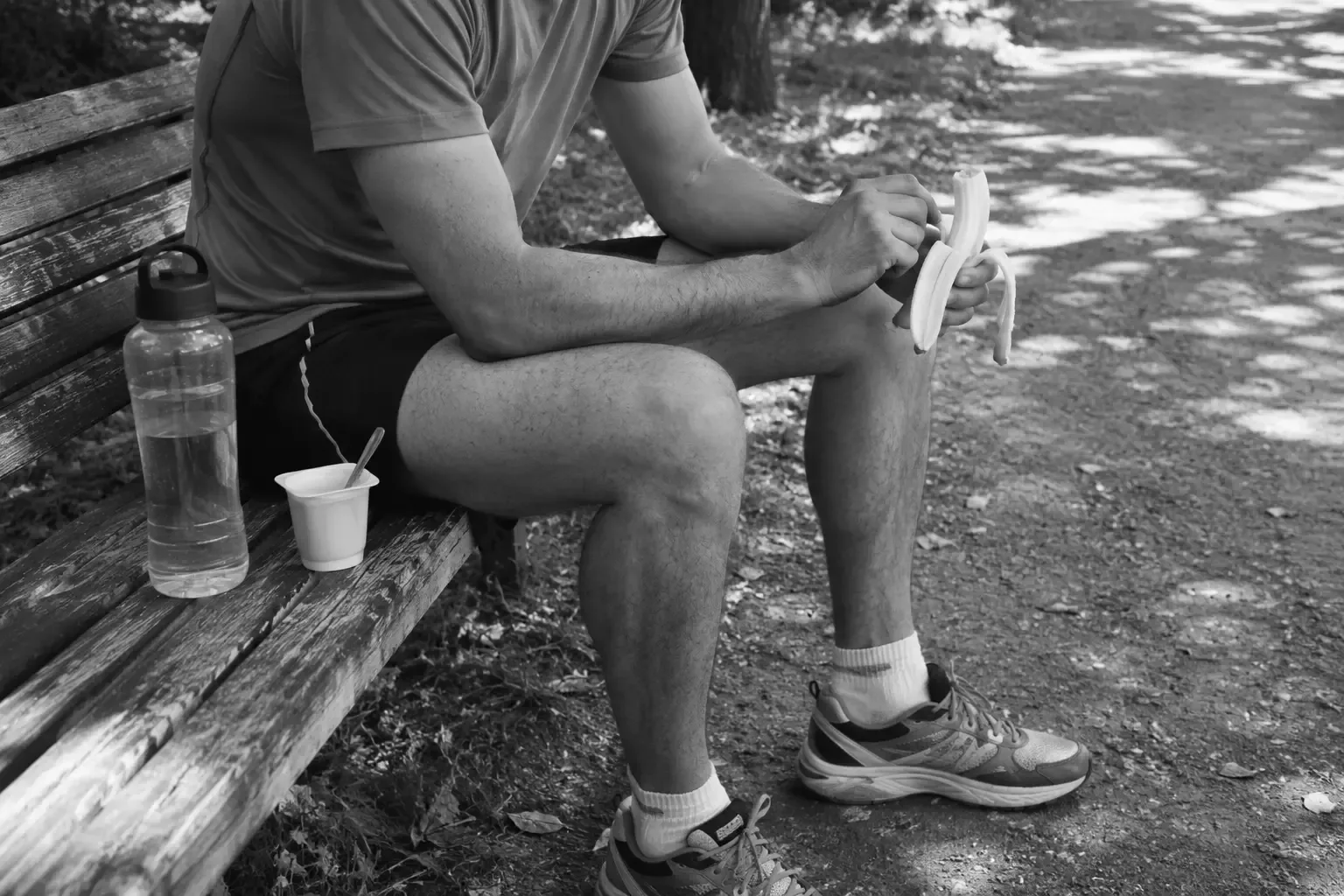
If you can't face food straight after a hard run, a glass of milk or a smoothie is fine until your appetite comes back. The same carb logic that gets you ready to run, covered in what to eat before a run, works in reverse afterwards: the harder the session, the more carbs you need.
Sleep does most of the work
Sleep is where most recovery actually happens, and nothing you buy replaces it. If you train hard and sleep 6 hours, you will feel it in your legs within a week.
Practical rules:
- Protect sleep after your long run. Late-night long runs and big evenings out are a bad pairing.
- Move hard sessions away from bad nights. If you slept 5 hours, run easy or rest and do the workout tomorrow.
- Watch the trend, not one night. One bad night before a race is normal. A week of short sleep in a big training block is a reason to cut the volume.
Recovery by type of run
The right recovery depends on what you just ran. A 30-minute jog and a 32 km (20 mi) long run are different problems.
After an easy run
You don't need to do much. Eat when you are hungry, drink when you are thirsty, and run again tomorrow if your plan says so. Easy runs are meant to be easy enough to repeat. If one leaves you wrecked, it was too fast: the talk test from how to breathe while running applies here too.
After a long run
This is where recovery starts to matter. Walk it off, eat a proper meal, and expect heavy legs the next day. Most plans put a rest day or a short easy run after the long run for a reason.
If your long run went badly or you had to cut it short, don't make it up the next day. The missed long run guide covers what to do instead.
After a hard workout
Intervals and tempo runs stress your legs and your energy stores more than the distance suggests. Treat them like a long run: a proper meal, then at least one easy day before the next hard session. Two hard days in a row is the classic way to turn good training into a slump. Getting faster comes from the hard session plus the easy days around it, not from stacking workouts.
After a race
After a half marathon, take a few days off or walk, then run easy for a week or so. After a marathon, plan on a week of rest or walking and two to three more weeks of easy running before anything hard. Your legs may feel normal after a few days. The deeper fatigue lasts longer, so stay patient. The same patience you used in the marathon taper applies after the race too.
Active recovery: when a short easy run beats a rest day
Active recovery means light movement on a day after hard training: a short, very slow jog, a walk, an easy bike ride or a swim. It keeps you moving without adding stress.
A recovery jog should be slower than your normal easy pace. If your easy pace is 6:00 /km (9:39 /mi), a recovery jog sits around 6:30 to 7:00 /km (10:28 to 11:16 /mi) for 20 to 30 minutes. If you can't hold that and still feel okay, walk or take the day off. Our guide to recovery runs covers how long to make them and when a rest day is the better call.

Take a full rest day instead when your legs are still sore to the touch, when you slept badly, or when your plan already has a rest day there. Rest days are part of training, not a gap in it.
Foam rolling, ice baths, massage and compression
These are the extras. Some help you feel better, but none of them comes close to sleep, food and an easy next day.
| Tool | Verdict | When it is worth it |
|---|---|---|
| Walking cool-down | Worth doing | After every run, free |
| Foam rolling | Fine if you like it | Tight calves or quads, a few minutes each |
| Massage | Feels good, costs money | After a race or a big block |
| Compression socks | Optional | Long travel after a race |
| Ice bath | Skip it in normal training | Maybe between two races close together |

The ice bath is the one to be careful with. In a study on strength training, regular cold water immersion after sessions reduced the gains in muscle mass and strength compared with an active cool-down (Roberts et al., 2015). That was lifting, not running, but the lesson carries over: the soreness from training is part of how you adapt, so don't rush to switch it off after every session.
Signs you are not recovering
Normal tiredness fades in a day or two. Running fatigue that keeps building is your cue to back off. Watch for:
- Legs that still feel heavy after 2 or 3 easy days
- Easy pace feeling hard, or your heart rate higher than usual at the same pace
- A resting heart rate that stays above your normal for several mornings
- Poor sleep, low mood or no appetite during a big week
- A niggle that gets worse during a run instead of easing off
One or two of these: take an extra easy day or a rest day and cut the next week by a third. If it keeps going for weeks, see a doctor. Chest pain, fainting, unusual breathlessness, swelling or pain that changes how you run means stop and see a doctor or physio.
Common recovery mistakes
- Running the day after a hard workout too fast. This is the big one. The recovery run becomes a second workout.
- Skipping the meal after a long run. You feel fine at noon and flat for two days.
- Making up a missed session the next day. Two hard days in a row, and nothing gained.
- Racing again too soon after a marathon. Your legs stop hurting long before you are recovered.
- Treating gadgets as recovery. Foam rolling an hour a week does not cancel 5 hours of sleep a night.
Build recovery into your plan
The free method is above: easy day after every hard one, food after long runs, sleep, and patience after races. A good marathon training plan or half marathon training plan already puts the easy days in the right places. A 16-week marathon plan, for example, follows most long runs with a rest day or an easy one.
The wall comes when your week doesn't match the paper. A bad night, a sick day or a long run moved to Sunday because of work, and suddenly two hard days land back to back. The plan doesn't move when your week does, so you either skip the session or run it tired.
Build your free plan for your race date. On the Coach plan, next week re-plans itself when you miss a run.
Free training plan
Build your free plan for your race date.
Pick your race and race date. Every week from today to race day is planned for you, with distances in km and miles.
General training guidance, not medical advice. Check with a doctor before increasing training if you have symptoms or a health condition.
Recovery after running is mostly boring: walk it off, eat a real meal, sleep, and keep the next day easy. Give a long run or hard workout two to three days before the next hard session, and a marathon a few weeks. Get the next run right and you rarely need the extras.
When you want those easy days placed around your race date for you, build your free plan and let the recovery come built in.
Frequently asked questions
Stop the hard running for a few days. Walk, sleep, eat proper meals and drink to thirst, then come back with short easy runs only. If you still feel wiped out after a week, or you have chest pain, dizziness or unusual breathlessness, see a doctor.
Walk for 5 to 10 minutes instead of stopping dead, and breathe slowly and deeply. During a run, the fix is to slow down or walk until you can talk in full sentences. If your heart rate stays high at rest for several days, take it easy and check with a doctor if it doesn't settle.
Usually it is one of three things: the run was harder than your fitness allows, you ran low on food or fluid, or you are short on sleep. Slow down your easy runs, eat within 2 hours of longer runs and protect your sleep. Feeling unwell after every run despite that is worth a check with a doctor.
Free training plan
Build your free plan for your race date.
On the Coach plan, next week re-plans itself when you miss a run.
Share article
About the author
More running training guides

Running basics · 12 min
What Is a Recovery Run? Pace, Length and When to Skip It
A recovery run is a short, very easy run you do the day after a long run or hard session. Here is how slow to run it, how long, how it differs from an easy run and a rest day, where it fits in a half or marathon week, and when to skip it.
Running basics · 10 min
10K Beginner Training Schedule: 10 Weeks From Run-Walk
A 10k beginner training schedule for runners starting from run-walk: 10 weeks, three timed sessions a week, a long session that grows to about 70 minutes, the paces behind common finish times and how to adjust the plan to your week.

Running basics · 11 min
10K Training Routine: 3 Runs a Week for 8 Weeks
A 10k training routine is three runs a week on fixed days: one easy run, one faster session and a long run that builds to the full 10 km (6.2 mi) at an easy pace. Here is the weekly layout, the 8-week schedule, the paces and the mistakes that break it.

Running basics · 11 min
5K Training Routine: The Weekly Schedule to Repeat
A good 5K training routine is three or four runs a week on fixed days: one key session, one longer easy run and easy running in between. Here are both weekly layouts, your paces, an 8-week schedule and the mistakes that stall it.
Running basics · 11 min
Interval Training Plan for Running: 8 Weeks With Paces
A simple 8-week interval training plan for running: one session a week at 5 km to 10 km effort, with paces per km and per mile, jog recoveries, a sample week and how to adjust it for a half marathon, a marathon or a comeback.
Running basics · 10 min
Running in the Heat: 9 Tips to Train Safely All Summer
Running in the heat tips that work: run early, run by effort instead of pace, drink and add salt on long runs, adapt over two weeks, and know the warning signs that mean stop.