
How to Warm Up Before Running: The 10-Minute Routine for Every Run
Raceblock team Updated November 10, 2026 11 min read
Free training plan for your race date

Free training plan for your race date
Build my free planIn this article
To warm up before running, walk briskly for 2 to 3 minutes, jog very easily for 5 minutes, then do 4 or 5 dynamic moves like leg swings, walking lunges and high knees. Before a fast session or a short race, finish with a few relaxed strides. The whole routine takes 10 to 15 minutes and needs no equipment.
The one idea this guide turns on: the harder and shorter the run, the longer the warm-up. An easy run barely needs one, because its first slow minutes do the job. A 5k race needs the full routine, while a marathon needs very little, because the first miles at goal pace warm you up.
How to warm up before running: the 10-minute routine
A good warm-up raises your heart rate, breathing and body temperature step by step, then moves your hips, knees and ankles through the range they use when you run. You start slow and finish close to the pace of the run ahead. The order matters more than the exact exercises.
How to warm up before running
- Walk briskly for 2 to 3 minutes
Start with a brisk walk, swinging your arms. It is the gentlest way to get blood moving, and it is the right start if you run first thing in the morning or after hours at a desk.
- Jog very easily for 5 minutes
Jog at a pace where you could chat in full sentences. It should feel almost too slow. If you only have time for one part of the warm-up, keep this one.
- Do 4 or 5 dynamic moves
Leg swings, walking lunges, high knees, butt kicks and hip circles, 10 to 15 reps or about 20 seconds each. Keep them smooth, not forced. The table below shows how to do each one.
- Add 4 to 6 strides before a fast run
A stride is a 15 to 20 second run where you build up to about the speed of a hard effort, stay relaxed, then ease off. Walk or jog back slowly between them. Strides switch your legs to faster running without tiring you. They are also the easiest way to get used to a quicker step rate without forcing it.
- Start the run or session within a few minutes
Don't stand around after the warm-up. Five minutes of waiting, especially in the cold, undoes most of it.

Dynamic warm-up exercises for runners
Dynamic moves take your joints through the motion of running while you keep moving. They are the opposite of holding a stretch: you move in and out of each position in a second or two. Pick four or five from this list; you don't need all of them every time.
| Exercise | How to do it | Reps | What it warms up |
|---|---|---|---|
| Leg swings, front to back | Hold a fence or post, swing one leg forward and back like a pendulum | 10 to 15 each leg | Hamstrings and hip flexors |
| Leg swings, side to side | Face the post, swing one leg across your body and out | 10 to 15 each leg | Inner and outer hips |
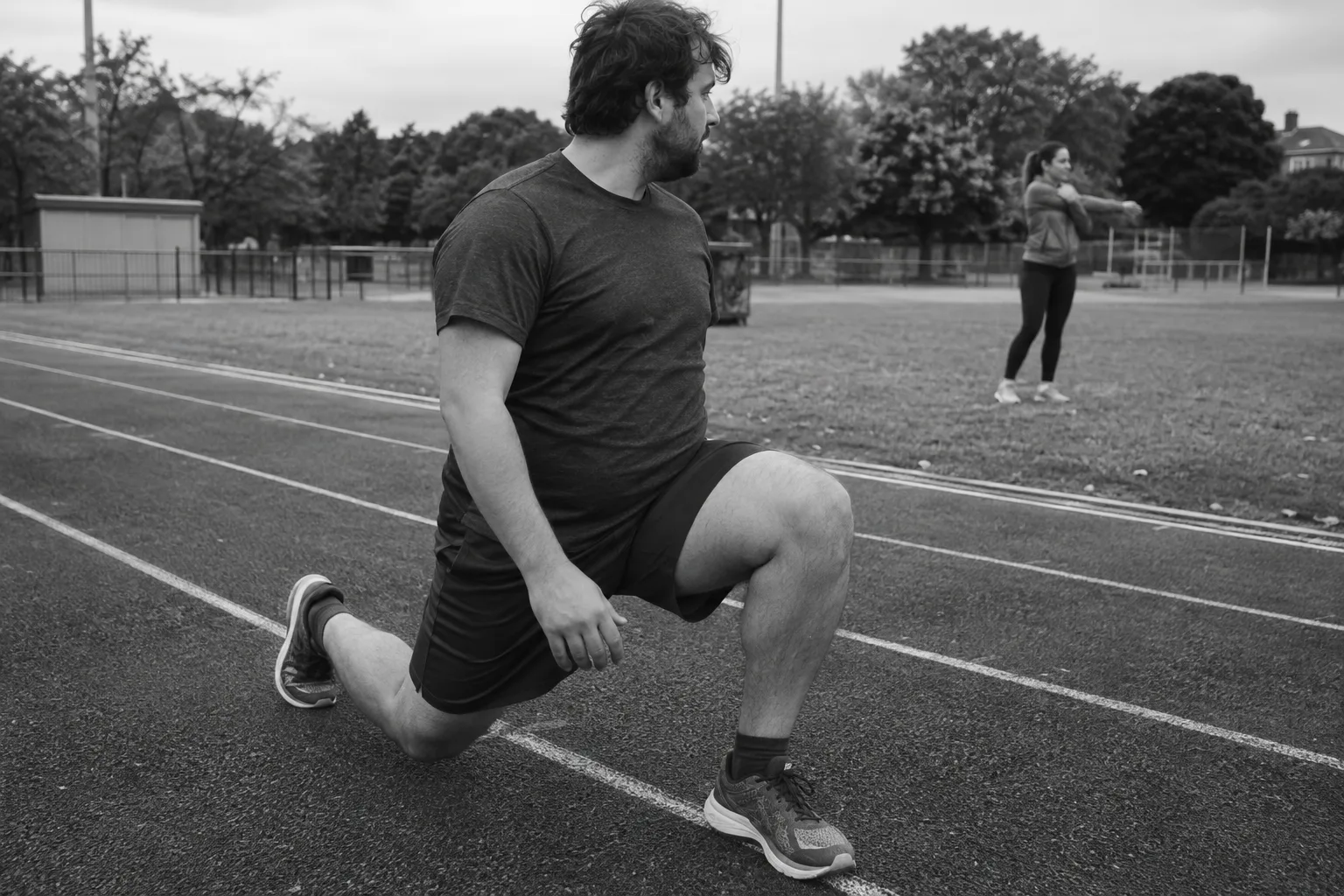
| Walking lunges | Long step forward, lower the back knee toward the ground, step through | 8 to 10 each leg | Glutes, quads, hip flexors |
| High knees | Jog on the spot or forward, lifting knees to hip height | 20 seconds | Hip flexors, quick feet |
| Butt kicks | Jog lightly, bringing your heels toward your glutes | 20 seconds | Quads and knees |
| Hip circles | Hands on hips, draw big slow circles with your hips | 8 each direction | Hips and lower back |
| Ankle bounces | Small, quick hops on the balls of your feet | 20 seconds | Calves, Achilles and ankles |
| A-skips | Skip forward, driving one knee up and landing under your hip | 2 x 20 seconds | Running posture and rhythm |
If you have tight hips from sitting all day, spend most of your time on leg swings and lunges. If your calves feel stiff in the first mile, add ankle bounces. A-skips are worth learning because they rehearse the same posture covered in our guide to proper form when running.

How long should you warm up before running?
Match the warm-up to how hard the run is, not how long it is. Easy runs need almost none, speed sessions and short races need the most, and long races sit in between. This is where most runners get it backwards: they do a careful routine before a slow 5 km (3.1 mi) jog, then skip it before intervals.
| Type of run | Warm-up length | What to do |
|---|---|---|
| Easy run | 0 to 5 minutes | Walk, then run the first 5 to 10 minutes slower than your usual easy pace |
| Long run | About 5 minutes | Brisk walk, a few leg swings, then a slow first 1 to 2 km (0.6 to 1.2 mi) |
| Tempo run | 10 to 15 minutes | Easy jog, dynamic moves, 2 to 4 strides |
| Intervals or hills | 15 to 20 minutes | Easy jog, full set of dynamic moves, 4 to 6 strides |
| 5 km (3.1 mi) or 10 km (6.2 mi) race | 15 to 20 minutes | Full routine, finishing 5 to 10 minutes before the start |
| Half marathon, 21.1 km (13.1 mi) | 5 to 10 minutes | Easy jog and a few strides, then start at goal pace |
| Marathon, 42.2 km (26.2 mi) | 0 to 5 minutes | A walk and a short jog. The first miles at goal pace are the warm-up |
Easy and long runs
On easy days the run is the warm-up. Start at a pace that feels a little too slow and let it pick up by itself after 5 to 10 minutes. If you are stiff, add a minute of leg swings at the door. This is enough for most of the running in a marathon training plan, because most of those miles are easy.
Tempo runs, intervals and hills
Hard sessions are where a warm-up pays off. Going straight into fast reps from cold makes the first ones feel awful and throws off your pacing. Jog easy for 10 minutes, do your drills, add strides, and only then start the first rep. If you are working on speed, as in our guide on how to run faster, treat the warm-up as part of the session, not an extra. The same routine, with a few extra drills, opens every session in our guide to sprinting faster.

Race day: 5k versus marathon
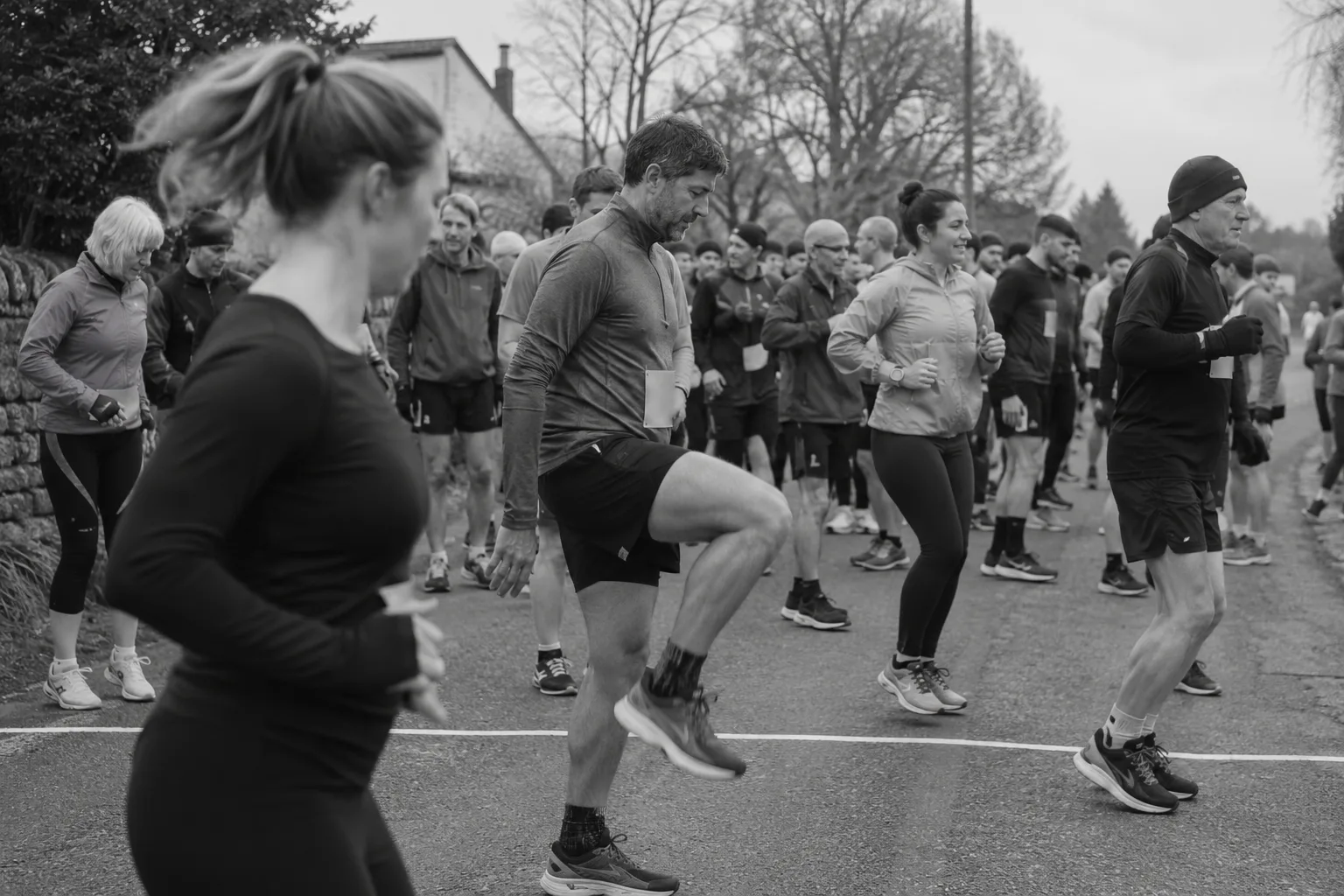
Short races start fast, so you need to be warm at the gun. Finish a full routine with a few strides 5 to 10 minutes before the start, then keep moving with light jogging in the start pen.
Marathons are the opposite. You will run for hours, so every bit of energy matters, and goal pace should feel easy for the first few miles anyway. Walk, jog for a few minutes, do some leg swings, and use the first 2 to 3 km (1.2 to 1.9 mi) to settle in. Check what your goal pace looks like per km and per mile in the marathon pace chart before race day, so you don't chase the crowd.
Should you stretch before running?
Not with long, held stretches. Holding a stretch for 30 seconds or more on cold muscles is not a warm-up, and it doesn't prepare you to run. Harvard Health advises warming the muscles with 5 to 10 minutes of light activity, such as a quick walk, before you stretch at all, because stretching cold muscles can hurt them.
So swap the static stretch for the dynamic moves above. If a short, gentle hold of a tight calf or hip feels good after your easy jog, that's fine. Save the long stretching for after the run, when these post-run stretches take about 10 minutes, or for a separate session.
Warming up on cold mornings and early runs
Cold weather and early starts both call for a slower, longer first few minutes, not a different routine. Your body is stiffer after a night in bed or a day at a desk, and cold air makes it worse.
- Do the first 3 to 5 minutes indoors: marching on the spot, high knees, leg swings in the hallway
- Head out straight after, before you cool down
- Wear gloves and a hat for the first mile; you can take them off later
- Run the first 10 minutes slower than usual and let the pace come to you
If you eat before an early run, give it time first. Our guide on what to eat before a run has a timing table for morning, long and hard runs.

Mistakes that ruin a warm-up
- Static stretching instead of moving. It feels like warming up, but you finish as cold as you started.
- Going too fast too soon. The easy jog should be easy. A warm-up that leaves you breathing hard eats into the session.
- Warming up, then waiting. A long gap before a race start or a group run puts you back where you began. Keep jogging lightly.
- The same routine for every run. A 20 minute warm-up before an easy 5 km (3.1 mi) is wasted time; no warm-up before intervals is a bad session.
- Pushing through pain. Stiffness that eases as you warm up is normal. Sharp pain, pain that gets worse as you run, swelling or chest pain means stop and see a doctor or physio.
A warm-up only helps if the training happens
The routine above takes care of the first ten minutes of every run. It can't fix a training week that falls apart. That's the wall most runners hit on their own: a sick week, a work trip or a missed long run, and the paper plan doesn't move when your week does. You end up skipping the session or cramming it in tired.
Build your free plan for your race date. On the Coach plan, next week re-plans itself when you miss a run. If your race is a half, start from a half marathon training plan instead.
Free training plan
Build your free plan for your race date.
Pick your race and race date. Every week from today to race day is planned for you, with distances in km and miles.
General training guidance, not medical advice. Check with a doctor before increasing training if you have symptoms or a health condition.
How to warm up before running comes down to effort. Before easy and long runs, start slow and let the first minutes warm you up. Before tempo runs, intervals and short races, do the full routine: a brisk walk, 5 minutes of easy jogging, four or five dynamic moves and a few strides. Before a marathon, keep it short and let the first miles do the work. Skip the long static stretches until after.
Then build the habit into a full training block: build your free plan for your race date and use the right warm-up for each session in it.
Frequently asked questions
Yes, but how much depends on the run. Before an easy run, starting at a slower than easy pace for the first 5 to 10 minutes is enough. Before a fast session or a short race, do a proper 10 to 20 minute warm-up with easy jogging, dynamic moves and strides, so the hard part doesn't start from cold.
For a 5k race, do the full routine: 10 minutes of easy jogging, four or five dynamic moves such as leg swings, lunges and high knees, then 4 to 6 relaxed strides. Finish 5 to 10 minutes before the start and keep moving while you wait. For an easy 5 km (3.1 mi) training run, just start slowly.
The best warm-up exercises for running are dynamic: leg swings front to back and side to side, walking lunges, high knees, butt kicks, hip circles, ankle bounces and A-skips. Do 10 to 15 reps or about 20 seconds of each after a few minutes of easy jogging. Strides are the best final step before anything fast.
Free training plan
Build your free plan for your race date.
On the Coach plan, next week re-plans itself when you miss a run.
Share article
About the author
More running training guides

Running basics · 12 min
What Is a Recovery Run? Pace, Length and When to Skip It
A recovery run is a short, very easy run you do the day after a long run or hard session. Here is how slow to run it, how long, how it differs from an easy run and a rest day, where it fits in a half or marathon week, and when to skip it.

Running basics · 10 min
10K Beginner Training Schedule: 10 Weeks From Run-Walk
A 10k beginner training schedule for runners starting from run-walk: 10 weeks, three timed sessions a week, a long session that grows to about 70 minutes, the paces behind common finish times and how to adjust the plan to your week.

Running basics · 11 min
10K Training Routine: 3 Runs a Week for 8 Weeks
A 10k training routine is three runs a week on fixed days: one easy run, one faster session and a long run that builds to the full 10 km (6.2 mi) at an easy pace. Here is the weekly layout, the 8-week schedule, the paces and the mistakes that break it.

Running basics · 11 min
5K Training Routine: The Weekly Schedule to Repeat
A good 5K training routine is three or four runs a week on fixed days: one key session, one longer easy run and easy running in between. Here are both weekly layouts, your paces, an 8-week schedule and the mistakes that stall it.

Running basics · 11 min
Interval Training Plan for Running: 8 Weeks With Paces
A simple 8-week interval training plan for running: one session a week at 5 km to 10 km effort, with paces per km and per mile, jog recoveries, a sample week and how to adjust it for a half marathon, a marathon or a comeback.

Running basics · 10 min
Running in the Heat: 9 Tips to Train Safely All Summer
Running in the heat tips that work: run early, run by effort instead of pace, drink and add salt on long runs, adapt over two weeks, and know the warning signs that mean stop.