
Best Stretches After Running: 5 Moves in a 10-Minute Routine
Raceblock team November 6, 2026 11 min read
Free training plan for your race date
Free training plan for your race date
Build my free planIn this article
The best stretches after running are a standing calf stretch, a standing quad stretch, a hamstring stretch, a kneeling hip flexor stretch and a figure-four glute stretch. Walk for 5 minutes first, then hold each one for about 30 seconds per side, gently, with no bouncing. The whole routine takes 8 to 10 minutes.
The one idea this guide turns on: stretching after a run is for how your legs move, not for how sore they feel. Research says a stretch won't stop tomorrow's soreness. What it does well is keep your calves and hips from locking up after hours of running and sitting. So pick the few stretches that cover what running tightens, keep them short and easy, and do them often.
Why stretch after running at all?
Stretch after running to keep your range of motion, not to stop soreness or injuries. A Cochrane review of stretching and muscle soreness found that stretching before, after or both does not produce clinically important reductions in soreness in healthy adults. A 2014 review of injury prevention trials in the British Journal of Sports Medicine found no clear injury benefit from stretching either.
That doesn't make stretching useless. Running works your legs through a short, repeated range of motion, thousands of times per run. Then most of us sit at a desk or in a car. Calves and hip flexors are the two places most runners feel that. A few minutes of easy stretching while your muscles are still warm is the cheapest way to keep them moving freely. It is also a good moment to notice anything that feels wrong before it becomes a problem.
If soreness is your real worry, the fixes are elsewhere: sleep, a meal with carbs and protein, and an easy day after a hard one. Our guide to recovery after running covers all of it.
Which stretch for which run
Not every run needs the same cool-down. The harder or longer the run, the gentler and later the stretching. Use this as your default:
| After this run | What to do | Time |
|---|---|---|
| Easy run, 5 to 10 km (3 to 6 mi) | Walk 3 to 5 minutes, then the five stretches if you want them | 5 to 10 min |
| Long run, 16 km (10 mi) or more | Walk 5 to 10 minutes, change into dry clothes, then gentle stretches at half your usual depth | 10 to 15 min |
| Intervals, tempo run or hills | Jog very easily for 10 minutes first, then calves and hip flexors | 10 to 15 min |
| Race day, 10k to marathon | Walk, eat, drink. Skip deep stretching that day; light stretches the next day | Next day |
| Desk job, tight hips | Add the hip flexor and glute stretches again in the evening | 2 to 4 min |
The pattern: the more damage a run did to your legs, the less you should pull on them straight after. A 32 km (20 mi) long run or a marathon leaves muscles that need rest and food, not a deep hamstring stretch.
The 5 best stretches after running
Do these in order, standing first, then on the ground. Hold each for about 30 seconds per side and do one or two rounds. You should feel a mild, even pull in the muscle, never a sharp pain or a pull in a joint. Breathe slowly; on each breath out, relax a little deeper.
Standing calf stretch
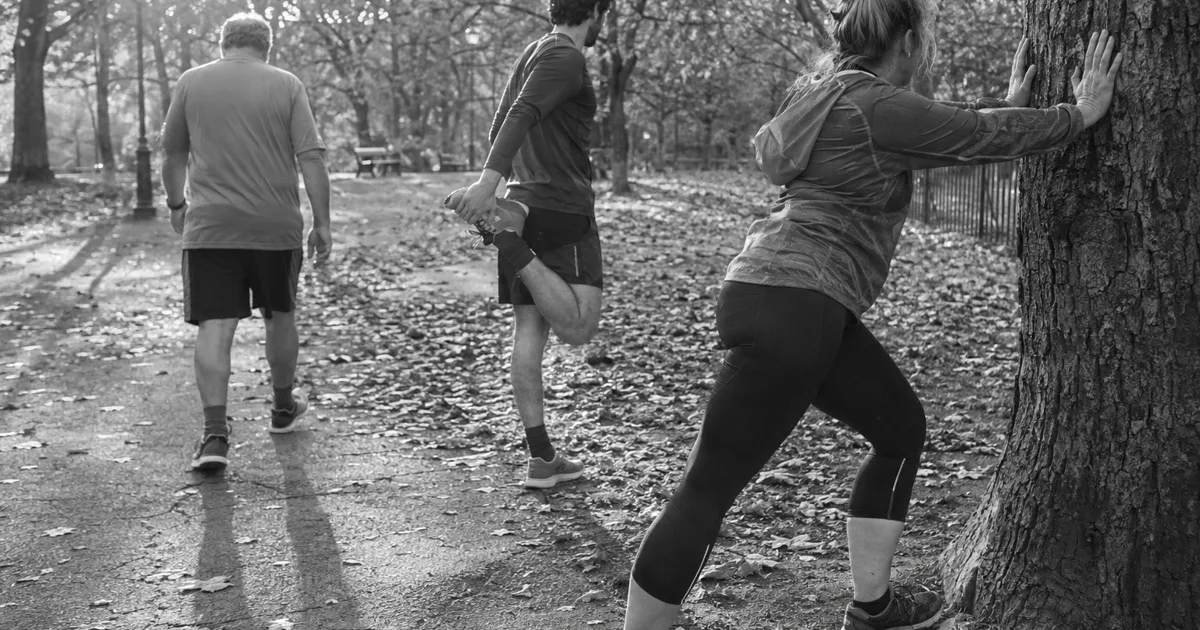
Put both hands on a wall, tree or fence. Step one foot back about a stride length, keep that leg straight and press the heel flat into the ground. Bend the front knee and lean forward until you feel the pull in the back calf.
Then bend the back knee slightly, keeping the heel down. That moves the stretch lower, into the deeper calf muscle (the soleus) that works hard on hills and long runs. Do both versions on each leg. If you only have time for one stretch, make it this one.
Standing quad stretch
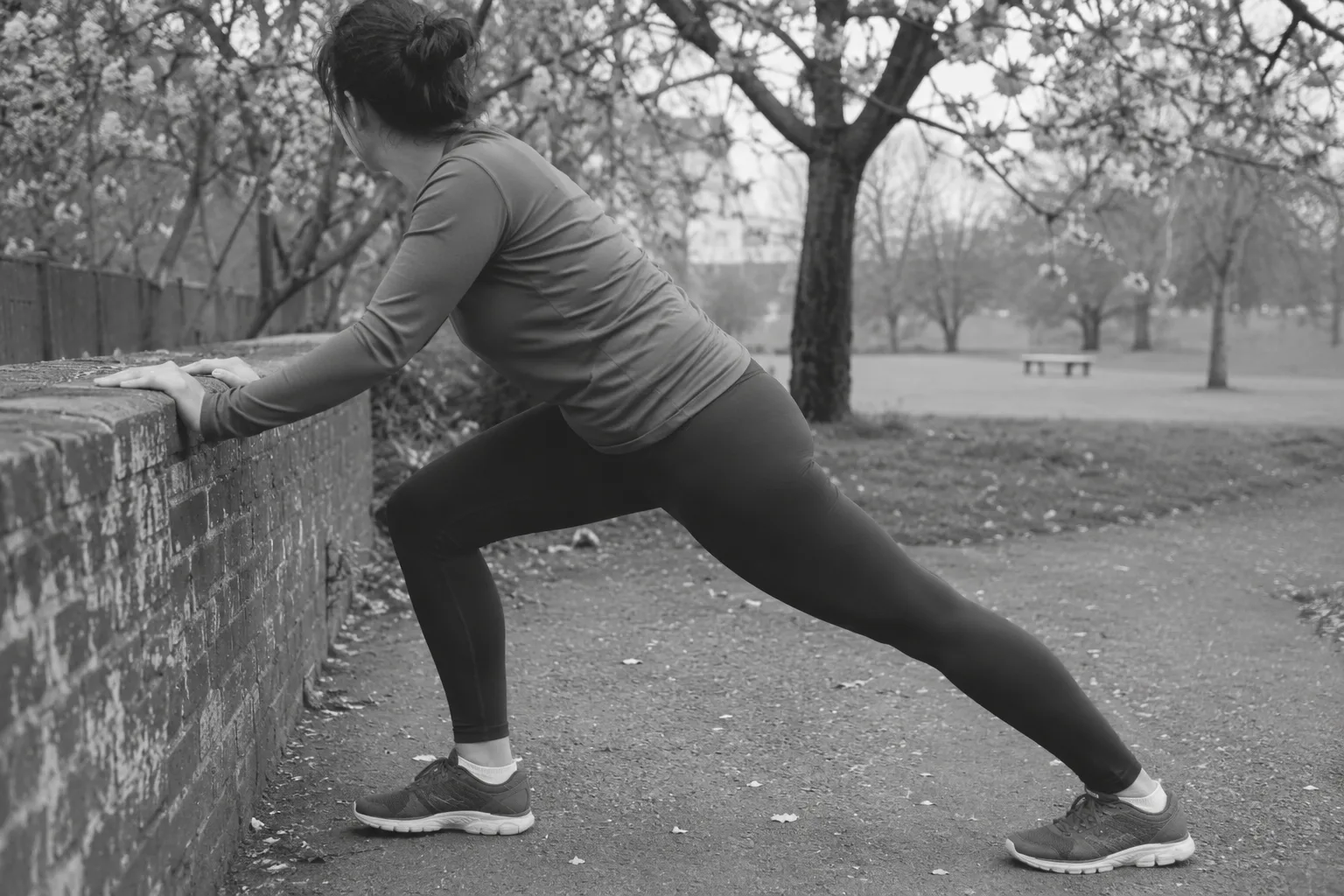
Stand tall and hold a railing or wall with one hand. Bend one knee and hold that ankle behind you, bringing the heel toward your glute. Keep your knees together and push your hips slightly forward. Don't arch your lower back or pull the knee out to the side.
If you can't reach your ankle, loop a towel or the sleeve of your jacket around it. If your knee complains when it is fully bent, stop at a smaller bend.
Hamstring stretch
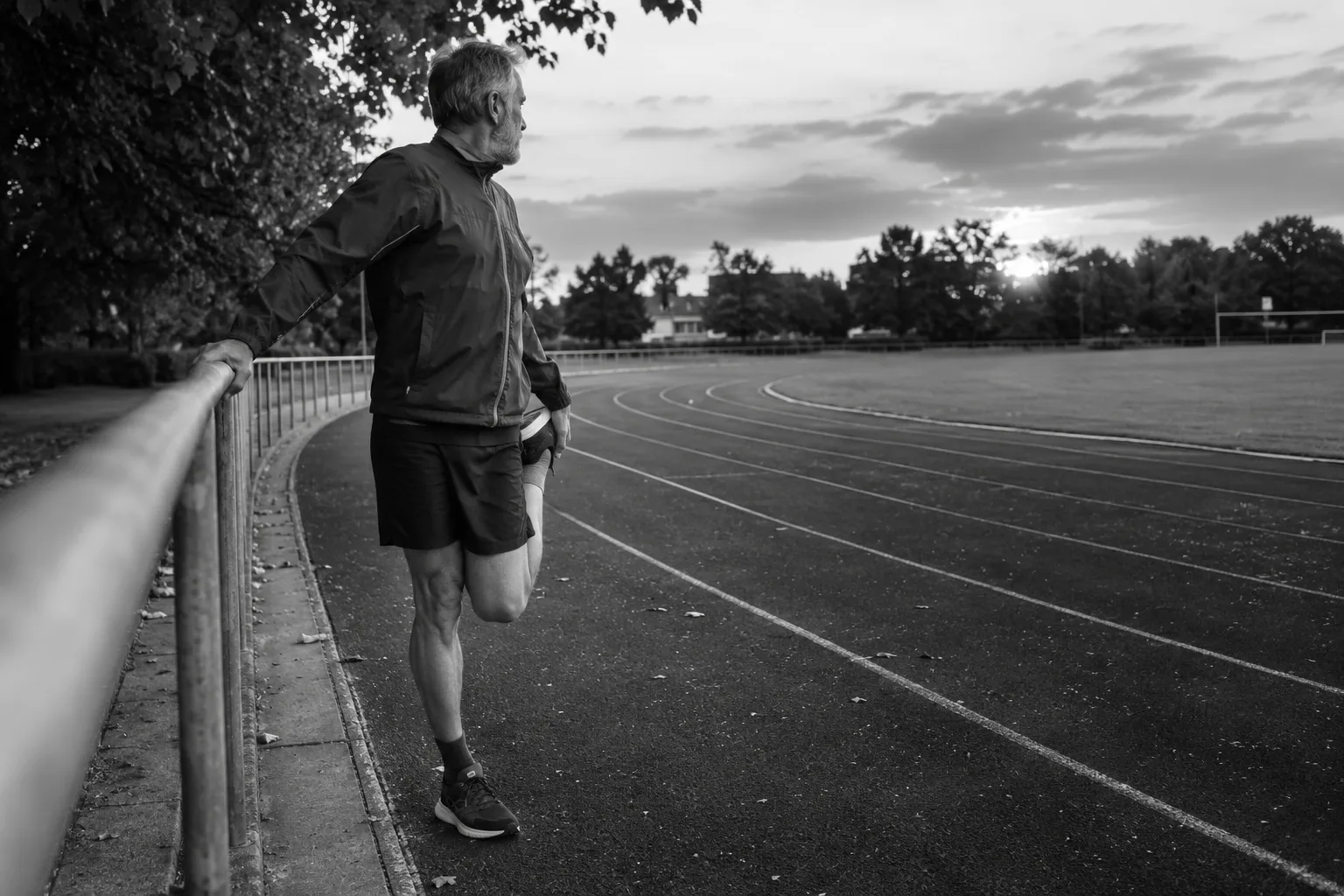
Rest one heel on a low step, curb or bench, with that leg straight and the toes pointing up. Keep your back flat and hinge forward from the hips until you feel the pull along the back of the thigh. Your hands rest on your thigh, not reaching for your toes.
The common mistake here is rounding the back to get further down. That stretches your back, not your hamstring. A lower step and a flat back beat a high bench and a curled spine. On tired legs after a long run, do this one lying down instead: on your back, loop a towel around one foot and lift the straight leg slowly.
Kneeling hip flexor stretch
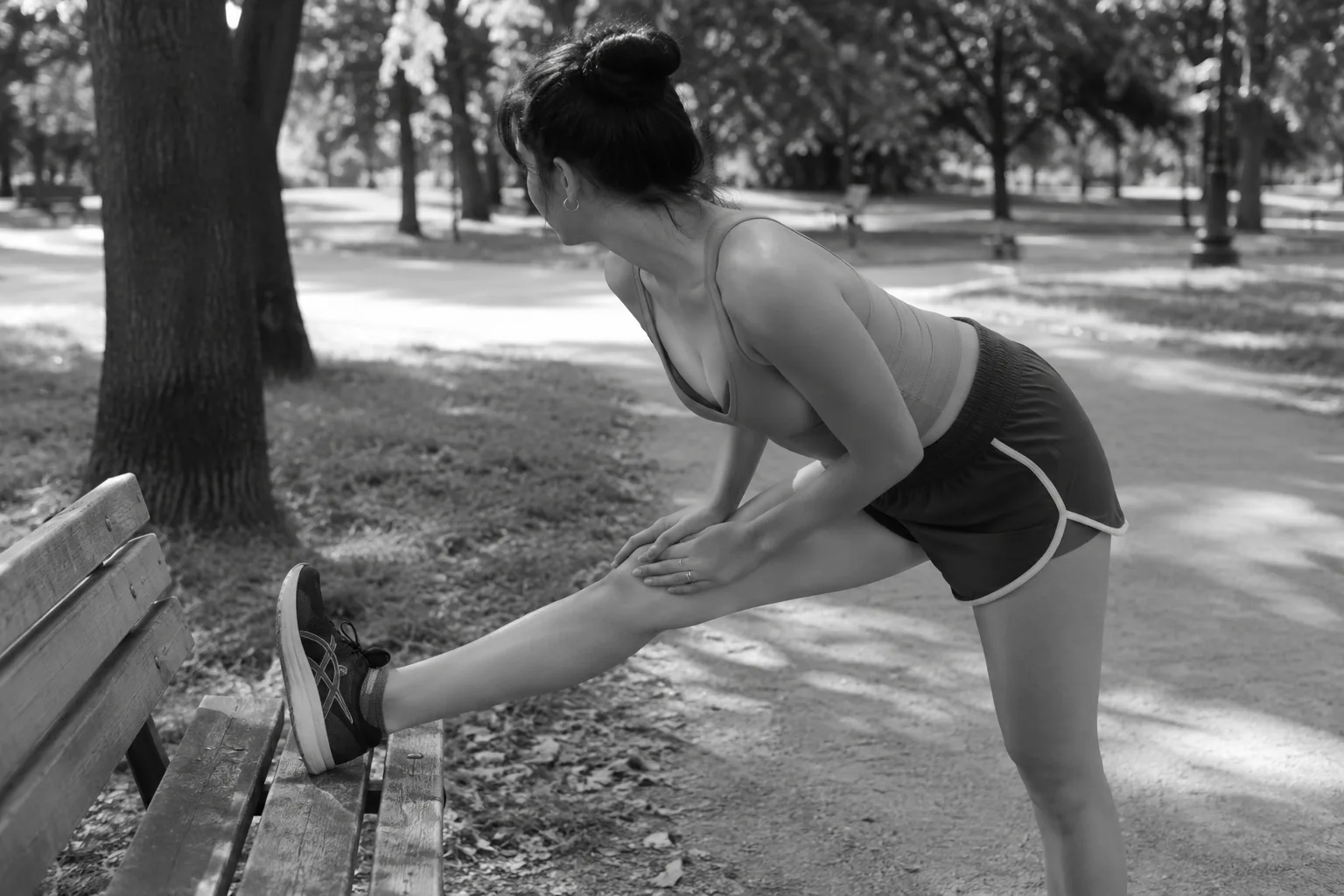
Kneel on one knee on something soft (grass, a mat, a folded jacket), with the other foot flat in front and that knee over the ankle. Tuck your tailbone under slightly, then move your hips forward until you feel the pull at the front of the hip of the kneeling leg. Keep your chest up.
This is the stretch for runners who sit all day. To feel more of it, raise the arm on the kneeling side over your head. If you feel it in your lower back instead of the front of the hip, tuck the hips more and lean forward less.
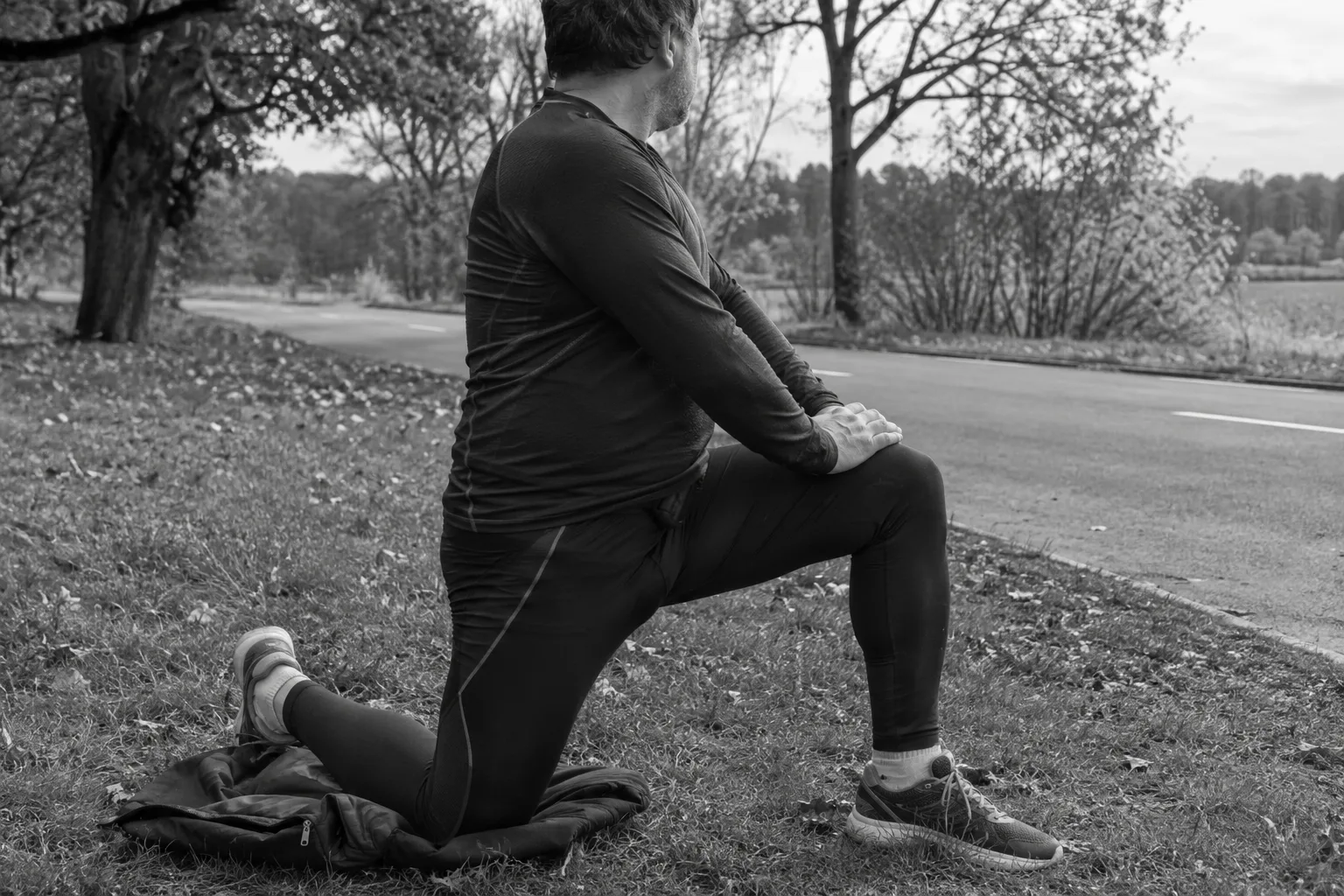
Figure-four glute stretch
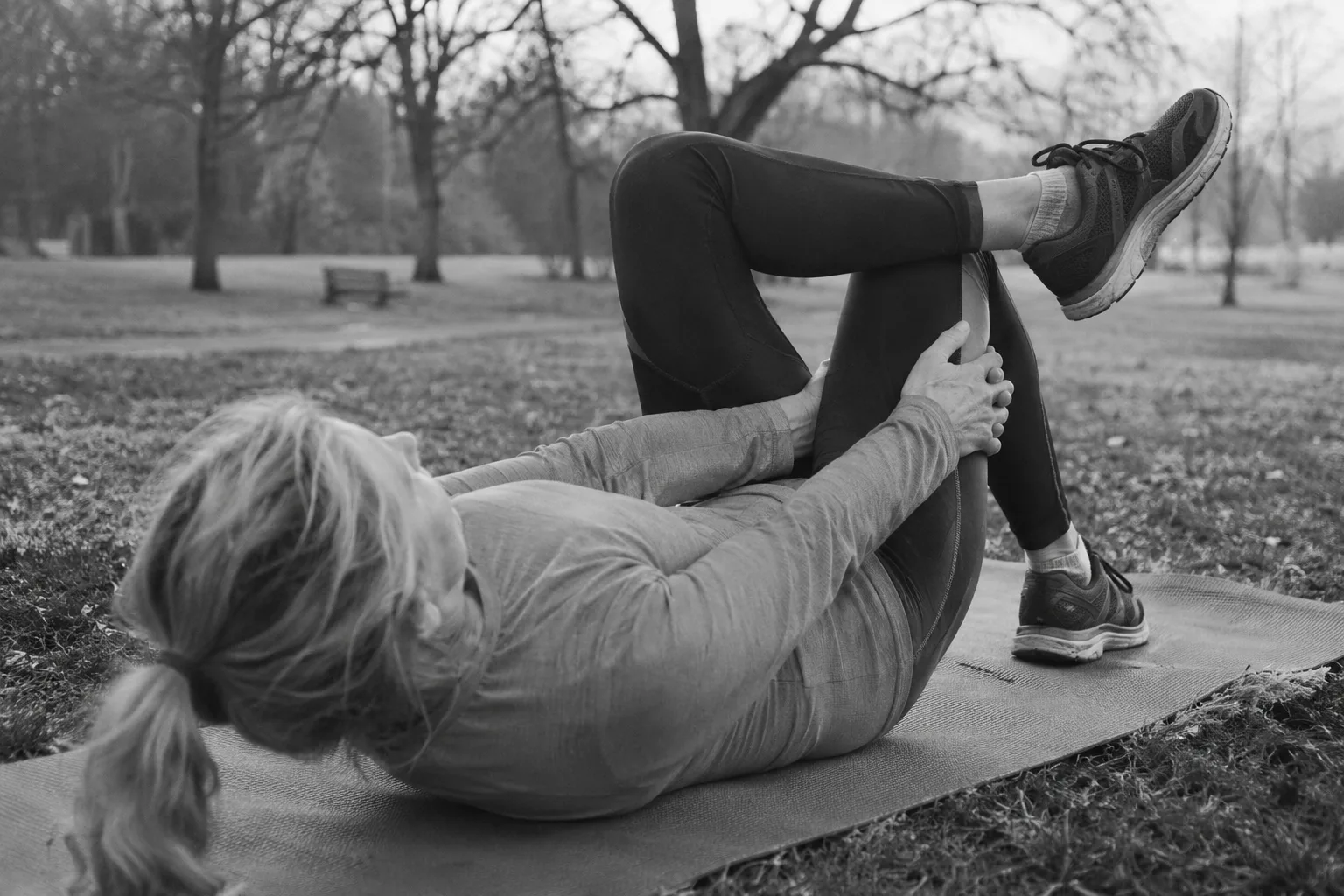
Lie on your back with both knees bent. Cross one ankle over the opposite knee, so your legs make the shape of a 4. Thread your hands behind the thigh of the bottom leg and pull it gently toward your chest. You'll feel it deep in the hip and glute of the crossed leg.
If lying on wet ground isn't an option, do it seated on a bench: ankle on the opposite knee, then lean forward with a straight back. Same stretch, no mat needed.
Two more if you have time
- Butterfly stretch for the inner thighs. Sit with the soles of your feet together and your knees falling out. Hold your feet and sit tall; let the knees drop slowly.
- Child's pose for the back. Kneel, sit back on your heels and walk your hands forward on the ground until your forehead rests near the floor. Good after hilly runs.
How to do the 10-minute routine
How to stretch after running
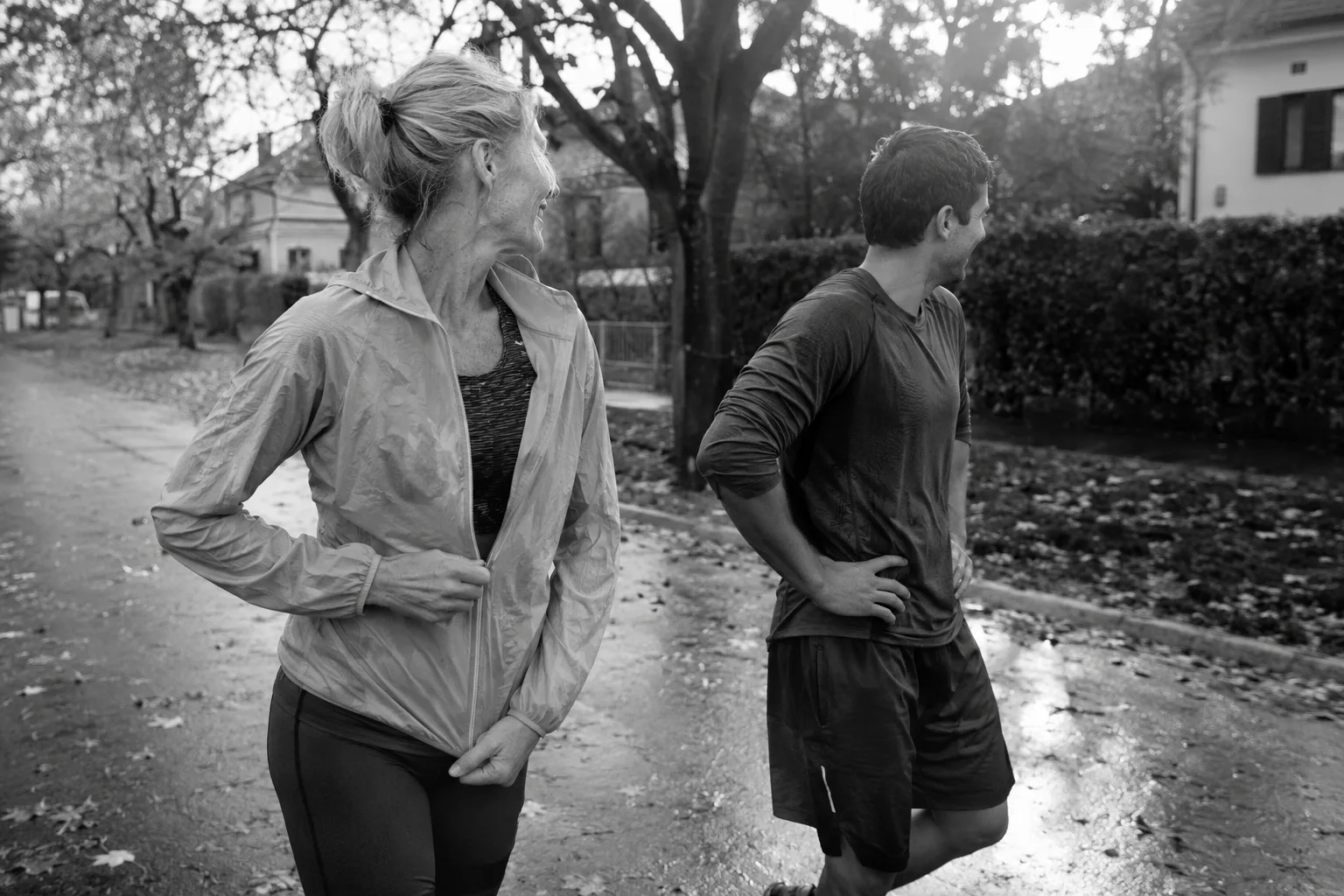
- Walk or jog very easily for 5 minutes
Let your breathing settle and your heart rate come down before you stop moving. After a hard session, make it 10 minutes of very easy jogging.
- Change out of wet clothes if it's cold
Stretching while you get cold and stiff defeats the purpose. Dry layers first, then stretch indoors if you need to.
- Do the five stretches in order, about 30 seconds per side
Calf, quad, hamstring, hip flexor, glute. Mild tension only. One round is fine on a short day; two on a long one.
- Finish with your tightest spot
Whatever felt tight on the run, give it one extra round. That is usually the calves or the hips.
Doing this before you run is a different job. Long held stretches on cold muscles don't prepare you to run; moving through dynamic drills does. See how to warm up before running for that routine.
Mistakes that make stretching worse
- Stretching straight after a hard run without walking first. Stop, drop and pull on a tight hamstring is the moment it complains. Walk for 5 minutes.
- Bouncing. Short bounces into a stretch tense the muscle you're trying to relax. Hold still.
- Pushing into pain. A stretch should feel like a mild pull. Sharp pain, pain in a joint, or pain that stays after you let go means stop.
- Stretching hard after a race. After a marathon, your legs need food, fluids and rest more than range. Keep it gentle or wait a day.
- Using stretching to run through pain. If a spot hurts during runs, a stretch won't fix it. Pain that gets worse as you run, swelling, numbness or chest pain means stop and see a doctor or physio.
- Skipping the easy days instead. No stretch makes up for running hard every day. If that sounds like your week, read is running every day bad.
Stretching only helps if the training happens
Five stretches after every run are easy to keep up. A training plan is harder. That's the wall most runners hit on their own: a sick week, a work trip or a missed long run, and the paper plan doesn't move when your week does. You skip the session, or cram it into tired legs and then skip the cool-down too.
Build your free plan for your race date. On the Coach plan, next week re-plans itself when you miss a run. If your race is a half, start with a half marathon training plan instead.
Free training plan
Build your free plan for your race date.
Pick your race and race date. Every week from today to race day is planned for you, with distances in km and miles.
General training guidance, not medical advice. Check with a doctor before increasing training if you have symptoms or a health condition.
The best stretches after running are the five that cover what running tightens: calves, quads, hamstrings, hip flexors and glutes. Walk first, hold each for about 30 seconds per side, stay at a mild pull and keep it gentle after long runs and races. Do it for how your legs move, and look to sleep, food and easy days for how they feel. Good running form and a sensible week do more than any stretch.
Then put the habit inside a full block: pick a marathon training plan or build your free plan for your race date, and finish every run with the same 10 minutes.
Frequently asked questions
Walk or jog very easily for 5 minutes, then do a standing calf stretch, a standing quad stretch, a hamstring stretch, a kneeling hip flexor stretch and a figure-four glute stretch. Hold each for about 30 seconds per side at a mild pull, with no bouncing. Keep it gentler after long runs and races.
About 5 to 10 minutes is enough for most runners. That covers five stretches at roughly 30 seconds per side, once or twice. Longer sessions are fine if you enjoy them, but they won't make you less sore the next day.
No. Research has not found that stretching after running prevents soreness or injuries, so skipping it now and then does no harm. The case for it is keeping your calves and hips moving freely, especially if you sit a lot. A short walk to cool down matters more than the stretches.
Free training plan
Build your free plan for your race date.
On the Coach plan, next week re-plans itself when you miss a run.
Share article
About the author
More running training guides
Running basics · 12 min
What Is a Recovery Run? Pace, Length and When to Skip It
A recovery run is a short, very easy run you do the day after a long run or hard session. Here is how slow to run it, how long, how it differs from an easy run and a rest day, where it fits in a half or marathon week, and when to skip it.
Running basics · 10 min
10K Beginner Training Schedule: 10 Weeks From Run-Walk
A 10k beginner training schedule for runners starting from run-walk: 10 weeks, three timed sessions a week, a long session that grows to about 70 minutes, the paces behind common finish times and how to adjust the plan to your week.
Running basics · 11 min
10K Training Routine: 3 Runs a Week for 8 Weeks
A 10k training routine is three runs a week on fixed days: one easy run, one faster session and a long run that builds to the full 10 km (6.2 mi) at an easy pace. Here is the weekly layout, the 8-week schedule, the paces and the mistakes that break it.
Running basics · 11 min
5K Training Routine: The Weekly Schedule to Repeat
A good 5K training routine is three or four runs a week on fixed days: one key session, one longer easy run and easy running in between. Here are both weekly layouts, your paces, an 8-week schedule and the mistakes that stall it.
Running basics · 11 min
Interval Training Plan for Running: 8 Weeks With Paces
A simple 8-week interval training plan for running: one session a week at 5 km to 10 km effort, with paces per km and per mile, jog recoveries, a sample week and how to adjust it for a half marathon, a marathon or a comeback.
Running basics · 10 min
Running in the Heat: 9 Tips to Train Safely All Summer
Running in the heat tips that work: run early, run by effort instead of pace, drink and add salt on long runs, adapt over two weeks, and know the warning signs that mean stop.