
Missed a Long Run in Marathon Training? What to Do Next
Raceblock team Updated November 9, 2026 8 min read
Free marathon plan for your race date

Free marathon plan for your race date
Build my free planIn this article
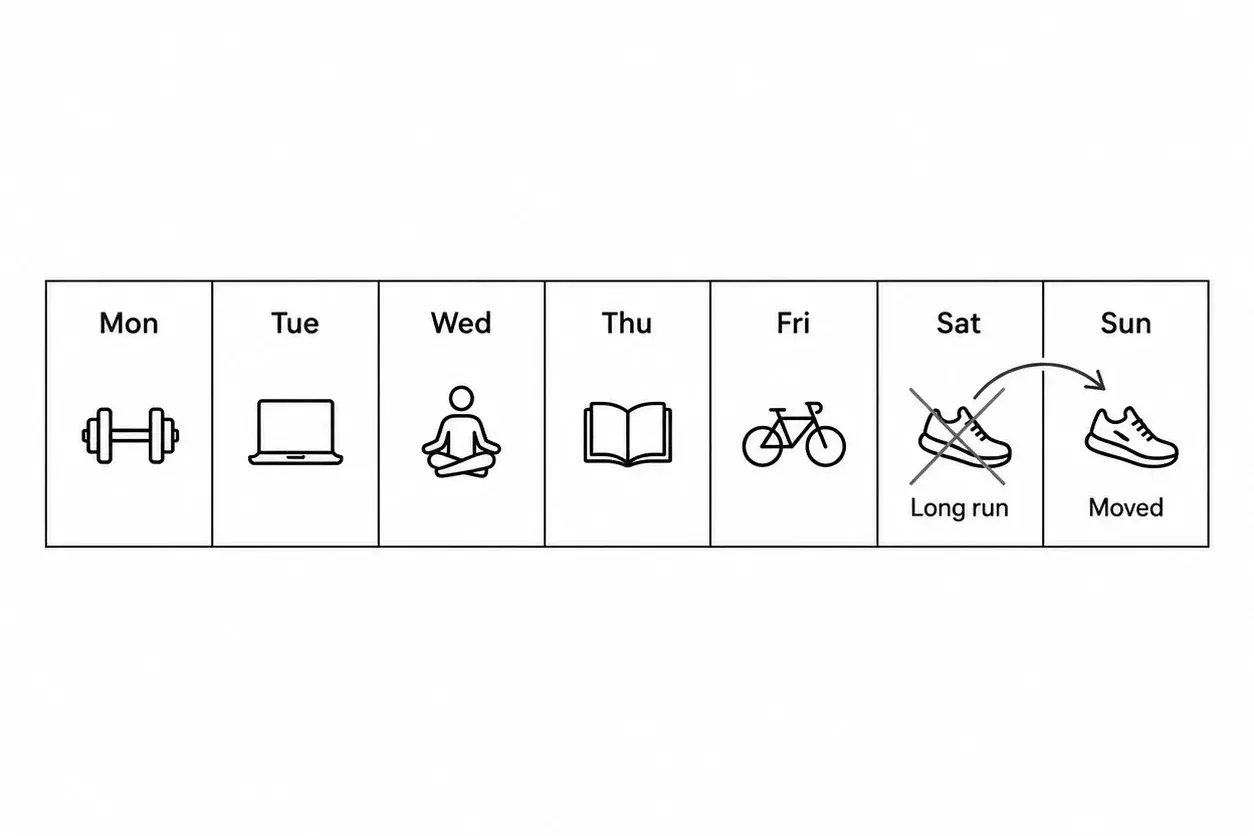
If you missed a long run, do not try to make it up by doubling the next one. Move it a day or two if your week allows, otherwise let it go and run the next long run as planned.
One long run is a small part of a marathon build. In a typical 16-week plan it is about 4% of your training distance, and the next long run already covers most of what you missed.
What happens if you skip a long run?
Very little, if it is one run. Fitness is built over weeks, not on a single Sunday. Research on detraining looks at stretches of insufficient training measured in weeks; Mujika and Padilla define short-term detraining as under 4 weeks of reduced training (Sports Medicine, 2000). A single skipped session is not that.

Here are the numbers from a real 16-week marathon plan: 4 running days a week, starting from 20 to 40 km (12 to 25 mi) a week.
| Distance | |
|---|---|
| All training before the taper (weeks 1 to 13) | 506.5 km (314.7 mi) |
| All long runs in those weeks | 215.6 km (134.0 mi) |
| The longest long run (week 11) | 20.6 km (12.8 mi) |
| Share of training distance if you miss it | 4.1% |
| Week 13 long run, still to come | 20.2 km (12.6 mi) |
Miss the biggest long run of the plan and the one 2 weeks later is only 0.4 km (0.2 mi) shorter. That is the counterintuitive part: the long run you missed matters less than the next one you run well.

Should you make up a missed long run?
Only if it fits without squeezing everything else. Use this table.
| Your situation | What to do |
|---|---|
| Missed it, and 2 or more easy days remain before your next quality session | Move it 1 or 2 days later, and drop an easy run that week |
| Missed it, no room this week | Skip it. Run next week as planned |
| Next week is a lighter week | Skip it. Keep the lighter week light |
| 3 weeks or less to race day | Let it go. The taper starts on schedule |
| Missed it to illness, back within a few days | Skip it. Start with 2 or 3 easy runs before the next long run |
| Missed a week or more | Repeat your last completed week, then build again |
| Missed the long run plus most of the week | Treat the week as lost; rejoin at the lighter of next week or your last completed week |
The one move that never works is stacking: running last week's long run and this week's long run within a few days, or adding the missed distance onto the next one. That turns one missed session into two hard weeks. A long run already needs 48 to 72 hours before the next hard session, which is why how to recover after a long run matters more than catching up.
Can I cut a long run short instead?
Yes, and it is often the better choice. A long run at 70% of the planned distance keeps the habit and the weekly rhythm. In the sample plan, 70% of the 20.6 km (12.8 mi) peak is 14.4 km (9.0 mi), still a solid run. Keep it at easy pace; shortening a run is not a reason to run it faster.
General training guidance, not medical advice. Check with a doctor before increasing training if you have symptoms or a health condition.
Coming back after being sick
If you missed runs because you were ill, getting well comes first. Fever, chest pain, shortness of breath or feeling faint are reasons not to run and to check with a doctor.

How to come back after missed runs
- Run 2 or 3 easy days first
Shorter than usual, at a pace where you can talk.
- Do the next long run only if those felt normal
If they did not, keep running easy and move the long run a week.
- Repeat your last completed week after a longer break
If you missed more than a week, repeat the last week you fully completed instead of jumping to where the plan says you should be.
- Do not add the missed distance anywhere
The missed kilometers are gone. The next long run as planned is enough.

The wall: a plan that can't see your week
All of this is simple on paper. In practice it means reworking your plan every time life happens: which week was the last you completed, which long run to skip, whether the lighter week still lands in the right place, whether the taper still starts 3 weeks out. A printed or PDF plan cannot do that. It doesn't move when your week does. The same problem hits every printed schedule, including the classic plans in Hal Higdon's marathon book.
That is the problem Raceblock is built around.
Free training plan
Build your free plan for your race date.
Pick your race and race date. Every week from today to race day is planned for you, with distances in km and miles.
Build your free plan for your race date. On the Coach plan, next week re-plans itself when you miss a run. It is built for Garmin and Apple Watch runners; see how Free and Coach compare, or how it stacks up as a Runna alternative.
Here is the full 16-week sample used in the numbers above, so you can see where each long run sits:
16-week marathon training plan
Every distance is in km and miles; every pace is per km and per mile. Lighter weeks are marked under the week number.
| Week | Mon | Tue | Wed | Thu | Fri | Sat | Sun | Total |
|---|---|---|---|---|---|---|---|---|
| Week 1Base | MonEasy5.8 km (3.6 mi)Conversational effort | TueEasy5.7 km (3.5 mi)Conversational effort | WedRest | ThuEasy5.7 km (3.5 mi)Conversational effort | FriRest | SatRest | SunLong12.8 km (8 mi)Conversational effort | Week total30 km (18.6 mi) |
| Week 2Base | MonEasy6.3 km (3.9 mi)Conversational effort | TueEasy6.3 km (3.9 mi)Conversational effort | WedRest | ThuEasy6.2 km (3.9 mi)Conversational effort | FriRest | SatRest | SunLong13.9 km (8.6 mi)Conversational effort | Week total32.7 km (20.3 mi) |
| Week 3Base | MonEasy6.9 km (4.3 mi)Conversational effort | TueEasy6.8 km (4.2 mi)Conversational effort | WedRest | ThuEasy6.8 km (4.2 mi)Conversational effort | FriRest | SatRest | SunLong15.1 km (9.4 mi)Conversational effort | Week total35.6 km (22.1 mi) |
| Week 4Base, lighter week | MonEasy6.2 km (3.9 mi)Conversational effort | TueEasy6.1 km (3.8 mi)Conversational effort | WedRest | ThuEasy6.1 km (3.8 mi)Conversational effort | FriRest | SatRest | SunLong13.6 km (8.5 mi)Conversational effort | Week total32 km (19.9 mi) |
| Week 5Build | MonEasy6.7 km (4.2 mi)Conversational effort | TueEasy6.7 km (4.2 mi)Conversational effort | WedRest | ThuEasy6.6 km (4.1 mi)Conversational effort | FriRest | SatRest | SunLong14.9 km (9.3 mi)Conversational effort | Week total34.9 km (21.7 mi) |
| Week 6Build | MonEasy7.3 km (4.5 mi)Conversational effort | TueEasy7.3 km (4.5 mi)Conversational effort | WedRest | ThuTempo7.3 km (4.5 mi)Comfortably hard | FriRest | SatRest | SunLong16.2 km (10.1 mi)Conversational effort | Week total38.1 km (23.7 mi) |
| Week 7Build | MonEasy8 km (5 mi)Conversational effort | TueEasy7.9 km (4.9 mi)Conversational effort | WedRest | ThuTempo7.9 km (4.9 mi)Comfortably hard | FriRest | SatRest | SunLong17.7 km (11 mi)Conversational effort | Week total41.5 km (25.8 mi) |
| Week 8Build, lighter week | MonEasy7.2 km (4.5 mi)Conversational effort | TueEasy7.1 km (4.4 mi)Conversational effort | WedRest | ThuEasy7.1 km (4.4 mi)Conversational effort | FriRest | SatRest | SunLong15.9 km (9.9 mi)Conversational effort | Week total37.3 km (23.2 mi) |
| Week 9Build | MonEasy7.8 km (4.8 mi)Conversational effort | TueEasy7.8 km (4.8 mi)Conversational effort | WedRest | ThuEasy7.8 km (4.8 mi)Conversational effort | FriRest | SatRest | SunLong17.3 km (10.7 mi)Conversational effort | Week total40.7 km (25.3 mi) |
| Week 10Build | MonEasy8.5 km (5.3 mi)Conversational effort | TueEasy8.5 km (5.3 mi)Conversational effort | WedRest | ThuTempo8.5 km (5.3 mi)Comfortably hard | FriRest | SatRest | SunLong18.9 km (11.7 mi)Conversational effort | Week total44.4 km (27.6 mi) |
| Week 11Peak | MonEasy9.3 km (5.8 mi)Conversational effort | TueEasy9.3 km (5.8 mi)Conversational effort | WedRest | ThuTempo9.2 km (5.7 mi)Comfortably hard | FriRest | SatRest | SunLong20.6 km (12.8 mi)Conversational effort | Week total48.4 km (30.1 mi) |
| Week 12Peak, lighter week | MonEasy8.4 km (5.2 mi)Conversational effort | TueEasy8.3 km (5.2 mi)Conversational effort | WedRest | ThuEasy8.3 km (5.2 mi)Conversational effort | FriRest | SatRest | SunLong18.5 km (11.5 mi)Conversational effort | Week total43.5 km (27 mi) |
| Week 13Peak | MonEasy9.1 km (5.7 mi)Conversational effort | TueEasy9.1 km (5.7 mi)Conversational effort | WedRest | ThuEasy9 km (5.6 mi)Conversational effort | FriRest | SatRest | SunLong20.2 km (12.6 mi)Conversational effort | Week total47.4 km (29.5 mi) |
| Week 14Taper | MonEasy6.9 km (4.3 mi)Conversational effort | TueEasy6.8 km (4.2 mi)Conversational effort | WedRest | ThuEasy6.8 km (4.2 mi)Conversational effort | FriRest | SatRest | SunLong15.1 km (9.4 mi)Conversational effort | Week total35.6 km (22.1 mi) |
| Week 15Taper | MonEasy5.1 km (3.2 mi)Conversational effort | TueEasy5.1 km (3.2 mi)Conversational effort | WedRest | ThuEasy5.1 km (3.2 mi)Conversational effort | FriRest | SatRest | SunLong11.4 km (7.1 mi)Conversational effort | Week total26.7 km (16.6 mi) |
| Week 16Taper, race week | MonEasy3.9 km (2.4 mi)Conversational effort | TueEasy3.8 km (2.4 mi)Conversational effort | WedRest | ThuEasy3.8 km (2.4 mi)Conversational effort | FriRest | SatRest | SunLong8.5 km (5.3 mi)Conversational effort | Week total20 km (12.4 mi) |
Race week. Keep the final week light. Start conservatively and adjust to conditions. Goal pace is a target, not a promised finish time.
- Easy
- Reduce load and keep movement comfortable.
- Rest
- Absorb training and recover for the next session.
- Long
- Build time on your feet without racing the session.
- Tempo
- Practice controlled quality with easy warm-up and cooldown.
General training guidance, not medical advice. Check with a doctor before increasing training if you have symptoms or a health condition.
The chart shows why one gap barely registers: the long runs climb in steps with lighter weeks between them, so the week after a missed run already sits close to where you would have been.
When a missed long run does matter

One missed long run rarely changes anything. A pattern does. If you have missed 3 or more long runs, or your longest run so far is well under the plan's peak with 4 weeks to go, look at the goal honestly. Options:
- Run the race for the finish and drop the time goal. Check a realistic pace on the marathon pace chart, and see what US marathon finishers average by age and gender if you want a landmark.
- Move to a later race if your entry allows it, and rebuild with a fresh plan.
- Switch to the half marathon if the event offers one. The half marathon training plans use a 2-week taper and a shorter long run.
Goal paces are targets, not promised finish times.
Missed a long run? Move it if the week has room, skip it if it doesn't, and let it go inside the last 3 weeks. Never double up. If you lost a week or more, restart from your last completed week.
If you are choosing a plan now, the 16-week marathon training plan is a full first-marathon block, the marathon training plan guide compares the other lengths, and our marathon taper guide covers the last 3 weeks.
And so you are not redoing this math every time a Sunday goes wrong, build your free plan for your race date. On the Coach plan, next week re-plans itself when you miss a run.
Frequently asked questions
Usually very little. In a 16-week plan, one long run is about 4% of your training distance, and the next long run covers most of it. Do not double the next one.
Yes. A few days off, whether planned or forced, will not undo weeks of training. Start back with easy runs and pick up the plan from there.
No. Research on detraining looks at stretches of weeks, not days. Run easy for your first day or two back, then continue the plan.
No. Inside the last 3 weeks, the taper matters more than the run you missed. Start the taper on schedule.
A short easy run 2 or 3 days out is normal in most tapers, for example 3 to 5 km (1.9 to 3.1 mi) easy. It keeps your legs moving without adding fatigue.
In Raceblock plans, the half marathon long run builds toward about 16 km (9.9 mi) for beginners and up to about 19 km (11.8 mi) for advanced runners, if your starting weekly distance and the weeks available allow it.
Free training plan
Build your free plan for your race date.
On the Coach plan, next week re-plans itself when you miss a run.
Share article
About the author
More running training guides

Marathon training · 11 min
Ultramarathon Training Tips: 12 Habits Beyond the Miles
The best ultramarathon training tips are about everything except the running: your stomach, your feet, your stops, the dark and the downhills. Here are 12, one job at a time.

Marathon training · 9 min
How Long Is a Marathon Run? 26.2 Miles, 42.2 km and Hours
A marathon run is 42.195 km (26.2 miles). See the exact distance, why your watch reads long, how many hours it takes at each pace, and how to plan for yours.

Marathon training · 12 min
Boston Marathon Training Guide: Hills, Downhills and Pacing
To train for the Boston Marathon, run a normal 16 to 18 week marathon build and add two things: downhill running for your quads and a patient first half. Here is the block for April 19, 2027, the hill work, a peak week and a pacing plan.

Marathon training · 10 min
Marathon: The Ultimate Training Guide Review and Plan Picker
Hal Higdon's Marathon: The Ultimate Training Guide is worth reading for the rules behind its plans: pick a program by your running today, protect the long run, step back every third week. Here is what it covers, which program fits you, and how to keep a printed plan working when your week changes.

Marathon training · 11 min
Ultra Marathon Training Guide: First 50K Schedule and Tips
To train for your first ultra marathon, take a marathon build and change three things: train in hours on your feet, add back-to-back long runs, and practice walking the hills and eating on the run. Here is a 16 week 50K schedule by phase, a typical week, the fueling math and the mistakes that cost the most.

Marathon training · 13 min
Marathon Training Routine: Build a Week You Can Repeat
A good marathon training routine fixes two days, the long run and one quality session, and keeps everything else easy. Here is the weekly structure for 3, 4 or 5 runs, where strength and rest go, and how to fit it around work.