
Side Stitch When Running: What Causes It and How to Stop It
Raceblock team November 12, 2026 11 min read
Free training plan for your race date
Free training plan for your race date
Build my free planIn this article
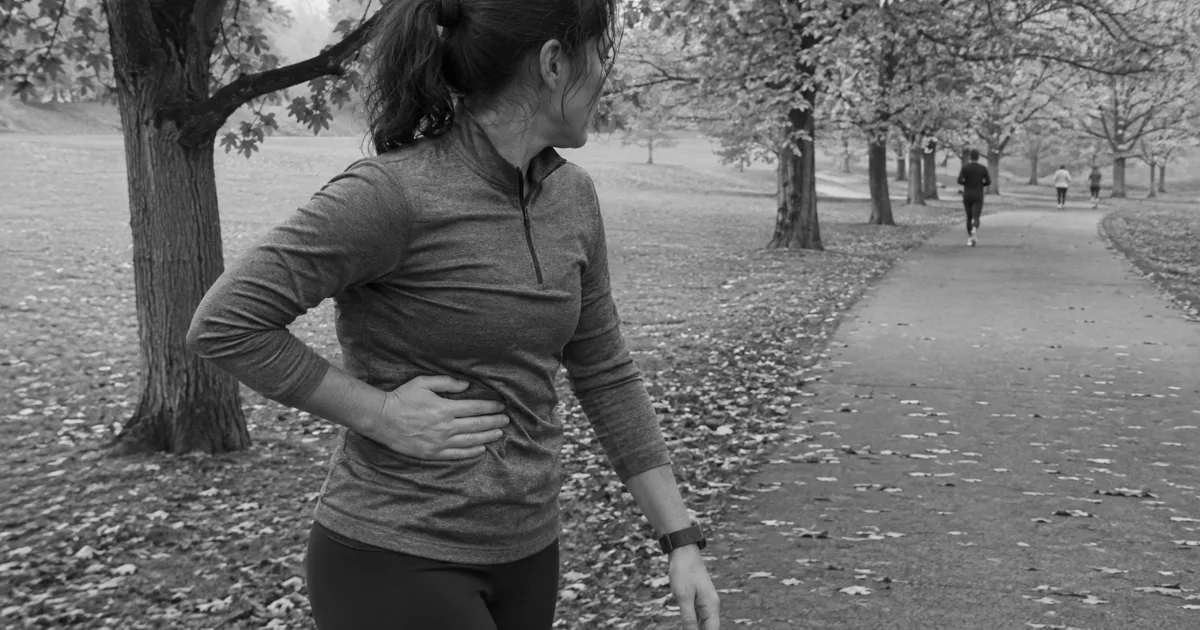
A side stitch when running is a sharp pain just under the ribs, usually on one side, that comes on mid-run and fades within minutes once you slow down. To stop one, ease off or walk, breathe out slowly, and press your fingers into the sore spot while bending a little toward it. To prevent the next one, look at what you ate and drank in the 2 hours before the run before you change anything else.
That last point is the one most runners miss. A stitch is not a sign that you are short of oxygen or unfit. The best current explanation is irritation of the lining of the belly wall, and a full stomach jolting with every step is one of the surest ways to set it off.
What causes a side stitch when running?
Nobody has proven a single cause, but the leading explanation is irritation of the parietal peritoneum, the thin lining on the inside of your belly wall. When your stomach is full, or your torso bounces and twists with every stride, that lining rubs and stretches, and it is sensitive enough to register as a sharp, well-placed pain.
The largest review of the research, by Morton and Callister, looked at the older theories too: a cramping diaphragm, stretched ligaments that hold your organs up, a cramp in the abdominal muscles, and less blood reaching the gut. Irritation of the peritoneum explained the pattern best, though the authors say more work is needed (Morton and Callister, Sports Medicine, 2015).
That same review gives a few facts that matter for runners:
- About 70% of runners report a stitch in the past year.
- In a single running event, about one in five runners gets one.
- Eating or drinking shortly before running makes it worse, and sugary, concentrated drinks are the worst offenders.
- It is most common in younger runners and has nothing to do with sex or body type.
- Fit runners still get stitches, just less often.
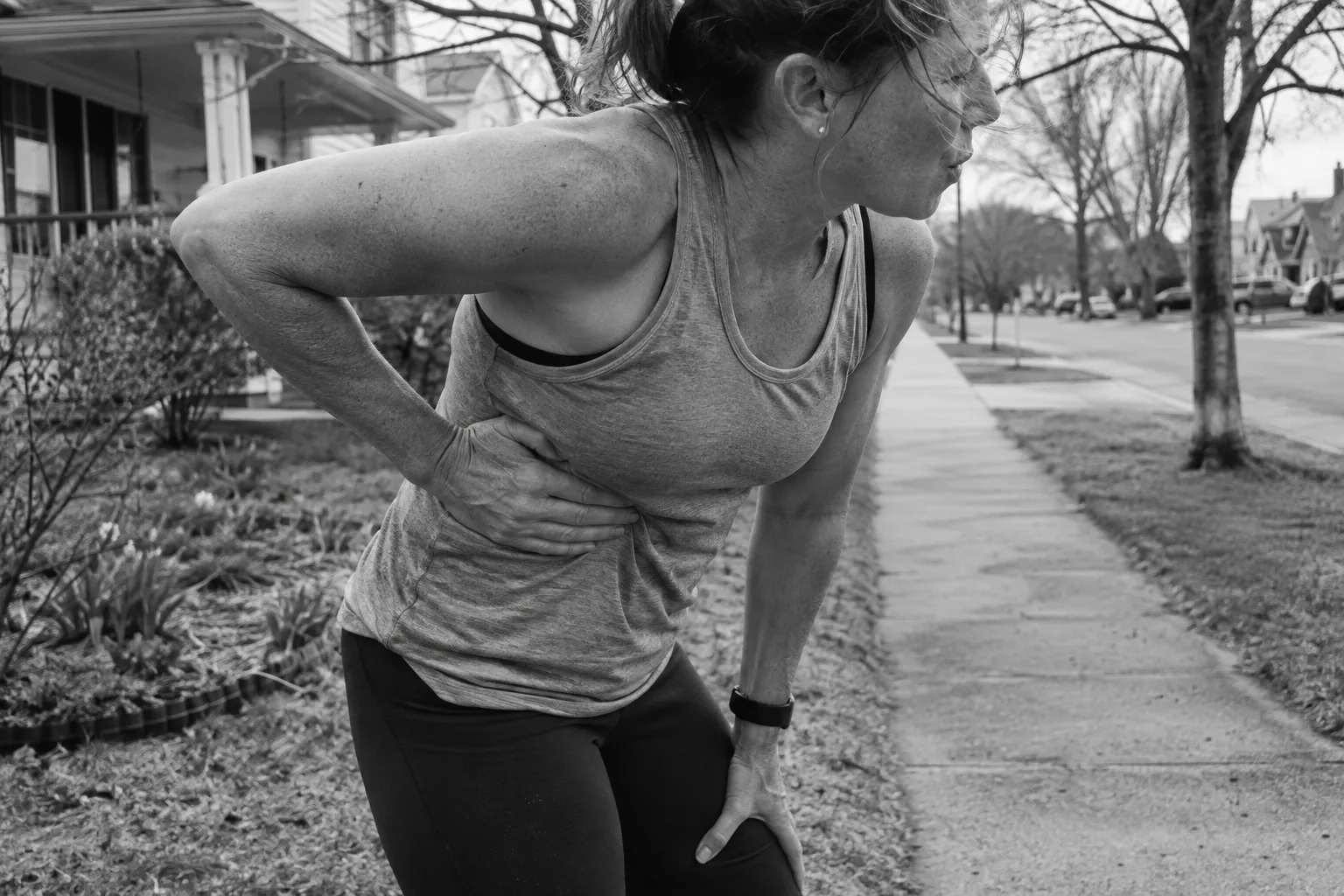
Running is a prime sport for stitches because it combines an upright torso with constant up and down jolting. In a survey of 965 regular sports people, 69% of runners and 62% of horse riders had had one in the past year, against 32% of cyclists, who sit still on the bike (Morton and Callister, Medicine and Science in Sports and Exercise, 2000). Swimmers, with lots of twisting, reported them most.
Which side is a side stitch on?
It can sit on either side, just under the ribs. Most people in that 2000 survey placed it in the left or right side of the belly, rather than the middle. Some also feel a strange ache at the tip of the shoulder at the same time, which fits with irritation near the diaphragm. Either side is normal for a stitch.
How to get rid of a side stitch while running
You get rid of a side stitch by taking away what triggers it: the jolting and the effort. Slow down, then work through the steps below. None of these has strong research behind it, but they are what most runners find works, and they cost nothing to try.
How to get rid of a side stitch while running
- Slow down or walk
Drop to an easy jog or a brisk walk. Less bounce means less tugging on the sore spot. On race day, a 1 to 2 minute walk costs far less time than running bent over for 3 km (1.9 mi).
- Breathe out slowly and fully
Take a deep breath in, then breathe out long and slow through pursed lips, as if blowing through a straw. Some runners time the out breath to land on the foot opposite the stitch.
- Press into the sore spot
Push two or three fingers firmly into the painful spot under your ribs and hold the pressure for 20 to 30 seconds while you walk.
- Bend toward the stitch
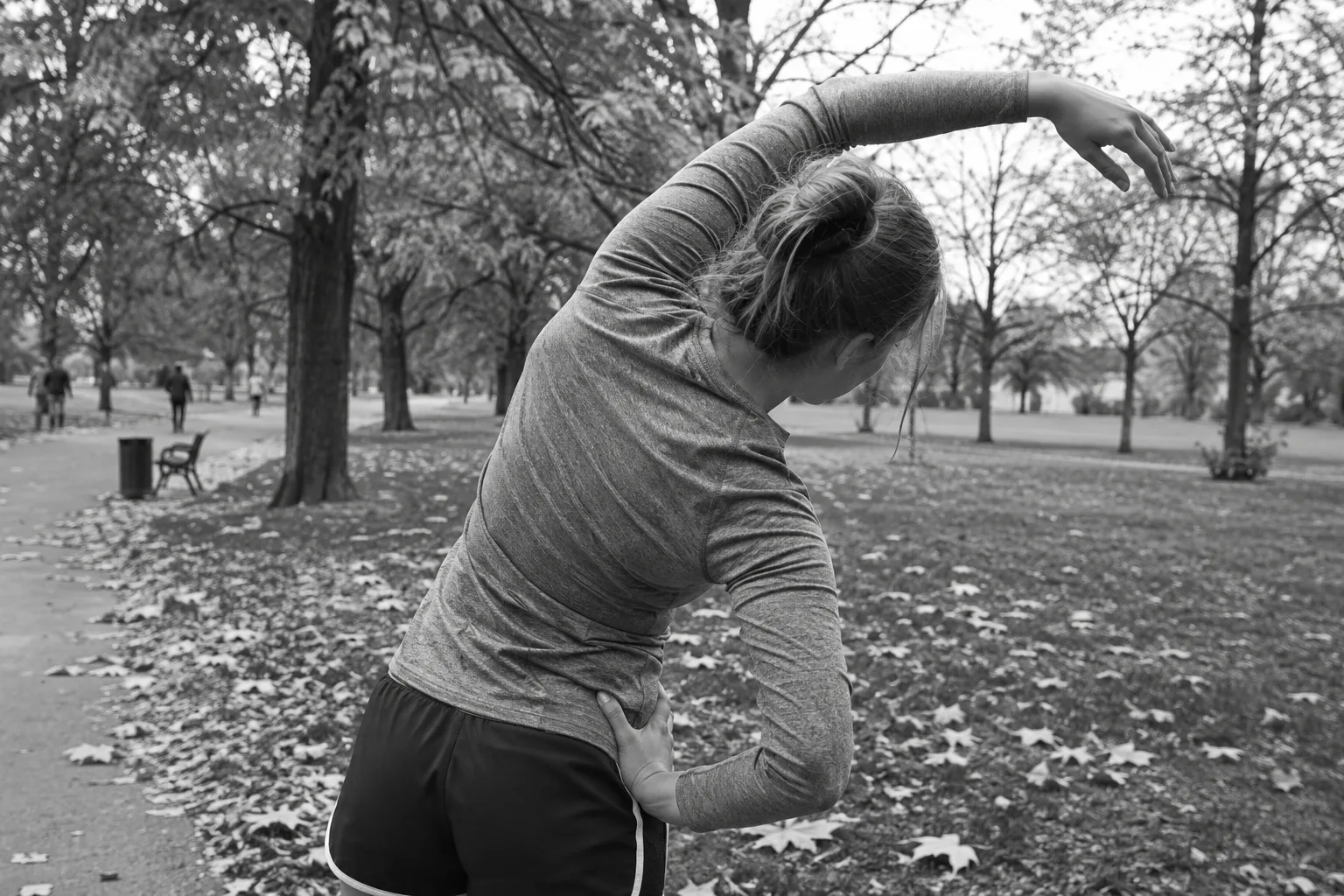
Lean forward a little, or bend your upper body toward the painful side, and hold it for a few breaths. Then stand tall and stretch the opposite arm overhead.
- Ease back in
Once the pain fades, build back up to your pace over 2 or 3 minutes instead of jumping straight back to it.

Most stitches fade within a few minutes of easing off. Some ache lightly for a while afterwards, and that is common too. What is not normal is pain that keeps getting worse after you stop, pain in the chest, pain spreading to the arm or jaw, dizziness or vomiting. Any of those means stop running and see a doctor.
How to prevent a side stitch when running
The strongest lever you have is what goes into your stomach before a run. The other three are how fast you start, how you hold your upper body, and how strong your trunk is. In that order.
1. Leave 2 hours after a meal
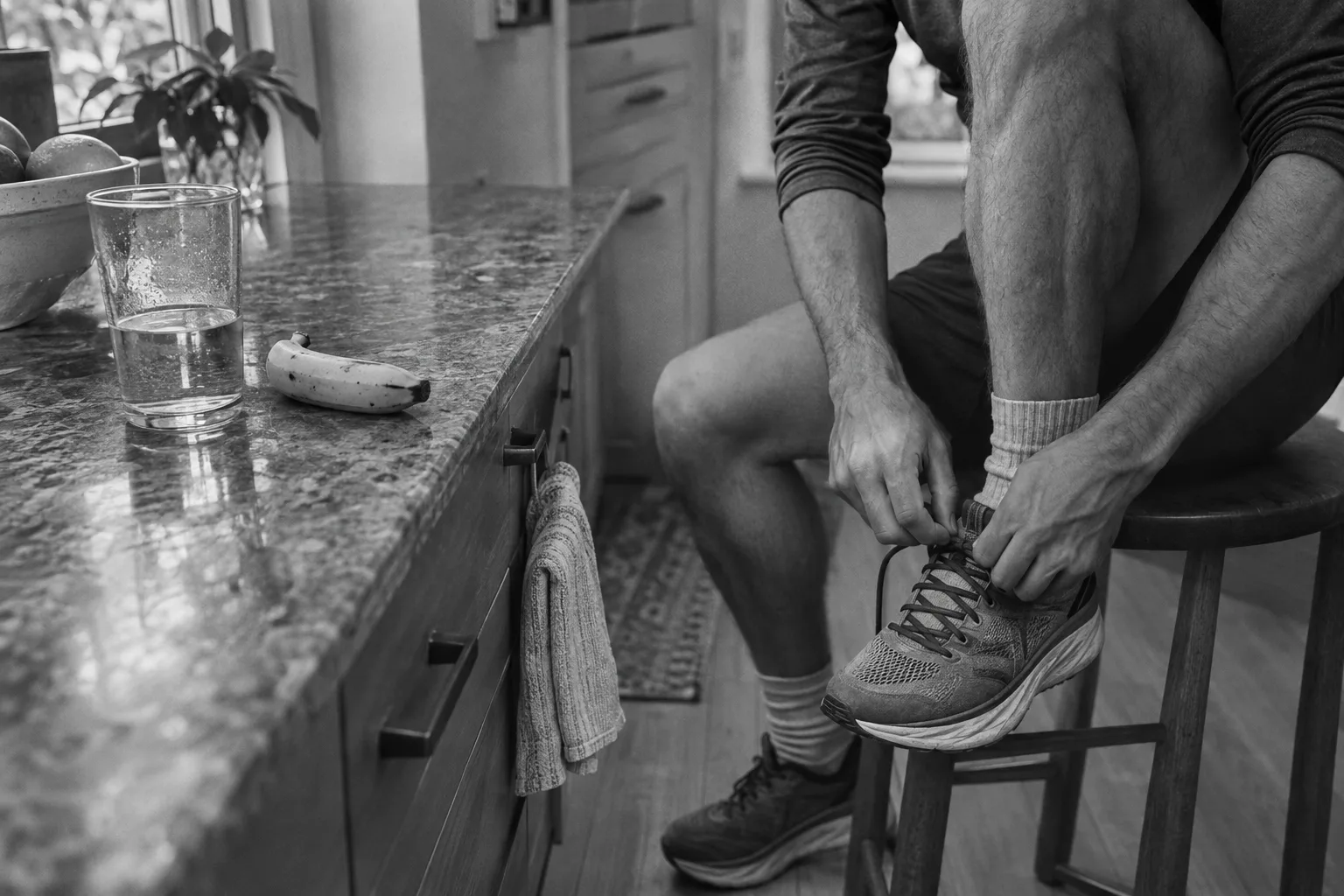
Big meals and big drinks right before running are the most reliable trigger. Leave about 2 hours after a full meal, and keep anything closer to the run small and plain, such as half a banana or a slice of toast. If you want a full timing guide, the pre-run eating table breaks it down by how long you have before you head out.
2. Sip, don't gulp, and go easy on sugary drinks
Concentrated, sugary drinks (fruit juice, soda, strong sports mixes) were the most provocative drinks in the research. Plain water in small sips is the safest choice before and during a run. If you need carbs on a long run, take small amounts often rather than a big bottle in one go.

3. Start slower than feels necessary
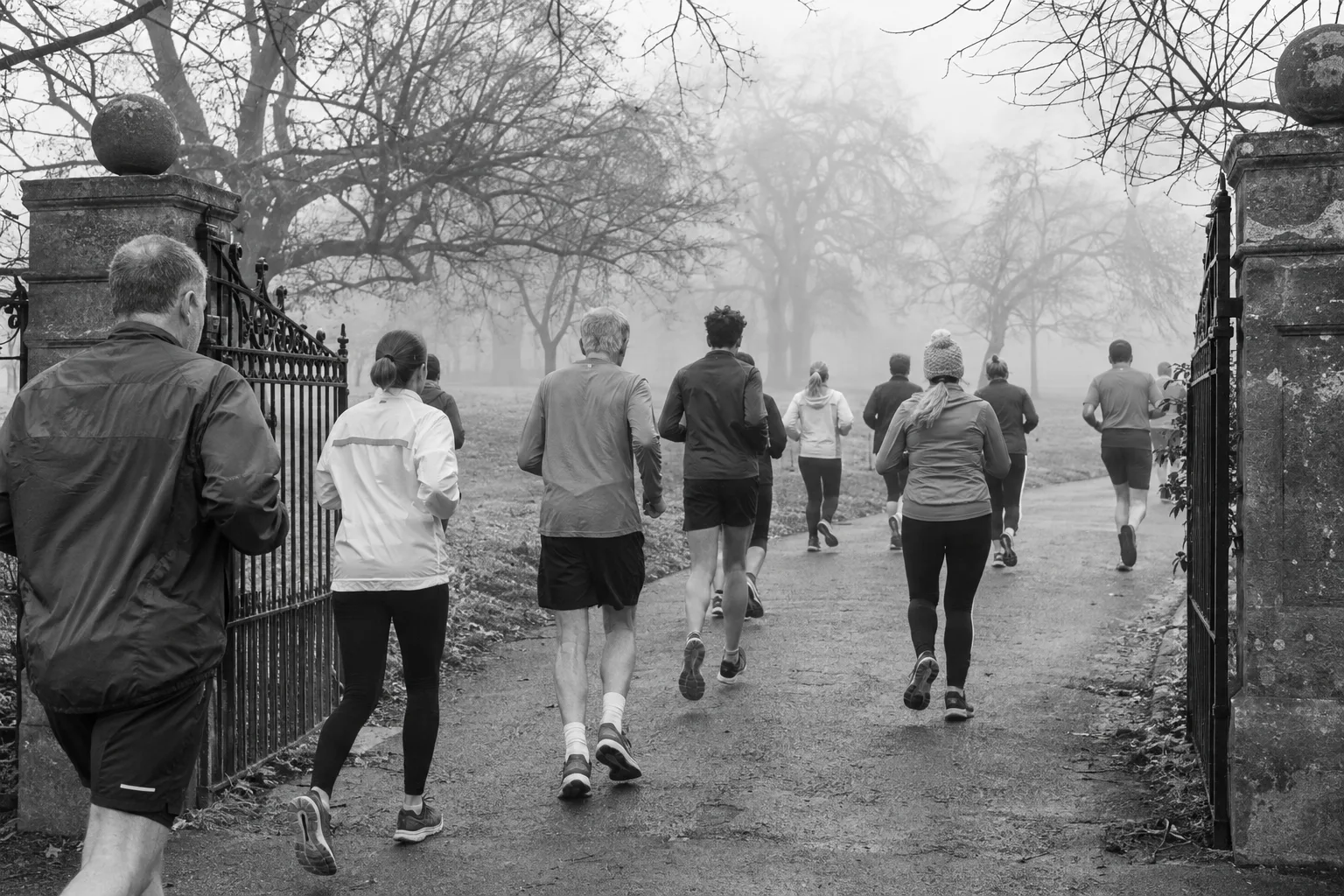
Going out too fast is a common trigger, and the first 10 minutes are where most runners overdo it. Run the first 1 to 2 km (0.6 to 1.2 mi) at a properly easy pace, slow enough to talk in full sentences. If you are not sure what that pace is for you, our guide to pace when running shows how to find your easy pace. A short warm-up before running does the same job before harder sessions.
4. Stand tall and strengthen your trunk
The review lists better posture, especially in the upper back, and a stronger trunk among the common prevention ideas. Run tall, with your chest open and shoulders relaxed rather than hunched, as described in our running form guide. Add two short sessions of planks, side planks and side bends a week. These help your running anyway, even if the stitch link is not proven.
Side stitch by situation: what to try first
Runners do not all get stitches in the same place or for the same reason. Find yours below.
| When it hits | Most likely trigger | What to try first |
|---|---|---|
| First 10 minutes of a run | Starting too fast | Open with 1 to 2 km (0.6 to 1.2 mi) at easy pace |
| Within an hour of eating | Full stomach | Leave about 2 hours after a meal; small snack only |
| After a sports drink or juice | Sugary, concentrated drink | Switch to water in small sips |
| Downhill or on fast intervals | Extra jolting of the torso | Shorten your stride, slow the descent |
| Race day, mid-race | Fast start, nerves, gels taken in one go | Walk 1 to 2 minutes, then ease back in; take fuel in small amounts |
| Every run, whatever you do | Not clear | See a doctor or physio to rule out anything else |
Is a side stitch the same as a muscle cramp?
Not quite. A muscle cramp is a muscle locking up, often in the calf or the abdominal wall, and you can usually feel the muscle tighten. A stitch is a sharp, local pain under the ribs that eases when you slow down. They can feel alike, and the research has never settled on one cause, so the label matters less than the fix: slow down, breathe out, press and stretch.
Is a side stitch a breathing problem?
Not mainly. Breathing hard is a sign you started too fast, which is a real trigger, but the research does not point to a lack of oxygen as the cause. If you often feel out of breath, the breathing while running guide covers the talk test and step rhythms that fix most of it.
Side stitch mistakes that cost you
- Running through it at full pace. It rarely fades while you keep bouncing at the same speed, and you end up running bent over and slower anyway.
- Eating a big meal an hour before. The single most common trigger, and the easiest to fix.
- Chugging a sports drink on the start line. A big volume of sugary liquid sloshing around is a classic recipe for a stitch.
- Racing the first kilometer. On a long run or race, a fast first 1 km (0.6 mi) buys you nothing and often costs you a walking break later.
- Assuming every side pain is a stitch. Pain that does not ease when you stop, or comes with fever, vomiting, chest pain or dizziness, is not something to train through. See a doctor.
Stitches and your training plan
Well trained runners still get stitches, but the research suggests they get them less often. The steady fix is consistent easy running, week after week, with the long run built up slowly. That is what a structured half marathon training plan or marathon training plan does for you.
The wall comes when your week stops matching the paper. A stitch that turns a long run into a walk, a cold, a work trip: a fixed plan does not move when your week does, so you either skip the session or cram it in and run tired. Our guide to a missed long run shows what to do by hand.
Build your free plan for your race date. On the Coach plan, next week re-plans itself when you miss a run.
Free training plan
Build your free plan for your race date.
Pick your race and race date. Every week from today to race day is planned for you, with distances in km and miles.
General training guidance, not medical advice. Check with a doctor before increasing training if you have symptoms or a health condition.
A side stitch when running is common, harmless in most cases and usually gone within minutes. Slow down, breathe out long, press into the spot and bend toward it. Then fix the cause, in this order: eat earlier, drink in sips, start slower, and run tall.
If stitches keep stopping your long runs, build your free plan for your race date so the easy miles that make them rarer are already in your week.
Frequently asked questions
The cause is not fully proven. The leading explanation is irritation of the peritoneum, the lining inside the belly wall, made worse by a full stomach and the jolting of each stride. Eating or drinking a lot in the 2 hours before running is the clearest trigger.
Most side pain that comes on mid-run and eases when you slow down is a stitch. The usual triggers are a recent meal or sugary drink, starting too fast, and lots of torso bounce on downhills or fast running. Eat earlier, sip water and start easy.
A muscle strain or cramp in the abdominal wall, rib or back pain, or gut problems can feel similar. A stitch eases within minutes of slowing down. Pain that keeps getting worse, comes back on every run, or comes with chest pain, fever, vomiting or dizziness needs a doctor to check it.
Cramps lower in the belly, often with an urge to find a toilet, are usually a gut issue rather than a stitch. They are often linked to what and when you ate, especially high fiber or fatty food, and to running hard. Eating earlier and keeping the pre-run meal plain is the first thing to try.
Runner's gut is the everyday name for stomach and bowel trouble during or after running: cramps, bloating, nausea or a sudden need for the toilet. It is different from a stitch, which sits under the ribs. If it is frequent or severe, see a doctor.
It usually means the 80/20 approach: about 80% of your running at an easy, conversational effort and about 20% harder. Keeping most runs easy also helps with stitches, because easy pace means less jolting and less temptation to start too fast.
Free training plan
Build your free plan for your race date.
On the Coach plan, next week re-plans itself when you miss a run.
Share article
About the author
More running training guides

Running basics · 12 min
What Is a Recovery Run? Pace, Length and When to Skip It
A recovery run is a short, very easy run you do the day after a long run or hard session. Here is how slow to run it, how long, how it differs from an easy run and a rest day, where it fits in a half or marathon week, and when to skip it.
Running basics · 10 min
10K Beginner Training Schedule: 10 Weeks From Run-Walk
A 10k beginner training schedule for runners starting from run-walk: 10 weeks, three timed sessions a week, a long session that grows to about 70 minutes, the paces behind common finish times and how to adjust the plan to your week.
Running basics · 11 min
10K Training Routine: 3 Runs a Week for 8 Weeks
A 10k training routine is three runs a week on fixed days: one easy run, one faster session and a long run that builds to the full 10 km (6.2 mi) at an easy pace. Here is the weekly layout, the 8-week schedule, the paces and the mistakes that break it.

Running basics · 11 min
5K Training Routine: The Weekly Schedule to Repeat
A good 5K training routine is three or four runs a week on fixed days: one key session, one longer easy run and easy running in between. Here are both weekly layouts, your paces, an 8-week schedule and the mistakes that stall it.
Running basics · 11 min
Interval Training Plan for Running: 8 Weeks With Paces
A simple 8-week interval training plan for running: one session a week at 5 km to 10 km effort, with paces per km and per mile, jog recoveries, a sample week and how to adjust it for a half marathon, a marathon or a comeback.
Running basics · 10 min
Running in the Heat: 9 Tips to Train Safely All Summer
Running in the heat tips that work: run early, run by effort instead of pace, drink and add salt on long runs, adapt over two weeks, and know the warning signs that mean stop.