
How to Breathe While Running: The Talk Test, Rhythm and Belly Breathing
Raceblock team Updated November 12, 2026 11 min read
Free training plan for your race date

Free training plan for your race date
Build my free planIn this article
To breathe well while running, slow down until you can speak in full sentences, breathe through your mouth and nose together, and let your breath fall into a steady rhythm with your steps, about 3 steps in and 3 steps out on easy runs. Most runners who feel out of breath don't have a breathing problem. They have a pace problem.
That is the one thing to take from this guide. Breathing drills help a little. Running your easy days truly easy helps far more, and it is the part almost everyone skips.
Why you get out of breath when you run
You get out of breath because you are asking for more oxygen than your current fitness can deliver at that pace. Your breathing speeds up to keep pace with the demand, and once you pass a certain effort it can't catch up any more.
That point has a name: the ventilatory threshold. Below it, breathing feels busy but under control. Above it, breathing gets ragged and you can only hold on for a limited time. New runners hit it at a jog. Fitter runners hit it much later, which is why the same route feels so different after a few months of training.
So the first fix is not a technique. It is the pace. A runner who starts every run at a "good workout" effort will feel short of breath every single time, whatever they do with their nose or mouth.
The talk test: the easiest way to control your breathing
The talk test is simple: on an easy run, you should be able to say a full sentence out loud without gasping between words. If you can't, slow down until you can, even if that means walking for a minute.
It works better than it sounds. In a study at the University of Wisconsin La Crosse, the point where people could no longer speak comfortably matched their ventilatory threshold closely, even after their fitness changed (Foster et al., 2008). In plain words: if you can talk, you are below the line where breathing gets out of hand.

This matters most for long run and easy days, which should be most of your week. If you follow a marathon training plan or a half marathon training plan, the easy runs are meant to feel conversational. Running them too fast is the most common reason runners say they "can't breathe" on runs that should feel comfortable.
Breathing rhythm: how many steps per breath?
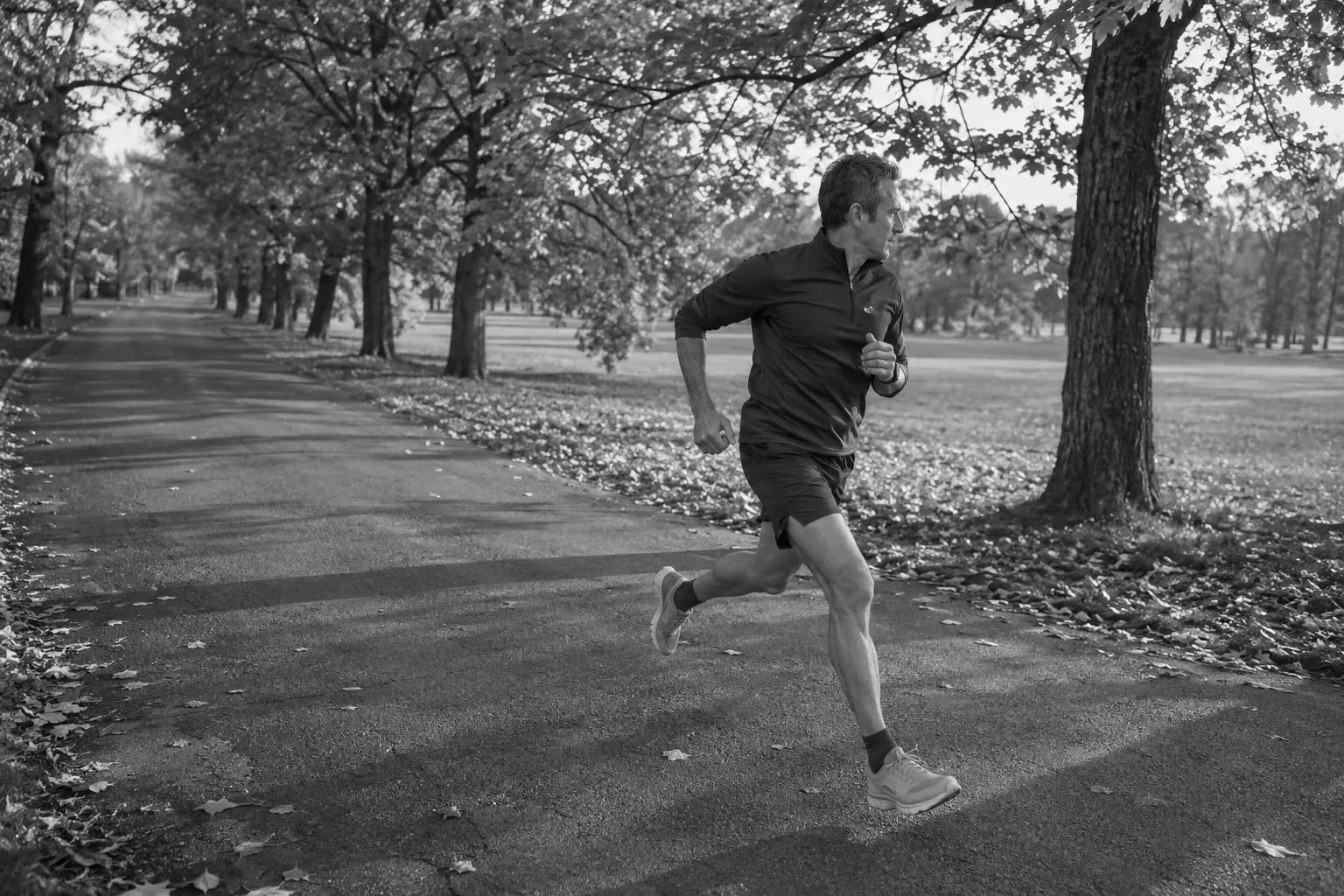
Count your steps against your breaths. On easy runs most people settle into about 3 steps while breathing in and 3 steps while breathing out (3:3). As the effort rises, it tightens to 2:2, and in a hard finish it may drop to 2:1 or 1:1.
You don't invent this rhythm, you notice it. Researchers who filmed runners found humans lock their breathing to their stride in several patterns, with 2 strides per breath the most common one (Bramble and Carrier, Science, 1983). A stride is two steps, so that is the familiar 2 steps in, 2 steps out.
| Run type | Rhythm (steps in : steps out) | Talk test | Nose or mouth |
|---|---|---|---|
| Very easy, recovery | 4:4 or 3:3 | Full sentences, could chat for an hour | Nose alone is possible |
| Easy run, long run | 3:3 | Full sentences | Nose and mouth together |
| Marathon pace | 3:3 or 2:2 | Short sentences | Mouth and nose |
| Tempo run | 2:2 | A few words at a time | Mouth, nose joins in |
| Hills, intervals | 2:2 or 2:1 | One or two words | Mouth |
| Final sprint | 1:1 | No talking | Mouth |
Use the table as a check, not a rule to force. If your easy run is already at 2:2, the answer is to run slower, not to stretch your breath to 3:3 at the same pace.
Some coaches teach an odd rhythm, such as 3 steps in and 2 steps out, so the exhale lands on the left foot one breath and the right foot the next. It can feel smooth and some runners like it. The evidence that it changes anything else is thin, so try it if you're curious and drop it if it feels forced.
Should you breathe through your nose or mouth when running?
Breathe through both. Your nose warms and filters the air, but it can't move enough air once the pace picks up, so your mouth takes over naturally. Forcing nose-only breathing on a tempo run just makes you slower.
Nose breathing is a good tool at very easy effort. If you can run with your mouth closed, you are almost certainly at easy pace. Some runners use it on recovery days as a built-in speed limit. On anything faster, open your mouth and keep your jaw relaxed.
How to belly breathe while running
Belly breathing (diaphragmatic breathing) means your belly moves out as you breathe in, instead of your shoulders and upper chest lifting. It lets you take a fuller breath with less effort, and it keeps your shoulders from creeping toward your ears.
Practise it lying down first, because it is hard to learn on the move.
How to practise belly breathing for running
- Lie on your back
Lie on the floor or grass with your knees bent and feet flat. Put one hand on your chest and one on your belly.
- Breathe in through your nose
Breathe in slowly for about 4 counts. The hand on your belly should rise; the hand on your chest should barely move.
- Breathe out slowly
Breathe out through your mouth for about 4 to 6 counts and feel the belly fall. Repeat for 5 minutes, once a day.
- Take it onto an easy run
On your next easy run, drop your shoulders, breathe out fully, and let the belly do the work. Check in once every kilometer (0.6 mi) at first.

Breathing by situation: what to do on each kind of run
Runners don't all struggle in the same place. Find your situation below and start there.
You are new to running
Walk breaks are not cheating. If you are breathless within the first 2 km (1.2 mi), alternate a few minutes of running with a minute of walking and keep the running slow enough to talk. Your breathing adapts as your fitness does, usually over weeks, not days. The guide to a marathon training routine shows how easy days fit around the rest of the week. For a week-by-week run-walk build from 20 to 40 minutes, see our guide on how to run longer without getting tired.
You are training for a marathon or half marathon
Your breathing is a pacing tool. On long runs, the talk test keeps you honest. At marathon pace you should still manage short sentences; if you can't, your goal pace may be too ambitious for now. Check the numbers on the marathon pace chart, or estimate a realistic goal from a recent race with the race time predictor. Goal pace is a target, not a promised finish time.
Hills and intervals
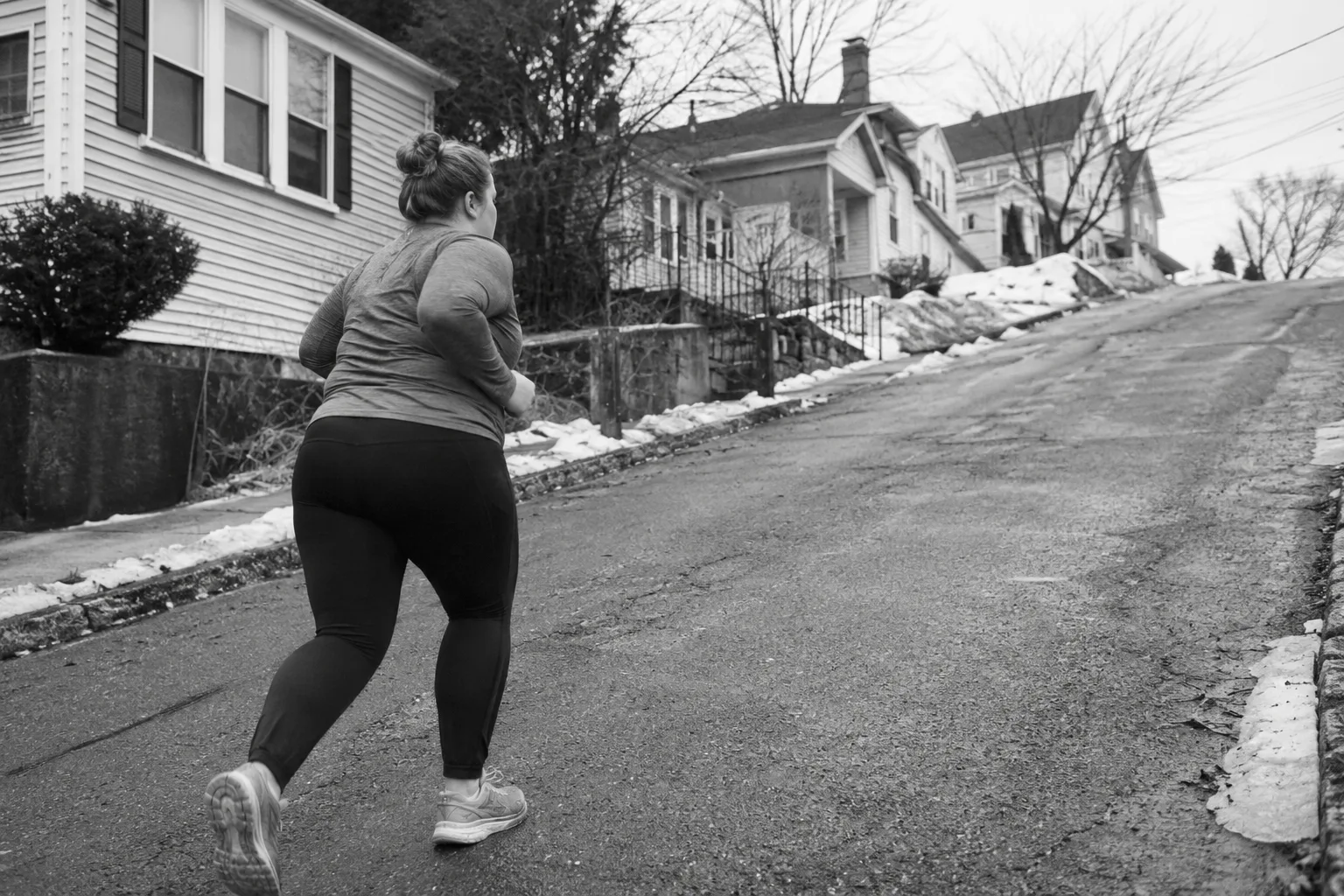
Breathing hard is the point of these sessions. Shorten your stride on hills, keep your chest up, and let the rhythm drop to 2:2 without fighting it. Breathe out firmly; a full exhale makes room for the next breath in. Between intervals, slow the breath down on purpose: long exhales during the recovery jog. A tall posture with low shoulders gives your lungs room, and our running form checklist covers head, arms and feet.
Tempo runs and race day
On a tempo run or in a race, settle into 2:2 early and hold it. Ragged breathing in the first 10 minutes of a race almost always means you started too fast. Ease off for 300 to 400 m (a quarter mile or so), let the rhythm come back, then hold the pace you can breathe at.

Cold air
Cold, dry air can make breathing feel sharp. A light buff or scarf over your mouth warms the air a little. Start slower than usual and let the first 10 minutes be your warm-up. If cold air brings on coughing or wheezing that doesn't settle, see a doctor.
Side stitches and breathing
A side stitch is a sharp pain under the ribs, often on the right side. Nobody fully agrees on the cause, but shallow, fast breathing and starting too quickly are common triggers.
When one hits, slow down or walk, breathe out slowly and fully, and press your hand gently into the sore spot. Most stitches fade in a few minutes, and our full guide to what causes a side stitch covers how to prevent the next one. Avoid a big meal in the 2 hours before a run if they keep coming back, and use this pre-run eating timing table to pick a smaller, earlier snack.

Breathing mistakes that cost you
- Running easy days too fast. This is the big one. Breathing feels hard because the pace is hard.
- Shallow chest breathing. Shoulders up, quick little breaths. You get less air for more work.
- Holding your breath. It happens on hills and when you concentrate. Breathe out on purpose.
- Forcing nose-only breathing at speed. It caps how much air you get. Open your mouth.
- Fighting the rhythm. Let it tighten as the effort rises; don't stretch it back to 3:3 by willpower.
- Ignoring warning signs. Chest pain, wheezing, dizziness or breathlessness that is out of proportion to the effort means stop and see a doctor. If you have asthma or a heart or lung condition, talk to a professional about how hard to train.
Building fitness is the long-term fix
Breathing gets easier as you get fitter, and fitness comes from consistent easy running stacked week after week, with a little harder work on top. That is why every good plan is mostly easy miles. A 16-week marathon training plan, for example, keeps most runs conversational and builds the long run slowly.
The plan only works if you actually run it, though. A sick week, a work trip or a missed long run is where most plans fall apart: the paper schedule doesn't move when your week does, so you either skip the session or cram it in and run tired.
Build your free plan for your race date. On the Coach plan, next week re-plans itself when you miss a run.
Free training plan
Build your free plan for your race date.
Pick your race and race date. Every week from today to race day is planned for you, with distances in km and miles.
General training guidance, not medical advice. Check with a doctor before increasing training if you have symptoms or a health condition.
Breathing well while running comes down to three things, in this order: run slow enough to talk on easy days, breathe through your mouth and nose from the belly, and let your breath settle into a rhythm with your steps. Fix the pace first and most breathing problems fix themselves.
When you're ready to put it into a full training block, build your free plan for your race date and let the easy days do the work.
Frequently asked questions
Slow down until you can speak a full sentence, then match your breathing to your steps: about 3 steps in and 3 steps out on easy runs. Breathe from your belly, drop your shoulders and breathe out fully.
Both together. Nose-only breathing works at very easy effort, but your mouth needs to open as the pace rises so you can move enough air.
Lie on your back with one hand on your chest and one on your belly. Breathe in through your nose so only the belly hand rises, then breathe out slowly. Practise for 5 minutes a day, then use it on easy runs.
Your lungs themselves change little with training. What improves is your aerobic fitness and the strength of your breathing muscles, and that comes from consistent easy running over weeks and months. Running easier, more often, is the most reliable route.
It usually refers to the 80/20 approach: about 80% of your running at an easy, conversational effort and about 20% harder. The easy 80% is exactly where the talk test applies.
It is a relaxation exercise: breathe in for 4 counts, hold for 7 and breathe out for 8. It is not a running rhythm, but some runners use it to calm nerves before a race or to wind down after a hard session.
Free training plan
Build your free plan for your race date.
On the Coach plan, next week re-plans itself when you miss a run.
Share article
About the author
More running training guides

Running basics · 12 min
What Is a Recovery Run? Pace, Length and When to Skip It
A recovery run is a short, very easy run you do the day after a long run or hard session. Here is how slow to run it, how long, how it differs from an easy run and a rest day, where it fits in a half or marathon week, and when to skip it.

Running basics · 10 min
10K Beginner Training Schedule: 10 Weeks From Run-Walk
A 10k beginner training schedule for runners starting from run-walk: 10 weeks, three timed sessions a week, a long session that grows to about 70 minutes, the paces behind common finish times and how to adjust the plan to your week.

Running basics · 11 min
10K Training Routine: 3 Runs a Week for 8 Weeks
A 10k training routine is three runs a week on fixed days: one easy run, one faster session and a long run that builds to the full 10 km (6.2 mi) at an easy pace. Here is the weekly layout, the 8-week schedule, the paces and the mistakes that break it.

Running basics · 11 min
5K Training Routine: The Weekly Schedule to Repeat
A good 5K training routine is three or four runs a week on fixed days: one key session, one longer easy run and easy running in between. Here are both weekly layouts, your paces, an 8-week schedule and the mistakes that stall it.
Running basics · 11 min
Interval Training Plan for Running: 8 Weeks With Paces
A simple 8-week interval training plan for running: one session a week at 5 km to 10 km effort, with paces per km and per mile, jog recoveries, a sample week and how to adjust it for a half marathon, a marathon or a comeback.

Running basics · 10 min
Running in the Heat: 9 Tips to Train Safely All Summer
Running in the heat tips that work: run early, run by effort instead of pace, drink and add salt on long runs, adapt over two weeks, and know the warning signs that mean stop.