
Marathon Taper: A 3-Week Plan With Real Weekly Mileage
Raceblock team Updated November 4, 2026 9 min read
Free marathon plan for your race date

Free marathon plan for your race date
Build my free planIn this article
A marathon taper is the last 3 weeks before race day, when you cut your weekly distance by about a quarter, then nearly half, then close to 60%, while keeping some goal-pace running in every week. For a half marathon, the same idea runs over 2 weeks.
The mistake most first-timers make is cutting everything at once. Volume comes down. Intensity and the number of runs per week mostly stay.
What is a marathon taper?
A taper is a planned drop in training load before a race, so you arrive rested without losing the fitness you built. The research is clearer here than on most running topics.
A 2007 meta-analysis of 27 studies on competitive athletes found the best results came from a taper of about 2 weeks in which training volume dropped by 41 to 60%, with intensity and training frequency left alone (Bosquet et al., Medicine and Science in Sports and Exercise). Marathon plans usually stretch that to 3 weeks because the longest run of the cycle sits 3 weeks out and your legs need that extra week to absorb it.
So the rule of thumb is simple: run less, not slower, and not less often.
When should a marathon taper begin?
Start the taper the week after your longest long run, which in most plans is 3 weeks before race day. For a half marathon, start 2 weeks out.
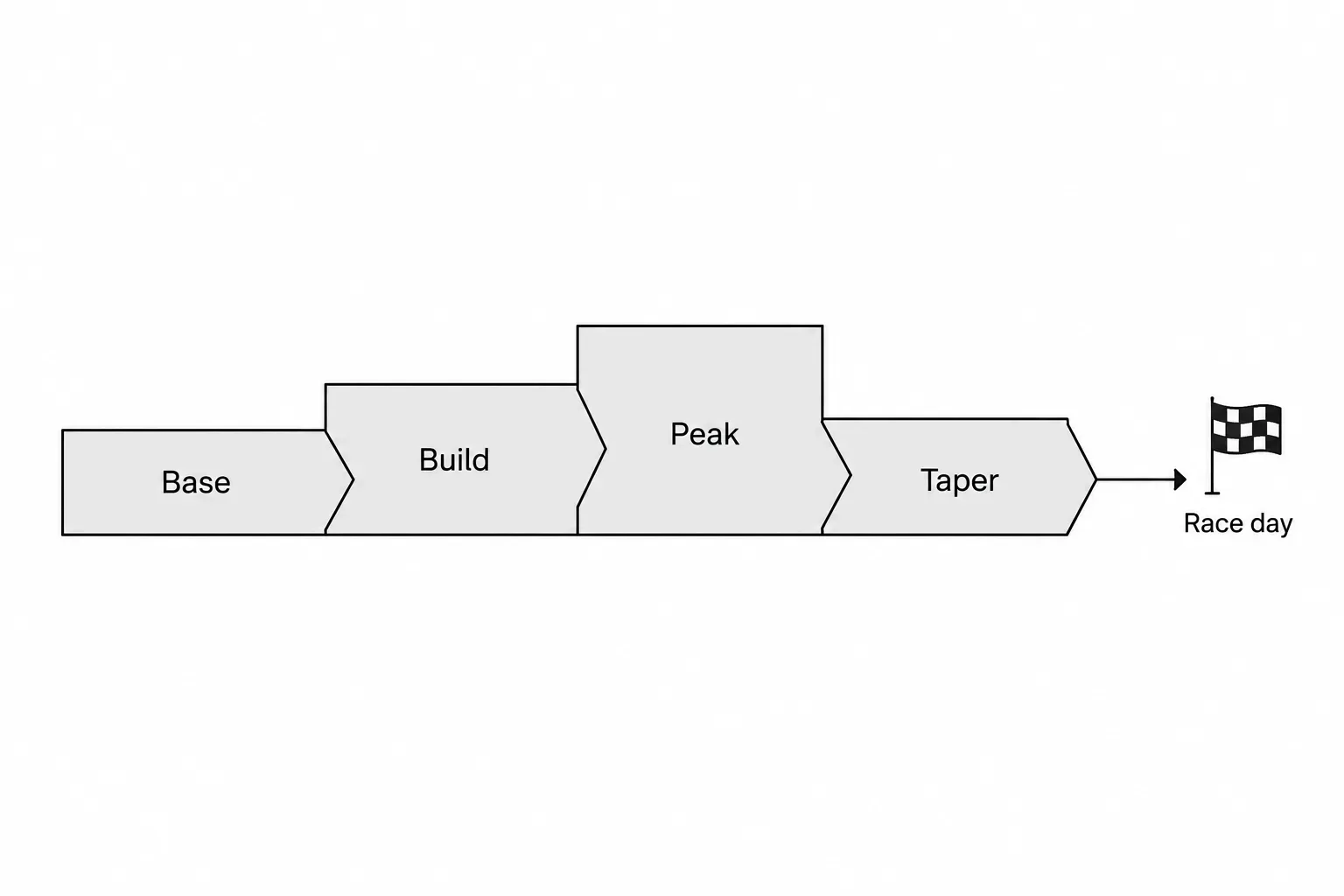
- Base weeks 1 to 4
- Build weeks 5 to 10
- Peak weeks 11 to 13
- Taper weeks 14 to 16
- Lighter weeks 4, 8 and 12
If you are newer to the distance or your peak week was a big jump for you, 3 weeks is the safer default for the marathon. If your peak was modest, you will still feel the benefit of 3 lighter weeks; a taper is not only for high-mileage runners.
The 3-week marathon taper, in numbers
Here is how the taper looks in a real 16-week plan: 4 running days a week, starting from 20 to 40 km (12 to 25 mi) a week. The last full training week is 47.4 km (29.5 mi) with a 20.2 km (12.6 mi) long run.
| Week | Weekly distance | Share of last full week | Long run | What stays the same |
|---|---|---|---|---|
| Last full week (week 13) | 47.4 km (29.5 mi) | 100% | 20.2 km (12.6 mi) | Your usual routine |
| Taper week 1 (3 weeks out) | 35.6 km (22.1 mi) | 75% | 15.1 km (9.4 mi) | 4 runs, short goal-pace segment |
| Taper week 2 (2 weeks out) | 26.7 km (16.6 mi) | 56% | 11.4 km (7.1 mi) | 4 runs, a few strides |
| Race week | 20.0 km (12.4 mi) on the schedule | 42% | Race day | Easy runs, a short shakeout |
That is a drop of about 25%, 44% and 58%, which lands inside the 41 to 60% range from the research by the final week. The long run shrinks fastest, because it is the session that leaves the most fatigue behind.
The bar chart makes the shape obvious: thirteen weeks of building with lighter weeks along the way, then three clearly shorter bars at the end.

General training guidance, not medical advice. Check with a doctor before increasing training if you have symptoms or a health condition.
The full plan, computed by the same engine, looks like this:
16-week marathon training plan
Every distance is in km and miles; every pace is per km and per mile. Lighter weeks are marked under the week number.
| Week | Mon | Tue | Wed | Thu | Fri | Sat | Sun | Total |
|---|---|---|---|---|---|---|---|---|
| Week 1Base | MonEasy5.8 km (3.6 mi)Conversational effort | TueEasy5.7 km (3.5 mi)Conversational effort | WedRest | ThuEasy5.7 km (3.5 mi)Conversational effort | FriRest | SatRest | SunLong12.8 km (8 mi)Conversational effort | Week total30 km (18.6 mi) |
| Week 2Base | MonEasy6.3 km (3.9 mi)Conversational effort | TueEasy6.3 km (3.9 mi)Conversational effort | WedRest | ThuEasy6.2 km (3.9 mi)Conversational effort | FriRest | SatRest | SunLong13.9 km (8.6 mi)Conversational effort | Week total32.7 km (20.3 mi) |
| Week 3Base | MonEasy6.9 km (4.3 mi)Conversational effort | TueEasy6.8 km (4.2 mi)Conversational effort | WedRest | ThuEasy6.8 km (4.2 mi)Conversational effort | FriRest | SatRest | SunLong15.1 km (9.4 mi)Conversational effort | Week total35.6 km (22.1 mi) |
| Week 4Base, lighter week | MonEasy6.2 km (3.9 mi)Conversational effort | TueEasy6.1 km (3.8 mi)Conversational effort | WedRest | ThuEasy6.1 km (3.8 mi)Conversational effort | FriRest | SatRest | SunLong13.6 km (8.5 mi)Conversational effort | Week total32 km (19.9 mi) |
| Week 5Build | MonEasy6.7 km (4.2 mi)Conversational effort | TueEasy6.7 km (4.2 mi)Conversational effort | WedRest | ThuEasy6.6 km (4.1 mi)Conversational effort | FriRest | SatRest | SunLong14.9 km (9.3 mi)Conversational effort | Week total34.9 km (21.7 mi) |
| Week 6Build | MonEasy7.3 km (4.5 mi)Conversational effort | TueEasy7.3 km (4.5 mi)Conversational effort | WedRest | ThuTempo7.3 km (4.5 mi)Comfortably hard | FriRest | SatRest | SunLong16.2 km (10.1 mi)Conversational effort | Week total38.1 km (23.7 mi) |
| Week 7Build | MonEasy8 km (5 mi)Conversational effort | TueEasy7.9 km (4.9 mi)Conversational effort | WedRest | ThuTempo7.9 km (4.9 mi)Comfortably hard | FriRest | SatRest | SunLong17.7 km (11 mi)Conversational effort | Week total41.5 km (25.8 mi) |
| Week 8Build, lighter week | MonEasy7.2 km (4.5 mi)Conversational effort | TueEasy7.1 km (4.4 mi)Conversational effort | WedRest | ThuEasy7.1 km (4.4 mi)Conversational effort | FriRest | SatRest | SunLong15.9 km (9.9 mi)Conversational effort | Week total37.3 km (23.2 mi) |
| Week 9Build | MonEasy7.8 km (4.8 mi)Conversational effort | TueEasy7.8 km (4.8 mi)Conversational effort | WedRest | ThuEasy7.8 km (4.8 mi)Conversational effort | FriRest | SatRest | SunLong17.3 km (10.7 mi)Conversational effort | Week total40.7 km (25.3 mi) |
| Week 10Build | MonEasy8.5 km (5.3 mi)Conversational effort | TueEasy8.5 km (5.3 mi)Conversational effort | WedRest | ThuTempo8.5 km (5.3 mi)Comfortably hard | FriRest | SatRest | SunLong18.9 km (11.7 mi)Conversational effort | Week total44.4 km (27.6 mi) |
| Week 11Peak | MonEasy9.3 km (5.8 mi)Conversational effort | TueEasy9.3 km (5.8 mi)Conversational effort | WedRest | ThuTempo9.2 km (5.7 mi)Comfortably hard | FriRest | SatRest | SunLong20.6 km (12.8 mi)Conversational effort | Week total48.4 km (30.1 mi) |
| Week 12Peak, lighter week | MonEasy8.4 km (5.2 mi)Conversational effort | TueEasy8.3 km (5.2 mi)Conversational effort | WedRest | ThuEasy8.3 km (5.2 mi)Conversational effort | FriRest | SatRest | SunLong18.5 km (11.5 mi)Conversational effort | Week total43.5 km (27 mi) |
| Week 13Peak | MonEasy9.1 km (5.7 mi)Conversational effort | TueEasy9.1 km (5.7 mi)Conversational effort | WedRest | ThuEasy9 km (5.6 mi)Conversational effort | FriRest | SatRest | SunLong20.2 km (12.6 mi)Conversational effort | Week total47.4 km (29.5 mi) |
| Week 14Taper | MonEasy6.9 km (4.3 mi)Conversational effort | TueEasy6.8 km (4.2 mi)Conversational effort | WedRest | ThuEasy6.8 km (4.2 mi)Conversational effort | FriRest | SatRest | SunLong15.1 km (9.4 mi)Conversational effort | Week total35.6 km (22.1 mi) |
| Week 15Taper | MonEasy5.1 km (3.2 mi)Conversational effort | TueEasy5.1 km (3.2 mi)Conversational effort | WedRest | ThuEasy5.1 km (3.2 mi)Conversational effort | FriRest | SatRest | SunLong11.4 km (7.1 mi)Conversational effort | Week total26.7 km (16.6 mi) |
| Week 16Taper, race week | MonEasy3.9 km (2.4 mi)Conversational effort | TueEasy3.8 km (2.4 mi)Conversational effort | WedRest | ThuEasy3.8 km (2.4 mi)Conversational effort | FriRest | SatRest | SunLong8.5 km (5.3 mi)Conversational effort | Week total20 km (12.4 mi) |
Race week. Keep the final week light. Start conservatively and adjust to conditions. Goal pace is a target, not a promised finish time.
- Easy
- Reduce load and keep movement comfortable.
- Rest
- Absorb training and recover for the next session.
- Long
- Build time on your feet without racing the session.
- Tempo
- Practice controlled quality with easy warm-up and cooldown.
General training guidance, not medical advice. Check with a doctor before increasing training if you have symptoms or a health condition.
How to taper for a marathon
- Run your longest run 3 weeks out
The taper starts the week after the biggest long run of the plan.
- Cut to about 75% in taper week 1
Keep the same number of runs and one short block at goal pace inside an easy run.
- Cut to about 56% two weeks out
Keep the runs, shorten them, and add a few relaxed strides after an easy run.
- Run about 42% in race week
Easy runs, a short goal-pace segment midweek and a very easy shakeout or rest the day before.
- Change nothing else
Same shoes, same breakfast, same gels and same bedtime you used on your long runs.
What to keep, what to cut
| Keep | Cut |
|---|---|
| The number of runs per week | The length of every run, the long run most |
| Short goal-pace segments (for a 4:00 marathon, 5:41 /km or 9:09 /mi) | Long intervals and anything that leaves you sore for days |
| Strides: 4 to 6 relaxed 20-second pickups after an easy run | New shoes, new gels, new stretches, new gym classes |
| Your normal sleep and meal times | Extra miles to "test" your fitness |

Keeping a little speed in the legs matters. Runners who drop every pace session often say they feel flat and heavy on race morning. A 3 km (1.9 mi) block at goal pace inside an easy run in taper week 1, and a few strides in week 2, keep the rhythm without adding fatigue.
The half marathon taper: 2 weeks
The half marathon version uses the same rules over 2 weeks. In a 12-week beginner plan starting from 10 to 20 km (6 to 12 mi) a week, the peak week is 22.2 km (13.8 mi).
| Week | Weekly distance | Share of peak week |
|---|---|---|
| Peak week (2 weeks out) | 22.2 km (13.8 mi) | 100% |
| Taper week 1 | 16.6 km (10.3 mi) | 75% |
| Race week | 12.4 km (7.7 mi) | 56% |
The 12-week half marathon training plan shows the same 2-week taper inside a full block, and the half marathon training plans guide compares every other length.
Do you really need to taper for a half marathon?
Yes, but a shorter one. A half takes far less out of you than a marathon, so 10 to 14 days of reduced distance is enough. Runners who skip the taper completely tend to start the race carrying the fatigue of their biggest week.
Mistakes that cost you on race day
- Cutting everything at once. Dropping to two short jogs a week feels restful, then race morning feels sluggish. Keep the frequency.
- Squeezing in a missed long run. If you lost your longest run to illness or work, do not run it 2 weeks out. It is gone. More on that in our guide to a missed long run.
- Racing a tune-up too close. A hard 10K (6.2 mi) or half inside the last 2 weeks eats into the taper. Keep any race at least 3 weeks out.
- Trying anything new. Shoes, socks, breakfast and gels should all have been tested on long runs already.

When the taper plan doesn't fit your week

The taper above assumes the 13 weeks before it went to plan. Most don't. A cold in week 11 or a work trip in week 12 changes where your peak actually was, and a fixed plan keeps counting down as if nothing happened. That is the wall with a printed or PDF plan: it doesn't move when your week does.
The fix is a plan that starts from your race date and your real weekly distance.
Free training plan
Build your free plan for your race date.
Pick your race and race date. Every week from today to race day is planned for you, with distances in km and miles.
Build your free plan for your race date. On the Coach plan, next week re-plans itself when you miss a run. It is built for Garmin and Apple Watch runners, and you can see how Free and Coach compare before you choose.
Race week, day by day
For a Sunday marathon, the runs before the race add up to about 12 km (7.5 mi):
| Day | Run |
|---|---|
| Monday | Rest |
| Tuesday | 4.5 km (2.8 mi) easy with 4 strides |
| Wednesday | 4 km (2.5 mi) easy with 1.5 km (0.9 mi) at goal pace |
| Thursday | Rest |
| Friday | 3.5 km (2.2 mi) easy |
| Saturday | 15 minutes very easy, or rest |
| Sunday | Race |

Race breakfast follows the same nothing-new rule: eat the meal you tested before your long runs, 2 to 4 hours before the start, using the timing in our guide to what to eat before a run.
Check your goal splits on the marathon pace chart, or estimate a realistic goal from a recent race with the race time predictor. Goal pace is a target, not a promised finish time.
A good taper is boring on purpose: same days, same routine, shorter runs, a little goal pace, nothing new. Start 3 weeks out for a marathon and 2 for a half, cut volume to about 75%, 56% and 42%, and leave the hard work where it already is.
If you have not picked a plan yet, the 16-week marathon training plan shows a full first-marathon cycle with a 3-week taper built in, and the marathon training plan guide compares every other length.
And if your weeks stop matching the plan before race day, build your free plan for your race date. On the Coach plan, next week re-plans itself when you miss a run.
Frequently asked questions
About 3 weeks before race day, the week after your longest long run. For a half marathon, start 2 weeks out.
10 to 14 days is enough for most runners. Cut weekly distance to about 75% of your peak week, then about 56% in race week, and keep a few short pace segments.
Most plans put the longest run 3 weeks out instead. In the 16-week sample above, the long run 2 weeks out is 11.4 km (7.1 mi) and the one 3 weeks out is 15.1 km (9.4 mi), down from a 20.2 km (12.6 mi) peak.
A taper lets the fatigue from your biggest weeks clear while the fitness stays. The 2007 meta-analysis cited above found performance gains from a 2-week taper that cut volume by 41 to 60% and kept intensity and frequency.
It is a pacing rule of thumb: run the first 10 miles (16 km) a little easier than goal pace, the next 10 miles (16 km) at goal pace, and race the last 10 km (6.2 mi). It belongs to race day, not to the taper.
Start the taper: about 75% of your peak weekly distance, the same number of runs, one short block at goal pace and a few strides. Do not add a long run you missed earlier.
Free training plan
Build your free plan for your race date.
On the Coach plan, next week re-plans itself when you miss a run.
Share article
About the author
More running training guides

Marathon training · 11 min
Ultramarathon Training Tips: 12 Habits Beyond the Miles
The best ultramarathon training tips are about everything except the running: your stomach, your feet, your stops, the dark and the downhills. Here are 12, one job at a time.

Marathon training · 9 min
How Long Is a Marathon Run? 26.2 Miles, 42.2 km and Hours
A marathon run is 42.195 km (26.2 miles). See the exact distance, why your watch reads long, how many hours it takes at each pace, and how to plan for yours.

Marathon training · 12 min
Boston Marathon Training Guide: Hills, Downhills and Pacing
To train for the Boston Marathon, run a normal 16 to 18 week marathon build and add two things: downhill running for your quads and a patient first half. Here is the block for April 19, 2027, the hill work, a peak week and a pacing plan.

Marathon training · 10 min
Marathon: The Ultimate Training Guide Review and Plan Picker
Hal Higdon's Marathon: The Ultimate Training Guide is worth reading for the rules behind its plans: pick a program by your running today, protect the long run, step back every third week. Here is what it covers, which program fits you, and how to keep a printed plan working when your week changes.

Marathon training · 11 min
Ultra Marathon Training Guide: First 50K Schedule and Tips
To train for your first ultra marathon, take a marathon build and change three things: train in hours on your feet, add back-to-back long runs, and practice walking the hills and eating on the run. Here is a 16 week 50K schedule by phase, a typical week, the fueling math and the mistakes that cost the most.

Marathon training · 13 min
Marathon Training Routine: Build a Week You Can Repeat
A good marathon training routine fixes two days, the long run and one quality session, and keeps everything else easy. Here is the weekly structure for 3, 4 or 5 runs, where strength and rest go, and how to fit it around work.