
What Is a Negative Split in Running? Splits for Every Goal
Raceblock team Updated November 9, 2026 11 min read
Free training plan for your race date

Free training plan for your race date
Build my free planIn this article
A negative split means you run the second half of a race faster than the first half. In a marathon built around a 4:00 goal, that could be 2:01:00 for the first 21.1 km (13.1 mi) and 1:59:00 for the second.
Here is the part most runners miss: you do not earn a negative split in the last 10 km (6.2 mi) by finishing hard. You earn it in the first 10 km by running slower than feels right. The finish is just where the restraint pays out.
What does a negative split mean in running?
A negative split is a race where your second half takes less time than your first. If you go through halfway in 2:01:00 and finish the marathon in 4:00:00, your second half took 1:59:00, a 2 minute negative split. The opposite, a slower second half, is a positive split. Running both halves in the same time is an even split.
The name comes from the math: second half time minus first half time gives a negative number. You can apply it to any split, not just halves. A runner whose last 5 km (3.1 mi) of a 10 km is faster than the first 5 km has negative split that race too.
Here is what the three pacing types look like for a 4:00 marathon goal.
| Split type | First half | Second half | First half pace | Second half pace |
|---|---|---|---|---|
| Positive split | 1:55:00 | 2:05:00 | 5:27 /km (8:46 /mi) | 5:55 /km (9:32 /mi) |
| Even split | 2:00:00 | 2:00:00 | 5:41 /km (9:09 /mi) | 5:41 /km (9:09 /mi) |
| Negative split | 2:01:00 | 1:59:00 | 5:44 /km (9:14 /mi) | 5:38 /km (9:05 /mi) |
Look at how small the negative split row is. The first half is only 3 seconds per km (5 seconds per mi) slower than even pace. Nobody is asking you to jog the first half and sprint the second.

Most amateur races go the other way. The start is crowded, your legs are fresh after the taper, and the pace on your watch feels too easy. So you run with the people around you, and 5:41 /km quietly becomes 5:25 /km (8:43 /mi). That feels fine for 25 km (15.5 mi). The bill comes later.
Why do negative splits work?
Negative splits work because a slightly slower start costs you very little early and saves you a lot late. A 2025 review of marathon pacing in Frontiers in Physiology lists the main reasons: a more even start spares glycogen, keeps body temperature lower and limits cardiovascular drift, the slow rise in heart rate at the same pace over a long run (Grivas, 2025). Together those delay fatigue in the last third of the race.

The idea of "banking time" is the trap. Say a runner aiming at 5:41 /km goes through the first 10 km (6.2 mi) at 5:26 /km (8:45 /mi). They have banked 2 minutes 30 seconds. If they then fade by 30 seconds per km over the last 10 km, which is common when the first half was too fast, they lose 5 minutes. The bank was a loan, and the interest was high.
The same review is clear that negative splits are not for every runner in every race. Heat, hills, wind and your fitness on the day all change the best plan. That is why the target below is small: even to slightly negative, not a dramatic finish. The same idea works on an ordinary training run, and our guide on how to pace yourself when running shows how.
How big should your negative split be?
For most runners, aim for a second half that is 1 to 2% faster than the first. That is a small margin, and it is the whole point: big negative splits usually mean the first half was too slow and you left time on the course.
The right size depends mostly on how long the race is. The longer it is, the more fatigue builds late, so the more the early restraint matters.
| Race | Example goal | First half | Second half | Target negative split | Start pushing |
|---|---|---|---|---|---|
| 5 km (3.1 mi) | 30:00 | 15:10, 6:04 /km (9:46 /mi) | 14:50, 5:56 /km (9:33 /mi) | 10 to 20 seconds | Last 1 km (0.6 mi) |
| 10 km (6.2 mi) | 55:00 | 27:45, 5:33 /km (8:56 /mi) | 27:15, 5:27 /km (8:46 /mi) | 20 to 30 seconds | Last 3 km (1.9 mi) |
| Half marathon | 2:00:00 | 1:00:30, 5:44 /km (9:14 /mi) | 59:30, 5:38 /km (9:05 /mi) | 30 to 60 seconds | After 15 km (9.3 mi) |
| Marathon | 4:00:00 | 2:01:00, 5:44 /km (9:14 /mi) | 1:59:00, 5:38 /km (9:05 /mi) | 1 to 2 minutes | After 32 km (20 mi) |
Marathon: hold back for 30 km
The marathon is where negative splits matter most and go wrong most. Run the first 10 km (6.2 mi) 5 to 10 seconds per km slower than goal pace, settle into goal pace from 10 km to 32 km (20 mi), and only then decide whether to press. If you feel bad at 32 km, holding pace is your negative split.
These are the halves for common marathon goals with a 2 minute negative split. For the full kilometer and mile splits, see the marathon pace chart.
| Goal time | Even pace | First half | First half pace | Second half | Second half pace |
|---|---|---|---|---|---|
| 3:30:00 | 4:59 /km (8:01 /mi) | 1:46:00 | 5:01 /km (8:05 /mi) | 1:44:00 | 4:56 /km (7:56 /mi) |
| 4:00:00 | 5:41 /km (9:09 /mi) | 2:01:00 | 5:44 /km (9:14 /mi) | 1:59:00 | 5:38 /km (9:05 /mi) |
| 4:30:00 | 6:24 /km (10:18 /mi) | 2:16:00 | 6:27 /km (10:22 /mi) | 2:14:00 | 6:21 /km (10:13 /mi) |
| 5:00:00 | 7:07 /km (11:27 /mi) | 2:31:00 | 7:09 /km (11:31 /mi) | 2:29:00 | 7:04 /km (11:22 /mi) |
Not sure which goal row is yours? Pick it from a recent race with the race time predictor, not from the time you would like to run. A goal that is too fast makes a negative split almost impossible, however patient you are. Or work out your own halves here:
Marathon pace calculator
Splits for a 4:00:00 marathon, even pace
- Average pace per km
- 5:41 /km
- Average pace per mile
- 9:09 /mi
- Halfway
- 2:00:00
- Second half
- 2:00:00
Kilometer splits
| km | mi | Split | Elapsed |
|---|---|---|---|
| 1 | 0.6 | 5:41 | 5:41 |
| 2 | 1.2 | 5:41 | 11:23 |
| 3 | 1.9 | 5:41 | 17:04 |
| 4 | 2.5 | 5:41 | 22:45 |
| 5 | 3.1 | 5:41 | 28:26 |
| 6 | 3.7 | 5:41 | 34:08 |
| 7 | 4.3 | 5:41 | 39:49 |
| 8 | 5 | 5:41 | 45:30 |
| 9 | 5.6 | 5:41 | 51:11 |
| 10 | 6.2 | 5:41 | 56:53 |
| 11 | 6.8 | 5:41 | 1:02:34 |
| 12 | 7.5 | 5:41 | 1:08:15 |
| 13 | 8.1 | 5:41 | 1:13:57 |
| 14 | 8.7 | 5:41 | 1:19:38 |
| 15 | 9.3 | 5:41 | 1:25:19 |
| 16 | 9.9 | 5:41 | 1:31:00 |
| 17 | 10.6 | 5:41 | 1:36:42 |
| 18 | 11.2 | 5:41 | 1:42:23 |
| 19 | 11.8 | 5:41 | 1:48:04 |
| 20 | 12.4 | 5:41 | 1:53:45 |
| 21 | 13 | 5:41 | 1:59:27 |
| 22 | 13.7 | 5:41 | 2:05:08 |
| 23 | 14.3 | 5:41 | 2:10:49 |
| 24 | 14.9 | 5:41 | 2:16:31 |
| 25 | 15.5 | 5:41 | 2:22:12 |
| 26 | 16.2 | 5:41 | 2:27:53 |
| 27 | 16.8 | 5:41 | 2:33:34 |
| 28 | 17.4 | 5:41 | 2:39:16 |
| 29 | 18 | 5:41 | 2:44:57 |
| 30 | 18.6 | 5:41 | 2:50:38 |
| 31 | 19.3 | 5:41 | 2:56:19 |
| 32 | 19.9 | 5:41 | 3:02:01 |
| 33 | 20.5 | 5:41 | 3:07:42 |
| 34 | 21.1 | 5:41 | 3:13:23 |
| 35 | 21.7 | 5:41 | 3:19:05 |
| 36 | 22.4 | 5:41 | 3:24:46 |
| 37 | 23 | 5:41 | 3:30:27 |
| 38 | 23.6 | 5:41 | 3:36:08 |
| 39 | 24.2 | 5:41 | 3:41:50 |
| 40 | 24.9 | 5:41 | 3:47:31 |
| 41 | 25.5 | 5:41 | 3:53:12 |
| 42 | 26.1 | 5:41 | 3:58:53 |
| 42.2 | 26.2 | 1:07 | 4:00:00 |
Mile splits
| Mile | km | Split | Elapsed |
|---|---|---|---|
| 1 | 1.6 | 9:09 | 9:09 |
| 2 | 3.2 | 9:09 | 18:18 |
| 3 | 4.8 | 9:09 | 27:28 |
| 4 | 6.4 | 9:09 | 36:37 |
| 5 | 8 | 9:09 | 45:46 |
| 6 | 9.7 | 9:09 | 54:55 |
| 7 | 11.3 | 9:09 | 1:04:05 |
| 8 | 12.9 | 9:09 | 1:13:14 |
| 9 | 14.5 | 9:09 | 1:22:23 |
| 10 | 16.1 | 9:09 | 1:31:32 |
| 11 | 17.7 | 9:09 | 1:40:41 |
| 12 | 19.3 | 9:09 | 1:49:51 |
| 13 | 20.9 | 9:09 | 1:59:00 |
| 14 | 22.5 | 9:09 | 2:08:09 |
| 15 | 24.1 | 9:09 | 2:17:18 |
| 16 | 25.7 | 9:09 | 2:26:28 |
| 17 | 27.4 | 9:09 | 2:35:37 |
| 18 | 29 | 9:09 | 2:44:46 |
| 19 | 30.6 | 9:09 | 2:53:55 |
| 20 | 32.2 | 9:09 | 3:03:05 |
| 21 | 33.8 | 9:09 | 3:12:14 |
| 22 | 35.4 | 9:09 | 3:21:23 |
| 23 | 37 | 9:09 | 3:30:32 |
| 24 | 38.6 | 9:09 | 3:39:41 |
| 25 | 40.2 | 9:09 | 3:48:51 |
| 26 | 41.8 | 9:09 | 3:58:00 |
| 26.2 | 42.2 | 2:00 | 4:00:00 |
4:00:00 marathon · even pace
- 5 km28:26
- 10 km56:53
- 15 km1:25:19
- 20 km1:53:45
- 25 km2:22:12
- 30 km2:50:38
- 35 km3:19:05
- 40 km3:47:31
- 42.2 km4:00:00
Raceblock pace band · myraceblock.com
Half marathon: patience for 15 km
In a half marathon, run the first 5 km (3.1 mi) a touch easy, hold goal pace to 15 km (9.3 mi), then use the last 6 km (3.7 mi) to pick it up. The half marathon pace chart has the kilometer and mile splits for each goal time.
10 km and 5 km: closer to even
Shorter races leave less room. In a 10 km, start controlled for the first 2 km (1.2 mi) and squeeze the pace from 7 km (4.3 mi). In a 5 km, a near even split with a fast last kilometer is the realistic target. A proper warm-up matters more here, because a cold start makes the first kilometer feel brutal; here is how to warm up before running.
How to run a negative split on race day
The plan is simple. The hard part is following it when the gun goes and everyone around you is running faster.

How to run a negative split
- Set your goal pace from a recent race
Use a race or time trial from the last 6 to 8 weeks to pick a realistic goal, then work out your halfway time before race day.
- Start 5 to 10 seconds per km slower than goal pace
Run the first 5 to 10 km (3.1 to 6.2 mi) slightly slow on purpose. It should feel too easy. That feeling is correct.
- Settle into goal pace
After the opening section, run goal pace and stop looking at your total time. Check each kilometer or mile split instead.
- Check yourself at halfway
Compare your halfway time with your plan. Up to a minute slow in a marathon is fine. More than a minute fast means ease off now, not later.
- Press only in the final quarter
From 32 km (20 mi) in a marathon or 15 km (9.3 mi) in a half, pick up the pace a few seconds per km if you feel good. If you do not, holding pace still gives you an even or slightly negative split.
One habit makes this easier: run by the split for each kilometer or mile, not the average pace on your watch. The average hides a fast first 5 km for most of the race.
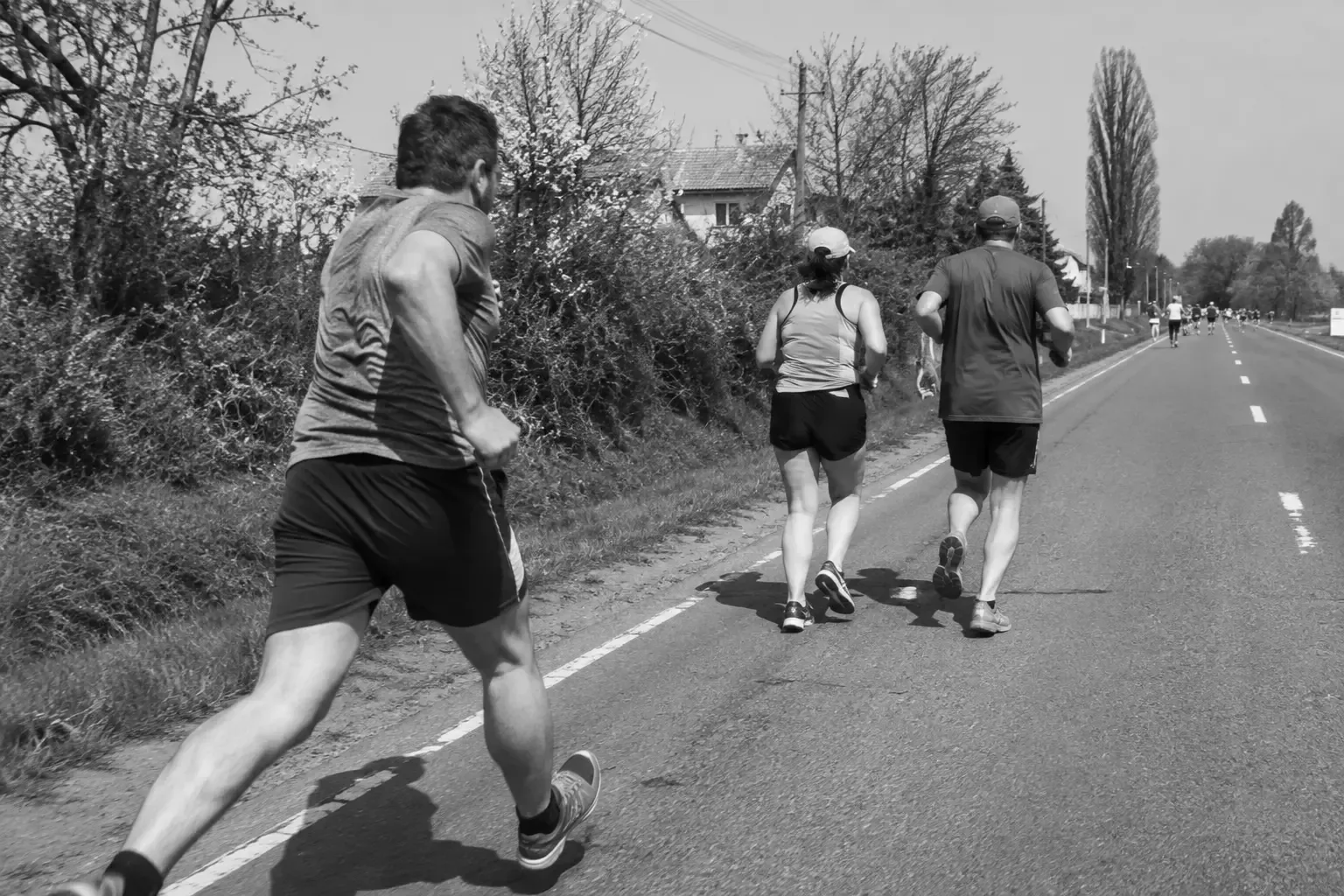
How to train for a negative split
You train a negative split by teaching your legs to run faster when they are already tired. Two sessions do most of the work, and both sit inside a normal easy week.
Progression runs
A progression run starts easy and gets faster in steps. For example, run 40 minutes: the first 20 at easy pace, the next 10 at marathon pace, and the last 10 at half marathon pace. Once every week or two is enough.

Fast finish long runs
In the second half of your marathon block, end some long runs with 3 to 8 km (2 to 5 mi) at goal marathon pace. The rest of the run stays easy. This is the race in miniature: patience first, goal pace on tired legs at the end. Slot these into a marathon training plan rather than adding them on top, and never on every long run.

Keep the rest of the week easy
Negative split training only works if the other days are easy enough to recover from. This is the 80% rule in running: about 80% of your runs at an easy, chatty pace and about 20% hard. Progression runs and fast finish long runs count as part of that hard 20%. Our guide to running faster with the 80/20 week shows how to lay out the easy days around them.
Mistakes that ruin a negative split
- Racing the first 5 km. The single most common cause of a positive split. You feel great because you just tapered.
- Banking time. Running early kilometers fast "to have some in hand" costs more late than it saves early.
- Starting far too slow. A 5 minute negative split in a marathon usually means the first half was wasted, not that the plan worked.
- Trusting the average pace on your watch. It hides early mistakes. Read each split instead.
- Ignoring the course and weather. A hilly second half or rising heat can make an even split the smart race. Adjust the plan, not your ego.
- Never practising it. If you have never run goal pace on tired legs in training, race day is a bad place to start.
General training guidance, not medical advice. Check with a doctor before increasing training if you have symptoms or a health condition. Pain, swelling, chest pain or feeling faint means stop and see a doctor or physio.
When your week stops matching the plan
Everything above works with a notebook. Write your halfway time on your hand, put a progression run in your week and a fast finish into every second or third long run, and you have a negative split plan.
The wall comes when life moves the week. A cold takes out the fast finish long run, a work trip eats a progression run, or you have to decide what to do after you missed a long run. A written plan does not move when your week does, so the sessions that teach the negative split are usually the first to be dropped.
That is the part Raceblock handles. Build your free plan for your race date. On the Coach plan, next week re-plans itself when you miss a run.
Free training plan
Build your free plan for your race date.
Pick your race and race date. Every week from today to race day is planned for you, with distances in km and miles.
Negative splits in one line
A negative split is a faster second half, and you get it by starting a few seconds per kilometer slower than feels right, holding goal pace in the middle, and only pressing in the final quarter. Aim for 1 to 2% faster, not a heroic finish.
If you have a race booked, build a free plan for your race date and let the progression runs and fast finish long runs land in the right weeks for you.
Source: pacing physiology from Grivas (2025), Frontiers in Physiology. Paces and split times on this page are computed from the goal times shown.
Frequently asked questions
Yes, for most distance runners a small negative split is a sign of good pacing. It means you started under control and had energy left for the second half. In longer races like the half marathon and marathon, it usually beats going out fast and fading.
For races of 10 km (6.2 mi) and longer, an even or slightly negative split is better for most runners. A positive split usually means the start was too fast, and the time lost late is bigger than the time gained early. On a course that is much harder in the second half, an even effort can still give a small positive split, and that is fine.
Yes, when it is too big. A second half that is many minutes faster than the first usually means you started far slower than you needed to and left time on the course. Aim for about 1 to 2% faster, roughly 1 to 2 minutes in a marathon or 30 to 60 seconds in a half.
It means running about 80% of your training at an easy, conversational pace and about 20% hard. Sessions that train a negative split, such as progression runs and fast finish long runs, belong in that hard 20%. The easy days let you recover so those sessions go well.
Free training plan
Build your free plan for your race date.
On the Coach plan, next week re-plans itself when you miss a run.
Share article
About the author
More running training guides

Pacing and race day · 11 min
10K Running Pace Chart: Every Time From 35 to 75 Minutes
A 10K running pace chart for every finish time from 35:00 to 1:15:00: pace per km and per mile, 5 km halfway splits, 400 m laps, treadmill speeds, and what your 10K says about a half or marathon.

Pacing and race day · 10 min
How Long Does It Take to Run a Mile? Times by Age and Pace
Most people run a mile in 9 to 13 minutes at an easy pace and 6 to 8 minutes at race effort. See mile times by age, pace per km and how to get faster.

Pacing and race day · 9 min
How Long to Run a 10K: Finish Times, Miles and Training
A 10k run is 10 km (6.21 mi) and takes about 60 minutes at 6:00 /km (9:39 /mi). See finish times at every pace, how long to train for one and how to pace your first race.

Pacing and race day · 10 min
5K Running Pace Chart: Every Time From 15 to 45 Minutes
A 5K running pace chart for every finish time from 15:00 to 45:00: pace per km and per mile, 400 m lap times, treadmill speeds, and what your 5K says about a half or marathon.

Pacing and race day · 10 min
Average 5K Time by Age for Men and Women (20 to 80)
The average 5K time by age is about 22:41 for men and 27:19 for women in their 20s, slowing by about a minute every five years after 35. Here are the age tables, the race field median of 34:37, and how to find your own time.

Pacing and race day · 10 min
Running Pace Conversion Chart: Km, Mile and Treadmill
Convert any running pace between minutes per km and minutes per mile, and treadmill mph or km/h into pace, with marathon and half marathon finish times in the same charts.