
Ultramarathon Training Tips: 12 Habits Beyond the Miles
Raceblock team November 19, 2026 11 min read
Free marathon plan for your race date
Free marathon plan for your race date
Build my free planIn this article
The best ultramarathon training tips are about everything except the running: your stomach, your feet, your stops, the dark and the downhills. Fitness gets most first-timers to halfway, and the jobs nobody practiced decide the rest of the day.
This page is the checklist of those jobs, one tip at a time. If you still need the schedule itself, start with our ultra marathon training guide, which has the 16 week block for a first 50 km (31 mi). Come back here once the weeks are on your calendar.
Which ultramarathon training tips matter most for your race?
Every tip below helps at every distance, but the order changes with the race. The longer the day, the more it is decided by food, feet and sleep rather than pace. Use this table to pick your first three.
| Race | What usually decides the day | Put these tips first |
|---|---|---|
| 50 km (31 mi) | Pacing the first half and the climbs | Race terrain, power hiking, downhills |
| 50 mi (80 km) | Eating steadily after hour 4 | Gut training, real food, aid station stops |
| 100 km (62 mi) | Feet and stomach, often a stretch in the dark | Feet, night running, race in legs |
| 100 mi (161 km) | A night without sleep and the low points | Night running, aid station stops, race in legs |
If your race is a first 50 km and you are still building base, the run work comes from a normal marathon block such as our 16 week marathon training plan. The tips layer on top of that.
General training guidance, not medical advice. Check with a doctor before increasing training if you have symptoms or a health condition.
1. Train for the race you entered
Look up your race's distance and total climbing, then divide. A 50 km (31 mi) race with 1,000 m (3,281 ft) of climbing is 20 m of climbing per km (106 ft per mi). Plan your long runs so they climb about that much per km.
If you live somewhere flat, use what you have: a treadmill on incline, a multi-story car park, stairs, the one hill in town on repeat. Match the surface too. A race on rocky single track needs long runs on rocky single track, not on a towpath.
2. Lift twice a week
Two short strength sessions a week are the cheapest insurance an ultra runner can buy with time. A systematic review of strength training in middle and long distance runners found it improved running economy (Blagrove et al., 2018), and on a long day the legs that hold their shape on the last climb are the strong ones.

Keep it simple: step-ups, split squats, single-leg deadlifts and calf raises, 3 sets of 8 to 12 per side, about 30 minutes. A park bench is enough to start. Put the sessions on easy days, never the day before your long run. Our guide to strength training for long distance runners has full sessions.
3. Time your hiking against your jogging
On a steep climb, find out whether hiking or jogging is faster for you. Pick a hill that takes about 5 minutes. Jog it once, recover, then power hike it with short steps and hands on your thighs. Most runners are surprised how close the times are, and the hike leaves the legs far fresher.
Once you know your number, make it a rule for long runs: anything steeper than your test hill gets hiked. On flat ground, try a run-walk pattern such as 25 minutes running and 5 minutes walking, so walking feels like a plan rather than a failure.
4. Train your gut on a schedule
Your stomach can learn to handle food while you run, but only if you practice. A review of gut training in athletes found that carbohydrate intake during exercise can be trained, with less stomach trouble as tolerance goes up (Jeukendrup, 2017). The ISSN position stand on ultra nutrition (2019) suggests 30 to 50 g of carbohydrate an hour, so build toward that range step by step.
| Block weeks | Carbs per hour on long runs | What to practice |
|---|---|---|
| 1 to 4 | About 30 g | Start eating in the first 30 minutes, every 20 to 30 minutes |
| 5 to 8 | About 40 g | Add one real-food item per run |
| 9 to 12 | 40 to 50 g | Exact race products, at race timings |
| 13 to taper | Race plan | Same food, same watch alerts, no changes |
Do the math once. A 50 km (31 mi) that takes you 7 hours at 40 g an hour is 280 g of carbohydrate. Read the label on your gels and chews and count how many that is.
5. Practice real food on the move
Sweet gels get hard to swallow after a few hours. Many ultra runners switch to salty, plain food: boiled potatoes with salt, a small sandwich, crackers, a rice ball. Find out now which of these you can eat at a jog and which ones only work at a walk.

Pack the food the way you will race with it: in a zip bag in your vest, opened with cold hands. Eat it on the climbs, where you are hiking anyway. If you want ideas for the meal before a long run, see what to eat before a run.
6. Run downhill on purpose
Downhills hurt ultra runners more than climbs, because braking on every step loads the quads hard. From the middle of your block, put 10 to 15 minutes of steady downhill into each long run, on the kind of ground your race has.

Use short, quick steps, arms a little wide for balance and eyes 3 to 4 m (10 to 13 ft) ahead. Do not try to go fast. The goal is legs that still work on the last descent of the race. If a knee or shin hurts rather than just feels tired, stop and see a doctor or physio.
7. Do one long run into the dark
If your race starts before sunrise or runs past sunset, you will spend part of it on a trail lit by your headlamp. Everything is slower in the dark: footing, route finding, even eating. Practice it once or twice before race day.

Plan a long run of 2 to 3 hours that starts in daylight and finishes in the dark, on a trail you know, with someone who knows where you are. Use the headlamp and batteries you will race with, and check how long they last on the brightness you actually need.
8. Rehearse your aid station stops
Stops eat more time than slow kilometers. Ten aid stations at 5 minutes each is 50 minutes of standing still, and most of it is fumbling. Aim for about 2 minutes at each stop and practice it.
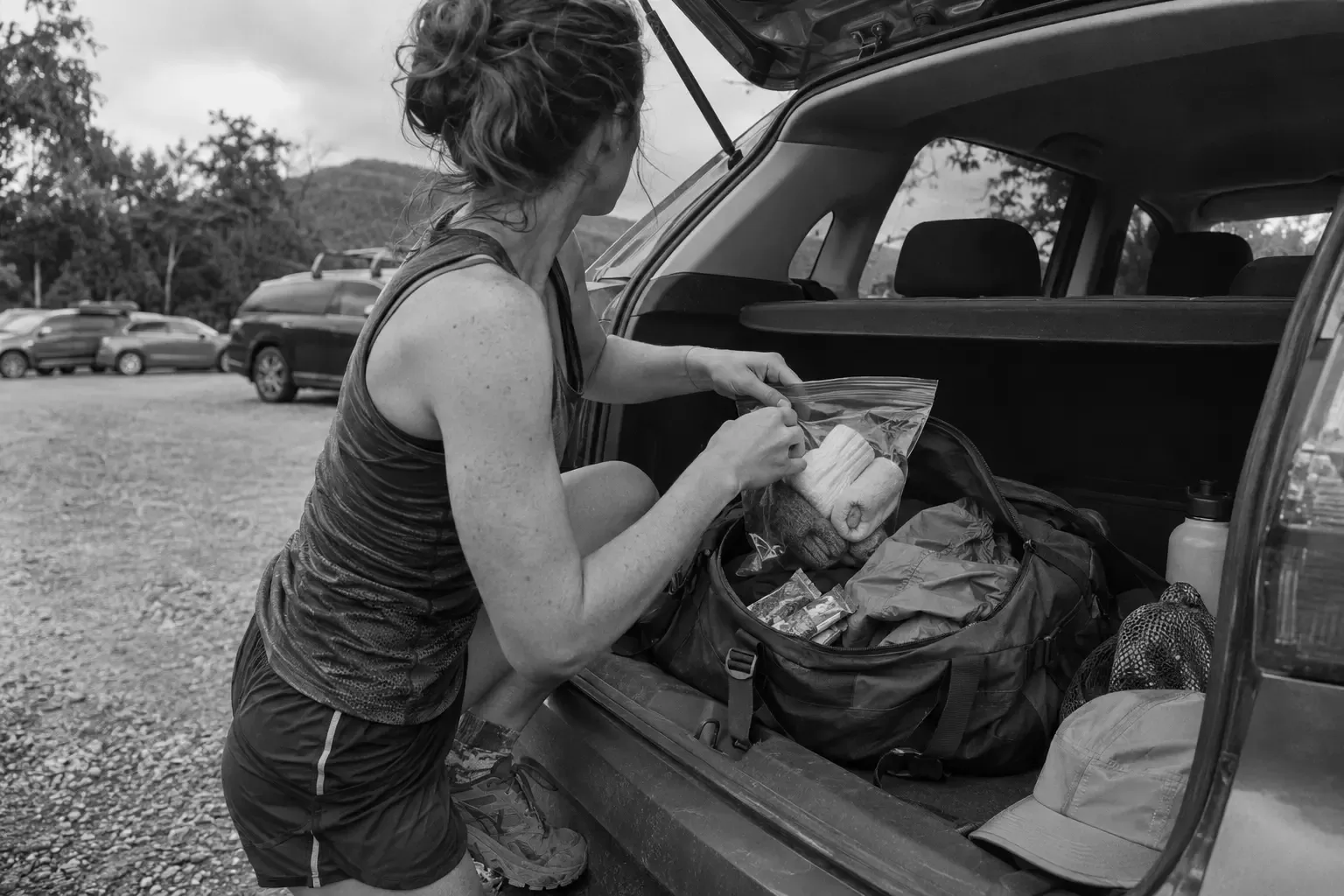
Use your car as a fake aid station on long runs. Loop past it every 10 to 15 km (6.2 to 9.3 mi), refill your flasks, swap food and leave, with a timer running. Pack your race drop bag the same way: clear zip bags, one job per bag, and a written list of what you need at each stop.
9. Treat your feet as kit
Feet end more first ultras than fitness does. A hot spot you ignore at 20 km (12.4 mi) can be a blister by 35 km (21.7 mi). Test your socks, shoes and any tape or anti-chafe cream on your longest runs, and stop to fix a hot spot the moment you feel it.

On one long run, practice a sock change: sit down, dry your feet, new socks, shoes back on, timed. Trim your toenails a few days before the race, not the night before. A blister that turns red, hot or swollen needs a doctor, not more kilometers.
10. Run a tune-up race
Four to six weeks before your ultra, run a shorter race as a dress rehearsal: a 25 to 35 km (16 to 22 mi) trail race or a road marathon, at easy effort. Wear your race kit, eat your race food and practice your stops. It is a training run with aid stations, not a race to empty yourself in.
Then treat the last two weeks before the ultra like a marathon taper: less distance, same routine, no new food or gear.
11. Cut back every third or fourth week
Ultra training adds up quietly: long runs, back-to-backs, hill work, strength. Every third or fourth week, cut your weekly distance by about a quarter and skip the back-to-back. That is when the work you did turns into fitness. Our guide to recovery after running covers sleep, food and easy days in those weeks.
12. Race in legs, not kilometers
Fifty kilometers (31 mi) is a big number to hold in your head at the start line. The distance between two aid stations is not. Before race day, write down each leg: distance, climbing and what you will eat on it. On the day, only think about the leg you are on.
Expect a low point, usually somewhere past halfway, and decide now what you will do when it comes: eat something, walk for 5 minutes, then reassess at the next aid station. Many low points are an empty stomach in disguise.
Where a written plan breaks
Every tip above assumes the weeks go to plan. They rarely do. A cold takes out your back-to-back weekend, a work trip lands on your night run, and a fixed schedule does not move. Most runners guess, and they usually guess by doing too much the next weekend. Our missed long run rules help, but the plan still does not move when your week does.
That is what Raceblock is for. Raceblock builds marathon plans, the base block most first 50 km (31 mi) runners train from. Build your free plan for your race date. On the Coach plan, next week re-plans itself when you miss a run.
Free training plan
Build your free plan for your race date.
Pick your race and race date. Every week from today to race day is planned for you, with distances in km and miles.
Your ultra tips in one line
Match your training to your race's terrain, lift twice a week, train your gut and your feet, practice the dark, the downhills and your stops, cut back every third or fourth week, and race one leg at a time.
The miles are the part you already know how to do. Put the schedule in place with the full ultra marathon guide, then use this list to make sure nothing else on the day is a surprise.
Sources: strength training and running economy from Blagrove, Howatson and Hayes (2018), Sports Medicine; gut training from Jeukendrup (2017), Sports Medicine; carbohydrate per hour from the International Society of Sports Nutrition position stand on ultra marathon nutrition (2019). Everything else on this page is general coaching guidance.
Frequently asked questions
Pick a 50 km (31 mi) race about 16 weeks out and build from a solid marathon base. On top of the running, practice the things that decide an ultra: hiking the climbs, eating 30 to 50 g of carbs an hour, running downhill, looking after your feet and moving fast through aid stations.
Aim for about 30 to 50 g of carbohydrate an hour, starting in the first 30 minutes. Use gels or chews early, then switch to salty real food such as boiled potatoes, small sandwiches or crackers when sweet food gets hard to swallow. Only race with food you have eaten on long runs.
Most runners in a 100 mi (161 km) race do not plan to sleep and keep moving through the night. Some take a short nap at an aid station if they are too sleepy to move safely. Whether you need one depends on your pace and the race cut-off, so practice running in the dark before you decide.
There is no single best workout, but the weekend back-to-back long run comes closest: a long run on Saturday on race-like terrain, then a shorter easy run on Sunday on tired legs. Add weekly hill hiking intervals and two short strength sessions, and keep the rest of your running easy.
Free training plan
Build your free plan for your race date.
On the Coach plan, next week re-plans itself when you miss a run.
Share article
About the author
More running training guides

Marathon training · 9 min
How Long Is a Marathon Run? 26.2 Miles, 42.2 km and Hours
A marathon run is 42.195 km (26.2 miles). See the exact distance, why your watch reads long, how many hours it takes at each pace, and how to plan for yours.

Marathon training · 12 min
Boston Marathon Training Guide: Hills, Downhills and Pacing
To train for the Boston Marathon, run a normal 16 to 18 week marathon build and add two things: downhill running for your quads and a patient first half. Here is the block for April 19, 2027, the hill work, a peak week and a pacing plan.

Marathon training · 10 min
Marathon: The Ultimate Training Guide Review and Plan Picker
Hal Higdon's Marathon: The Ultimate Training Guide is worth reading for the rules behind its plans: pick a program by your running today, protect the long run, step back every third week. Here is what it covers, which program fits you, and how to keep a printed plan working when your week changes.

Marathon training · 11 min
Ultra Marathon Training Guide: First 50K Schedule and Tips
To train for your first ultra marathon, take a marathon build and change three things: train in hours on your feet, add back-to-back long runs, and practice walking the hills and eating on the run. Here is a 16 week 50K schedule by phase, a typical week, the fueling math and the mistakes that cost the most.

Marathon training · 13 min
Marathon Training Routine: Build a Week You Can Repeat
A good marathon training routine fixes two days, the long run and one quality session, and keeps everything else easy. Here is the weekly structure for 3, 4 or 5 runs, where strength and rest go, and how to fit it around work.
Marathon training · 10 min
16 Week Marathon Training Plan for Beginners: 4 Runs a Week
A 16 week marathon training plan for beginners who already run: 4 runs a week, a long run that grows from 18 km (11.2 mi) to 29 km (18 mi), lighter weeks every fourth week and a 3-week taper, in km and miles.