
Boston Marathon Training Guide: Hills, Downhills and Pacing
Raceblock team November 9, 2026 12 min read
Free marathon plan for your race date
Free marathon plan for your race date
Build my free planIn this article
To train for the Boston Marathon, run a normal 16 to 18 week marathon build and change two things: train your legs to run downhill, and practice holding back on a fast first half. Boston drops about 140 m (460 ft) from Hopkinton to Boylston Street, and that free speed early is what makes the Newton hills hurt later.
Most runners train for Heartbreak Hill. The hill is not the problem. By the time you reach it at about km 32 (mile 20), the downhill miles have already worn out your quads, and that is the part of Boston you can actually train for.
What makes Boston different from other marathons?
Boston is a point to point course with a net downhill, a late climb and a mid morning start. Each of those changes how you train.

The B.A.A. course page maps it town by town. The parts that matter for training:
- The opening downhill. The first 6 km (4 mi) out of Hopkinton drop fast. Fresh legs and a crowd make goal pace feel easy, so most runners go out too quick.
- The rolling middle. Framingham to Wellesley rolls gently and keeps trending down. It is where you bank effort, not time.
- The Newton hills. Four climbs between about km 26 and km 34 (miles 16 to 21), ending with Heartbreak Hill. None is steep on its own. They come when your legs are already tired.
- The run in. The last 8 km (5 mi) into Boston are mostly downhill again, which is hard on legs that have nothing left.
- The long morning. You ride a bus to the start and wait in the Athletes' Village, then start mid morning. Practice eating breakfast earlier than you would on a normal race day.
The lesson: a flat road marathon plan gets you fit for 42.2 km (26.2 mi), but not for this shape. You need legs that take a beating downhill and still climb at km 30.
How long do you need to train for Boston?
Plan on 16 to 18 weeks of marathon training, starting from a base of steady running. The 2027 race falls on Monday, April 19, so the block lines up like this:

| Block length | Start week | Who it suits |
|---|---|---|
| 18 weeks | Monday, December 14, 2026 | First Boston, or a base under 40 km (25 mi) a week |
| 16 weeks | Monday, December 28, 2026 | Runners already doing 40 km (25 mi) or more a week |
| 12 weeks | Monday, January 25, 2027 | Only if you ran a marathon in the last 6 months and kept training |
Shorter than 12 weeks leaves no room for the downhill and hill work on top of the long runs. If your base is low, the 16 week marathon training plan shows how the weeks build, and you can add the two Boston sessions below to it.
Which Boston runner are you?
Boston fields two very different groups: qualifiers who earned a place with a fast time, and charity or invitational runners who may be running their first marathon. The training spine is the same. The emphasis is not.
| Your situation | Weekly distance at peak | What to focus on |
|---|---|---|
| Qualifier chasing a time | 60 to 90 km (37 to 56 mi) | Downhill strength and a patient first half |
| Charity runner, first marathon | 40 to 55 km (25 to 34 mi) | Long runs, time on feet and finishing comfortably |
| Repeat Boston runner | Same as your last good build | Fix what went wrong last time, usually the start |
If you qualified and want a good time
You already know how to train for a marathon. What usually goes wrong at Boston is pacing: runners hit their goal pace on the downhill opening, feel great, then lose minutes in Newton. Keep your usual week and swap one quality session every other week for downhill repeats. Run your marathon pace segments on rolling routes, not a flat track.
If you are running for a charity
Your job is to arrive healthy and finish strong, not to chase a time. Build the long run to 30 to 32 km (19 to 20 mi) and do most of your running at an easy, talking pace. Hills still matter: run your long runs on rolling roads so the Newton climbs are not the first hills your legs see all year. How many miles a week you should run helps you set a sensible weekly total from where you are now.
If you have run Boston before
Look at your splits from last time. If the second half was more than a few minutes slower than the first, the fix is the start, not more mileage. Practice running the first 20 minutes of every long run slower than you want to.
How to train for the Boston downhills
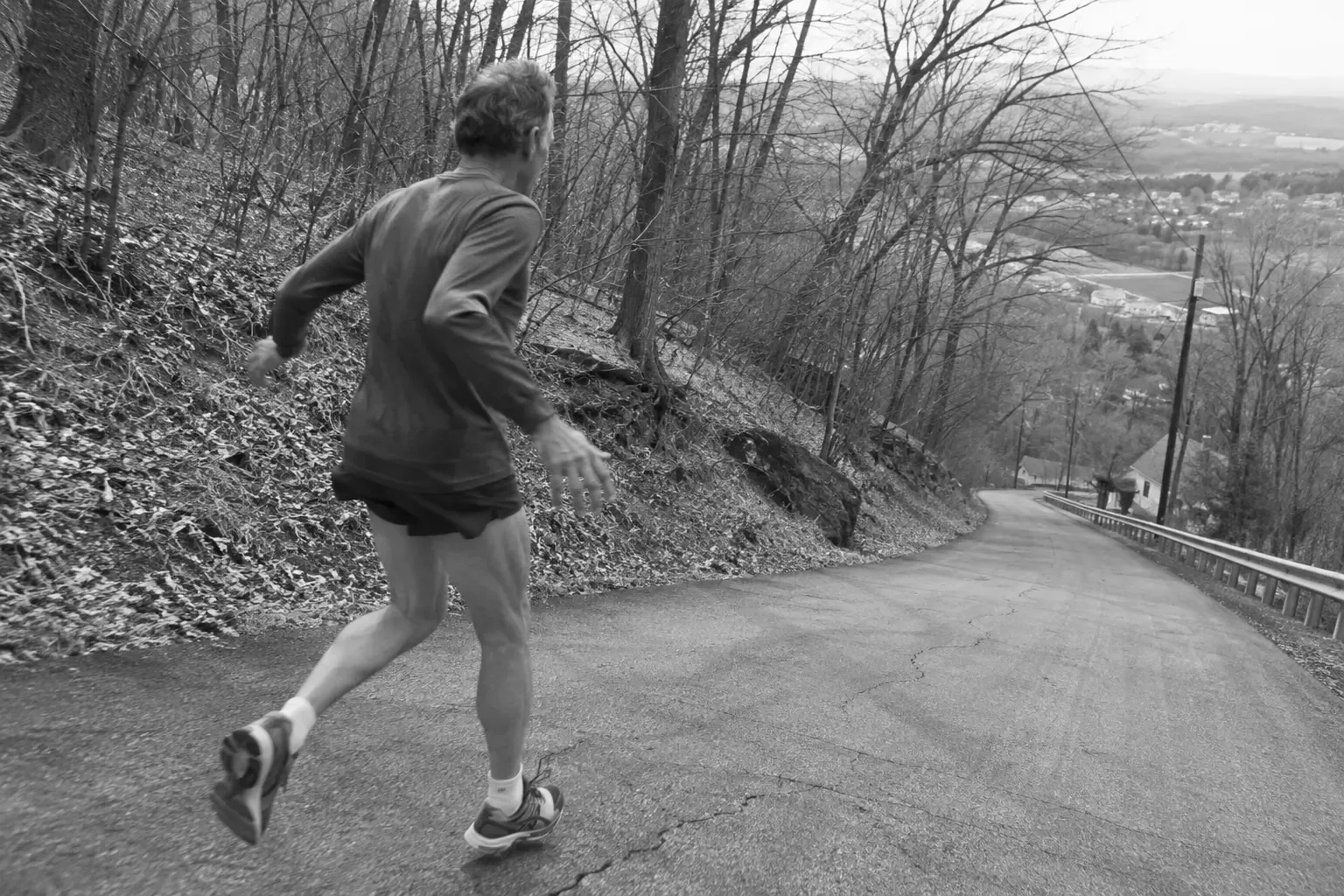
This is the session most Boston plans leave out. Running downhill loads your quads in a lengthening motion, and that is what leaves them sore and weak late in the race. Your legs adapt to it, but only if you train it.
How to train your legs for Boston's downhills
- Find a hill
Pick a road or path that drops gently for 200 to 400 m (0.1 to 0.25 mi), about the slope of a highway off ramp. Steep hills teach you to brake, which is the opposite of what you want.
- Start small in week 6
Run 4 x 200 m (0.1 mi) downhill at a relaxed, quick stride, walking or jogging back up. Do it once a week after an easy run.
- Build to longer repeats
Add one repeat each week, then lengthen them. By week 12, aim for 6 to 8 x 400 m (0.25 mi) downhill at about marathon pace.
- Put downhills in your long runs
Every other weekend, run your long run on a route with long descents in the second half, so you practice downhill running on tired legs.
- Hold form on the way down
Short, quick steps, feet landing under your hips, a slight lean forward from the ankles. If you hear your feet slapping, you are braking.
Back off for a week if your quads stay sore for more than two days after a session. Stop and see a physio if pain is sharp or in a joint.
How to train for the Newton hills and Heartbreak Hill
You do not need steep hill repeats for Boston. You need to climb steadily on tired legs, so the training is about when you run hills, not how hard.
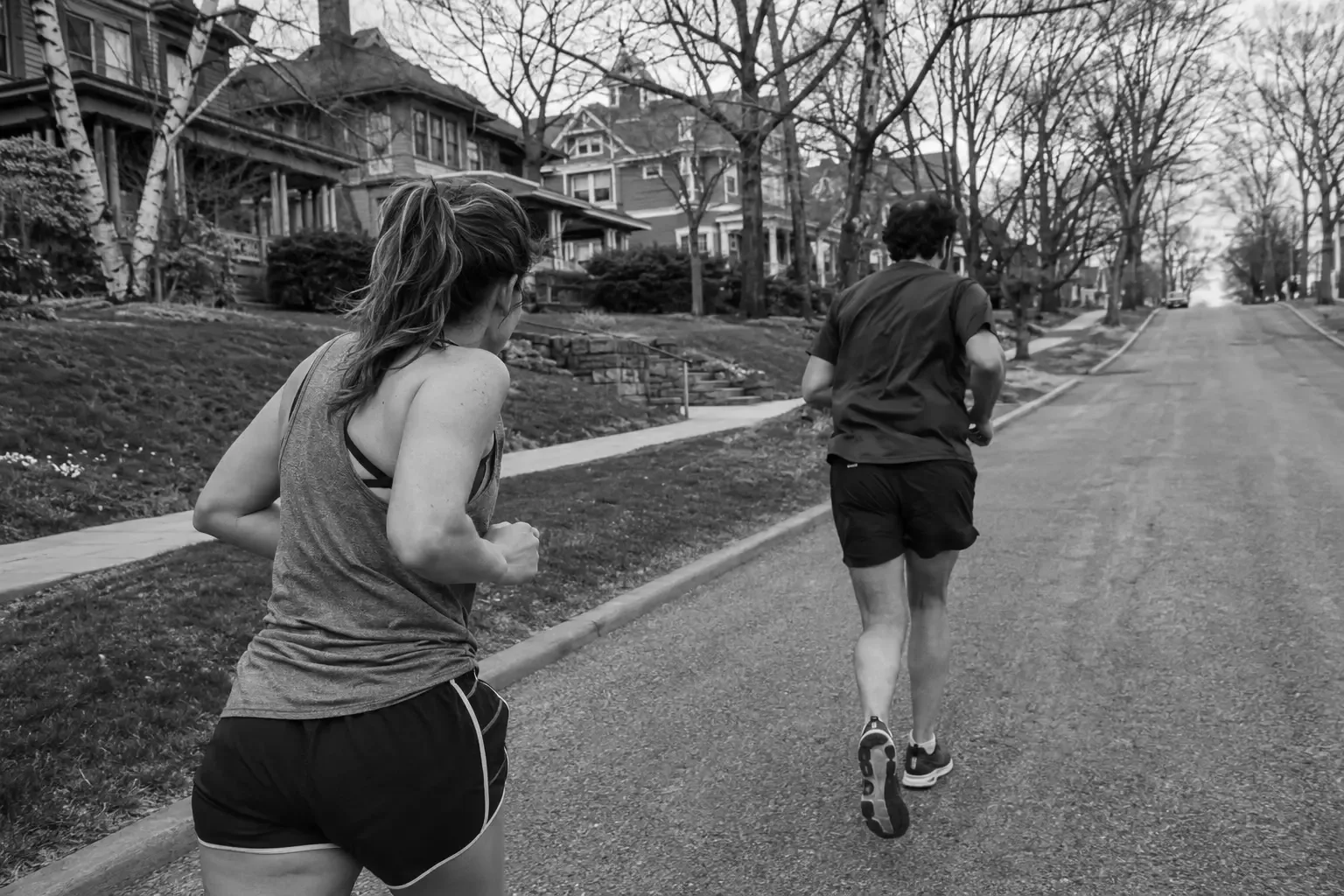
- Hilly long runs. Once every two weeks, put rolling climbs in the last third of your long run, around km 24 to 32 (miles 15 to 20).
- Hill reps by effort. Run 6 to 8 x 90 seconds uphill at the effort of your 10K race, jogging down. Keep the effort steady, not the pace.
- Practice the pace drop. Your pace will slow 10 to 20 s/km (15 to 30 s/mi) on each climb. That is normal. Hold the effort and let the pace go, then get it back on the downhill after the top.
If you train on a treadmill in winter, set a 2 to 3 percent incline for 3 to 5 minutes at a time inside a longer run. Most treadmills cannot go downhill, so do the downhill sessions outside when the roads are clear.
Training through a New England winter
Boston training runs from December to April, so most of your long runs happen in the cold, and race day can be anything from cold rain to a warm spring morning. Plan for both.

- Cold long runs. Dress for the second half, not the first 10 minutes. Gloves and a hat go on and off easily. Take your fluids even when you do not feel thirsty.
- Ice and snow days. Move the long run a day, or split it into a treadmill session and an outdoor one. A missed week is not a lost block, as what to do after a missed long run explains.
- A warm race day. If the forecast is warm, slow your goal pace and drink earlier. If you have a heart condition or have struggled in heat before, check with a doctor before you race.
A sample Boston week at peak
Here is what a peak week looks like for a runner around 60 km (37 mi) a week. Scale the distances to your level, and keep the order.
| Day | Session | Distance | The Boston twist |
|---|---|---|---|
| Monday | Rest or easy cross training | n/a | Recovery from the long run |
| Tuesday | Easy run plus downhill repeats | 10 km (6 mi) | 6 x 400 m (0.25 mi) downhill |
| Wednesday | Easy run | 8 km (5 mi) | Rolling route |
| Thursday | Marathon pace run | 14 km (9 mi) with 8 km (5 mi) at goal pace | Run it on rolling roads |
| Friday | Rest | n/a | |
| Saturday | Easy run | 6 km (4 mi) | Easy, short |
| Sunday | Long run | 29 to 32 km (18 to 20 mi) | Hills in the last third |
General training guidance, not medical advice. Check with a doctor before increasing training if you have symptoms or a health condition.
For a full week by week build, the plan engine below lays out an 18 week marathon block. Add the downhill and hill sessions above from week 6.
18-week marathon training plan
Every distance is in km and miles; every pace is per km and per mile. Lighter weeks are marked under the week number.
| Week | Mon | Tue | Wed | Thu | Fri | Sat | Sun | Total |
|---|---|---|---|---|---|---|---|---|
| Week 1Base | MonEasy4.8 km (3 mi)Conversational effort | TueEasy4.7 km (2.9 mi)Conversational effort | WedEasy4.7 km (2.9 mi)Conversational effort | ThuEasy4.7 km (2.9 mi)Conversational effort | FriRest | SatRest | SunLong11.1 km (6.9 mi)Conversational effort | Week total30 km (18.6 mi) |
| Week 2Base | MonEasy5.2 km (3.2 mi)Conversational effort | TueEasy5.2 km (3.2 mi)Conversational effort | WedEasy5.1 km (3.2 mi)Conversational effort | ThuEasy5.1 km (3.2 mi)Conversational effort | FriRest | SatRest | SunLong12.1 km (7.5 mi)Conversational effort | Week total32.7 km (20.3 mi) |
| Week 3Base | MonEasy5.6 km (3.5 mi)Conversational effort | TueEasy5.6 km (3.5 mi)Conversational effort | WedEasy5.6 km (3.5 mi)Conversational effort | ThuEasy5.6 km (3.5 mi)Conversational effort | FriRest | SatRest | SunLong13.2 km (8.2 mi)Conversational effort | Week total35.6 km (22.1 mi) |
| Week 4Base, lighter week | MonEasy5.1 km (3.2 mi)Conversational effort | TueEasy5 km (3.1 mi)Conversational effort | WedEasy5 km (3.1 mi)Conversational effort | ThuEasy5 km (3.1 mi)Conversational effort | FriRest | SatRest | SunLong11.9 km (7.4 mi)Conversational effort | Week total32 km (19.9 mi) |
| Week 5Base | MonEasy5.5 km (3.4 mi)Conversational effort | TueEasy5.5 km (3.4 mi)Conversational effort | WedEasy5.5 km (3.4 mi)Conversational effort | ThuEasy5.5 km (3.4 mi)Conversational effort | FriRest | SatRest | SunLong12.9 km (8 mi)Conversational effort | Week total34.9 km (21.7 mi) |
| Week 6Build | MonEasy6 km (3.7 mi)Conversational effort | TueEasy6 km (3.7 mi)Conversational effort | WedEasy6 km (3.7 mi)Conversational effort | ThuTempo6 km (3.7 mi)Comfortably hard | FriRest | SatRest | SunLong14.1 km (8.8 mi)Conversational effort | Week total38.1 km (23.7 mi) |
| Week 7Build | MonEasy6.6 km (4.1 mi)Conversational effort | TueEasy6.5 km (4 mi)Conversational effort | WedEasy6.5 km (4 mi)Conversational effort | ThuTempo6.5 km (4 mi)Comfortably hard | FriRest | SatRest | SunLong15.4 km (9.6 mi)Conversational effort | Week total41.5 km (25.8 mi) |
| Week 8Build, lighter week | MonEasy5.9 km (3.7 mi)Conversational effort | TueEasy5.9 km (3.7 mi)Conversational effort | WedEasy5.9 km (3.7 mi)Conversational effort | ThuEasy5.8 km (3.6 mi)Conversational effort | FriRest | SatRest | SunLong13.8 km (8.6 mi)Conversational effort | Week total37.3 km (23.2 mi) |
| Week 9Build | MonEasy6.4 km (4 mi)Conversational effort | TueEasy6.4 km (4 mi)Conversational effort | WedEasy6.4 km (4 mi)Conversational effort | ThuEasy6.4 km (4 mi)Conversational effort | FriRest | SatRest | SunLong15.1 km (9.4 mi)Conversational effort | Week total40.7 km (25.3 mi) |
| Week 10Build | MonEasy7 km (4.3 mi)Conversational effort | TueEasy7 km (4.3 mi)Conversational effort | WedEasy7 km (4.3 mi)Conversational effort | ThuTempo7 km (4.3 mi)Comfortably hard | FriRest | SatRest | SunLong16.4 km (10.2 mi)Conversational effort | Week total44.4 km (27.6 mi) |
| Week 11Build | MonEasy7.7 km (4.8 mi)Conversational effort | TueEasy7.6 km (4.7 mi)Conversational effort | WedEasy7.6 km (4.7 mi)Conversational effort | ThuTempo7.6 km (4.7 mi)Comfortably hard | FriRest | SatRest | SunLong17.9 km (11.1 mi)Conversational effort | Week total48.4 km (30.1 mi) |
| Week 12Build, lighter week | MonEasy6.9 km (4.3 mi)Conversational effort | TueEasy6.9 km (4.3 mi)Conversational effort | WedEasy6.8 km (4.2 mi)Conversational effort | ThuEasy6.8 km (4.2 mi)Conversational effort | FriRest | SatRest | SunLong16.1 km (10 mi)Conversational effort | Week total43.5 km (27 mi) |
| Week 13Peak | MonEasy7.5 km (4.7 mi)Conversational effort | TueEasy7.5 km (4.7 mi)Conversational effort | WedEasy7.4 km (4.6 mi)Conversational effort | ThuEasy7.4 km (4.6 mi)Conversational effort | FriRest | SatRest | SunLong17.6 km (10.9 mi)Conversational effort | Week total47.4 km (29.5 mi) |
| Week 14Peak | MonEasy8.2 km (5.1 mi)Conversational effort | TueEasy8.2 km (5.1 mi)Conversational effort | WedEasy8.1 km (5 mi)Conversational effort | ThuTempo8.1 km (5 mi)Comfortably hard | FriRest | SatRest | SunLong19.1 km (11.9 mi)Conversational effort | Week total51.7 km (32.1 mi) |
| Week 15Peak | MonEasy8.9 km (5.5 mi)Conversational effort | TueEasy8.9 km (5.5 mi)Conversational effort | WedEasy8.9 km (5.5 mi)Conversational effort | ThuTempo8.8 km (5.5 mi)Comfortably hard | FriRest | SatRest | SunLong20.9 km (13 mi)Conversational effort | Week total56.4 km (35 mi) |
| Week 16Taper | MonEasy6.7 km (4.2 mi)Conversational effort | TueEasy6.7 km (4.2 mi)Conversational effort | WedEasy6.6 km (4.1 mi)Conversational effort | ThuEasy6.6 km (4.1 mi)Conversational effort | FriRest | SatRest | SunLong15.7 km (9.8 mi)Conversational effort | Week total42.3 km (26.3 mi) |
| Week 17Taper | MonEasy5 km (3.1 mi)Conversational effort | TueEasy5 km (3.1 mi)Conversational effort | WedEasy5 km (3.1 mi)Conversational effort | ThuEasy5 km (3.1 mi)Conversational effort | FriRest | SatRest | SunLong11.7 km (7.3 mi)Conversational effort | Week total31.7 km (19.7 mi) |
| Week 18Taper, race week | MonEasy3.8 km (2.4 mi)Conversational effort | TueEasy3.8 km (2.4 mi)Conversational effort | WedEasy3.7 km (2.3 mi)Conversational effort | ThuEasy3.7 km (2.3 mi)Conversational effort | FriRest | SatRest | SunLong8.8 km (5.5 mi)Conversational effort | Week total23.8 km (14.8 mi) |
Race week. Keep the final week light. Start conservatively and adjust to conditions. Goal pace is a target, not a promised finish time.
- Easy
- Build aerobic endurance at a conversational effort.
- Rest
- Absorb training and recover for the next session.
- Long
- Build time on your feet without racing the session.
- Tempo
- Practice controlled quality with easy warm-up and cooldown.
General training guidance, not medical advice. Check with a doctor before increasing training if you have symptoms or a health condition.
The marathon training plan guide explains each phase and how to pick your level.
How to pace Boston
The race is won or lost in the first 16 km (10 mi). Here is a pacing plan built around a 3:30 goal, which is an average of 4:59 /km (8:01 /mi). Use the same shape for any goal time.
| Section | Distance | Plan | Example for a 3:30 goal |
|---|---|---|---|
| Hopkinton downhill | km 0 to 6 (mi 0 to 4) | 5 to 10 s/km slower than goal | 5:05 to 5:10 /km (8:11 to 8:19 /mi) |
| Rolling middle | km 6 to 26 (mi 4 to 16) | Goal pace, by feel | 4:59 /km (8:01 /mi) |
| Newton hills | km 26 to 34 (mi 16 to 21) | Hold effort, let pace drop | 5:10 to 5:20 /km (8:19 to 8:35 /mi) on climbs |
| Run in to Boston | km 34 to 42.2 (mi 21 to 26.2) | Goal pace or faster if your legs allow | 4:50 to 4:59 /km (7:47 to 8:01 /mi) |
Type in your own goal time to get your kilometer and mile splits:
Marathon pace calculator
Splits for a 4:00:00 marathon, even pace
- Average pace per km
- 5:41 /km
- Average pace per mile
- 9:09 /mi
- Halfway
- 2:00:00
- Second half
- 2:00:00
Kilometer splits
| km | mi | Split | Elapsed |
|---|---|---|---|
| 1 | 0.6 | 5:41 | 5:41 |
| 2 | 1.2 | 5:41 | 11:23 |
| 3 | 1.9 | 5:41 | 17:04 |
| 4 | 2.5 | 5:41 | 22:45 |
| 5 | 3.1 | 5:41 | 28:26 |
| 6 | 3.7 | 5:41 | 34:08 |
| 7 | 4.3 | 5:41 | 39:49 |
| 8 | 5 | 5:41 | 45:30 |
| 9 | 5.6 | 5:41 | 51:11 |
| 10 | 6.2 | 5:41 | 56:53 |
| 11 | 6.8 | 5:41 | 1:02:34 |
| 12 | 7.5 | 5:41 | 1:08:15 |
| 13 | 8.1 | 5:41 | 1:13:57 |
| 14 | 8.7 | 5:41 | 1:19:38 |
| 15 | 9.3 | 5:41 | 1:25:19 |
| 16 | 9.9 | 5:41 | 1:31:00 |
| 17 | 10.6 | 5:41 | 1:36:42 |
| 18 | 11.2 | 5:41 | 1:42:23 |
| 19 | 11.8 | 5:41 | 1:48:04 |
| 20 | 12.4 | 5:41 | 1:53:45 |
| 21 | 13 | 5:41 | 1:59:27 |
| 22 | 13.7 | 5:41 | 2:05:08 |
| 23 | 14.3 | 5:41 | 2:10:49 |
| 24 | 14.9 | 5:41 | 2:16:31 |
| 25 | 15.5 | 5:41 | 2:22:12 |
| 26 | 16.2 | 5:41 | 2:27:53 |
| 27 | 16.8 | 5:41 | 2:33:34 |
| 28 | 17.4 | 5:41 | 2:39:16 |
| 29 | 18 | 5:41 | 2:44:57 |
| 30 | 18.6 | 5:41 | 2:50:38 |
| 31 | 19.3 | 5:41 | 2:56:19 |
| 32 | 19.9 | 5:41 | 3:02:01 |
| 33 | 20.5 | 5:41 | 3:07:42 |
| 34 | 21.1 | 5:41 | 3:13:23 |
| 35 | 21.7 | 5:41 | 3:19:05 |
| 36 | 22.4 | 5:41 | 3:24:46 |
| 37 | 23 | 5:41 | 3:30:27 |
| 38 | 23.6 | 5:41 | 3:36:08 |
| 39 | 24.2 | 5:41 | 3:41:50 |
| 40 | 24.9 | 5:41 | 3:47:31 |
| 41 | 25.5 | 5:41 | 3:53:12 |
| 42 | 26.1 | 5:41 | 3:58:53 |
| 42.2 | 26.2 | 1:07 | 4:00:00 |
Mile splits
| Mile | km | Split | Elapsed |
|---|---|---|---|
| 1 | 1.6 | 9:09 | 9:09 |
| 2 | 3.2 | 9:09 | 18:18 |
| 3 | 4.8 | 9:09 | 27:28 |
| 4 | 6.4 | 9:09 | 36:37 |
| 5 | 8 | 9:09 | 45:46 |
| 6 | 9.7 | 9:09 | 54:55 |
| 7 | 11.3 | 9:09 | 1:04:05 |
| 8 | 12.9 | 9:09 | 1:13:14 |
| 9 | 14.5 | 9:09 | 1:22:23 |
| 10 | 16.1 | 9:09 | 1:31:32 |
| 11 | 17.7 | 9:09 | 1:40:41 |
| 12 | 19.3 | 9:09 | 1:49:51 |
| 13 | 20.9 | 9:09 | 1:59:00 |
| 14 | 22.5 | 9:09 | 2:08:09 |
| 15 | 24.1 | 9:09 | 2:17:18 |
| 16 | 25.7 | 9:09 | 2:26:28 |
| 17 | 27.4 | 9:09 | 2:35:37 |
| 18 | 29 | 9:09 | 2:44:46 |
| 19 | 30.6 | 9:09 | 2:53:55 |
| 20 | 32.2 | 9:09 | 3:03:05 |
| 21 | 33.8 | 9:09 | 3:12:14 |
| 22 | 35.4 | 9:09 | 3:21:23 |
| 23 | 37 | 9:09 | 3:30:32 |
| 24 | 38.6 | 9:09 | 3:39:41 |
| 25 | 40.2 | 9:09 | 3:48:51 |
| 26 | 41.8 | 9:09 | 3:58:00 |
| 26.2 | 42.2 | 2:00 | 4:00:00 |
4:00:00 marathon · even pace
- 5 km28:26
- 10 km56:53
- 15 km1:25:19
- 20 km1:53:45
- 25 km2:22:12
- 30 km2:50:38
- 35 km3:19:05
- 40 km3:47:31
- 42.2 km4:00:00
Raceblock pace band · myraceblock.com
The marathon pace chart has every goal time on one page. If you want to finish faster than you started, the idea behind a negative split is exactly what Boston rewards: patience early, strength late.
Common Boston training mistakes
- Training only on flat roads. Your legs reach Hopkinton never having run 6 km (4 mi) downhill at speed. The cost shows up after km 30 as sore, weak quads.
- Treating Heartbreak Hill as the whole race. Runners save everything for one hill and ignore the descents that do the damage. Train both.
- Racing the first half. Banking time on the downhill feels smart. It usually costs more time in Newton than it saved.
- Skipping long runs in bad weather. One move is fine. Three skipped long runs in January is a real gap.
- Changing everything in race week. New shoes, new gels and a new breakfast on the morning of a long wait are a risk you do not need.
When your training week falls apart
Everything above works on paper. Then January happens: a snowstorm on long run day, a sick week, a work trip in week 11. A printed plan does not move when your week does, so you end up guessing which runs to skip and how to catch up without doing too much at once.
That is the part Raceblock handles. Build your free plan for your race date. On the Coach plan, next week re-plans itself when you miss a run. It is built for Garmin and Apple Watch runners.
Free training plan
Build your free plan for your race date.
Pick your race and race date. Every week from today to race day is planned for you, with distances in km and miles.
Race week and the taper
Cut your weekly distance over the last 2 to 3 weeks and keep a little pace in your legs. The marathon taper guide has the week by week cuts. For Boston, add three things:

- Skip the downhill repeats in the last 10 days. Your legs need to arrive fresh, not adapted.
- Rehearse the morning. Do one long run where you eat breakfast 3 to 4 hours before you start, like the bus and Athletes' Village schedule will force you to.
- Pack for the wait. Old clothes to throw away at the start, extra food and a plan for rain.
Boston training in one line
Build a normal marathon block, add downhill running from week 6, put hills late in your long runs, and run the first 6 km (4 mi) slower than you want to. Heartbreak Hill is just a hill if your quads are still working when you get there.
If your race is booked, set April 19, 2027 in a free plan and add the Boston sessions to the weeks it builds.
Source: course profile and town by town route from the B.A.A. course page. Paces and schedules on this page are general coaching guidance, not a promised result.
Frequently asked questions
Give yourself 16 to 18 weeks of marathon training from a base of regular running. For the April 19, 2027 race, that means starting between mid and late December 2026. If you ran a marathon in the last six months and kept training, 12 weeks can work.
Most runners do well on four to five runs a week: one long run, one quality session such as downhill repeats or marathon pace, and two or three easy runs. Qualifiers chasing a time often run five or six days. Keep at least one full rest day.
Put rolling hills in the last third of your long runs every other week, so you practice climbing on tired legs. Add weekly downhill repeats from week 6, because sore quads from the downhill miles are what make Heartbreak Hill hard. On race day, hold your effort on the climb and let the pace slow.
Free training plan
Build your free plan for your race date.
On the Coach plan, next week re-plans itself when you miss a run.
Share article
About the author
More running training guides
Marathon training · 11 min
Ultramarathon Training Tips: 12 Habits Beyond the Miles
The best ultramarathon training tips are about everything except the running: your stomach, your feet, your stops, the dark and the downhills. Here are 12, one job at a time.

Marathon training · 9 min
How Long Is a Marathon Run? 26.2 Miles, 42.2 km and Hours
A marathon run is 42.195 km (26.2 miles). See the exact distance, why your watch reads long, how many hours it takes at each pace, and how to plan for yours.

Marathon training · 10 min
Marathon: The Ultimate Training Guide Review and Plan Picker
Hal Higdon's Marathon: The Ultimate Training Guide is worth reading for the rules behind its plans: pick a program by your running today, protect the long run, step back every third week. Here is what it covers, which program fits you, and how to keep a printed plan working when your week changes.
Marathon training · 11 min
Ultra Marathon Training Guide: First 50K Schedule and Tips
To train for your first ultra marathon, take a marathon build and change three things: train in hours on your feet, add back-to-back long runs, and practice walking the hills and eating on the run. Here is a 16 week 50K schedule by phase, a typical week, the fueling math and the mistakes that cost the most.

Marathon training · 13 min
Marathon Training Routine: Build a Week You Can Repeat
A good marathon training routine fixes two days, the long run and one quality session, and keeps everything else easy. Here is the weekly structure for 3, 4 or 5 runs, where strength and rest go, and how to fit it around work.
Marathon training · 10 min
16 Week Marathon Training Plan for Beginners: 4 Runs a Week
A 16 week marathon training plan for beginners who already run: 4 runs a week, a long run that grows from 18 km (11.2 mi) to 29 km (18 mi), lighter weeks every fourth week and a 3-week taper, in km and miles.