
Ultra Marathon Training Guide: First 50K Schedule and Tips
Raceblock team Updated November 19, 2026 11 min read
Free marathon plan for your race date

Free marathon plan for your race date
Build my free planIn this article
To train for your first ultra marathon, take a solid marathon build and change three things: train in hours on your feet instead of pace, add back-to-back long runs on the weekend, and practice walking the hills and eating on the run. Most first ultras are a 50 km (31 mi) race, and 16 weeks is a sensible block if you can already run a half marathon comfortably.
The part most runners get wrong is speed. An ultra is not a faster marathon, it is a slower, longer day where the legs that walk the climbs well and the stomach that keeps taking food decide how it goes. Your best training run for an ultra will feel almost too easy.
What counts as an ultra marathon?
An ultra marathon is any race longer than a marathon, so anything past 42.2 km (26.2 mi). The common first steps are 50 km (31 mi), then 50 mi (80 km), 100 km (62 mi) and 100 mi (161 km).
This guide is built around a first 50 km, because that is where almost everyone starts. A 50 km is only 7.8 km (4.9 mi) longer than a marathon, but it is usually on trails with climbing, so it takes far longer than the extra distance suggests. If you have only run road races, plan for time on your feet, not a finish time.
How long should you train for an ultra marathon?
Plan on 12 to 24 weeks for a first 50 km, depending on where you start. The table below is the verdict by starting point. The weeks assume four or five runs a week and no injury breaks.
| Where you are now | Weeks to a first 50 km (31 mi) | Your first job |
|---|---|---|
| Ran a marathon in the last 6 months | 12 to 16 | Add hills, back-to-back long runs and eating on the run |
| Ran a half marathon, never a marathon | 16 to 24 | Build to 40 km (25 mi) a week before the block starts |
| Run regularly, nothing longer than 10 km (6.2 mi) | 24 or more | Run a marathon block first, then come back |
If you have already run a marathon
You have the hard part: a body that handles a 30 km (19 mi) long run. A 12 to 16 week block works. Keep your usual week and swap the marathon-pace work for hills and hiking. The big change is the weekend: one long run becomes two runs on back-to-back days.
If your longest race is a half marathon
Give yourself 16 weeks at least, and more if your week is under 30 km (19 mi). Spend the first month building distance at easy pace, the way you would at the start of a marathon training plan. Only add the ultra-specific work once 40 km (25 mi) a week feels routine.
If you have never raced past 10 km
Run a marathon first, or at least train through a full 16 week marathon training plan before you sign up for an ultra. Jumping straight from 10 km to 50 km stacks too much new distance into one block, and that is when runners get hurt or stop enjoying it.
The ultra marathon training schedule, phase by phase
Here is a 16 week schedule for a first 50 km, starting from about 40 km (25 mi) a week. Every third or fourth week, cut the distance by about a quarter so your body catches up.
| Weeks | Phase | Weekly distance | Long run | Key session |
|---|---|---|---|---|
| 1 to 4 | Base | 40 to 50 km (25 to 31 mi) | 16 to 22 km (10 to 14 mi) | Strides and short hills |
| 5 to 9 | Build | 50 to 60 km (31 to 37 mi) | 24 to 30 km (15 to 19 mi) | First back-to-backs, hill repeats |
| 10 to 13 | Peak | 60 to 70 km (37 to 43 mi) | 32 to 38 km (20 to 24 mi), or 30 km + 15 km (19 mi + 9 mi) on back-to-back days | Race-terrain long runs with race food |
| 14 to 16 | Taper | About 70%, then 50%, then race week | 24 km (15 mi), then 16 km (10 mi), then race | Short easy runs, a few strides |
Notice what is missing: a long run of 50 km. You do not need to run the race distance in training. Your longest single run tops out around 38 km (24 mi), and the back-to-back weekend gives you the tired-legs practice without the recovery cost of one huge run.
General training guidance, not medical advice. Check with a doctor before increasing training if you have symptoms or a health condition.
A typical week in the build phase
| Day | Session | Example |
|---|---|---|
| Monday | Rest | Walk, mobility |
| Tuesday | Easy run plus strides | 10 km (6.2 mi) easy, 6 x 20 seconds fast and relaxed |
| Wednesday | Hills | 8 x 90 seconds uphill, walk or jog down |
| Thursday | Easy run | 8 to 10 km (5 to 6.2 mi) |
| Friday | Rest | Or 30 minutes of strength work |
| Saturday | Long run | 24 to 30 km (15 to 19 mi) on trail, race food |
| Sunday | Back-to-back run | 10 to 15 km (6.2 to 9.3 mi) easy on tired legs |
If your week does not fit that shape, our marathon training routine guide shows how to move the pieces around a work week.
Keep 80% of your running easy
The 80% rule in running means about 80% of your training is easy and about 20% is hard. In a review of well-trained endurance athletes, about 80% of sessions were at low intensity (Seiler, 2010). For an ultra, the easy share often runs even higher, because the long runs and back-to-backs are all easy.

Easy means you can talk in full sentences. As a guide, if your marathon pace is 6:00 /km (9:39 /mi), your flat ultra long runs sit around 7:00 to 7:30 /km (11:16 to 12:04 /mi), and slower on trail. Check your paces against a recent race with the race time predictor rather than guessing.
Keep one quality session a week: hills in the build, a short tempo in the base. The how to run faster guide covers strides, hills and tempo runs in detail. Do not add a second hard day just because the plan feels gentle. The volume is the hard part.
Train in hours, not kilometers
On trails, kilometers lie. A 20 km (12.4 mi) run with 800 m (2,625 ft) of climbing can take as long as 28 km (17.4 mi) on the road. So set your long runs in time: 2 hours, 3 hours, 4 hours, at easy effort, on terrain like your race.
Your race page lists the distance and the total climbing. Divide the climbing by the distance and you know how hilly your long runs should be. If you live somewhere flat, use stairs, a treadmill on incline or repeats of the one hill you have.
Walk the hills on purpose
Power hiking is the ultra skill road runners skip. On anything steep, a strong hike is about as fast as a slow jog and costs far less energy. Almost everyone walks the climbs in a 50 km, so practice it.

How to practice:
- In every long run, hike any climb you could not talk on
- Lean slightly forward from the ankles, short steps, hands on thighs on the steepest bits
- Once a week in the build, do 6 to 10 minutes of steep hiking intervals on a hill or treadmill
The descent matters as much. Running downhill on rocks with tired legs is where many first ultras fall apart. Include a few kilometers of downhill in your long runs from week 5 so your quads are ready.

Back-to-back long runs
A back-to-back is a long run on Saturday and a second, shorter run on Sunday. The second day teaches you to keep moving on tired legs, which is what the last third of an ultra feels like.
Start in the build phase with something like 24 km (15 mi) on Saturday and 10 km (6.2 mi) on Sunday. Build to about 30 km (19 mi) plus 15 km (9.3 mi) at the peak. Run the Sunday slower than feels necessary. If your legs hurt rather than just feel heavy, stop and rest. Pain, swelling or a limp means see a doctor or physio.
Eat and drink like it is race day
Fuel is the difference between a hard ultra and a miserable one. The International Society of Sports Nutrition recommends 150 to 400 kcal an hour during an ultra, with 30 to 50 g of carbohydrate, plus 450 to 750 mL (15 to 25 fl oz) of fluid an hour (ISSN position stand, 2019). Needs go up in heat; if you race in the heat, see a professional about fluid and sodium.
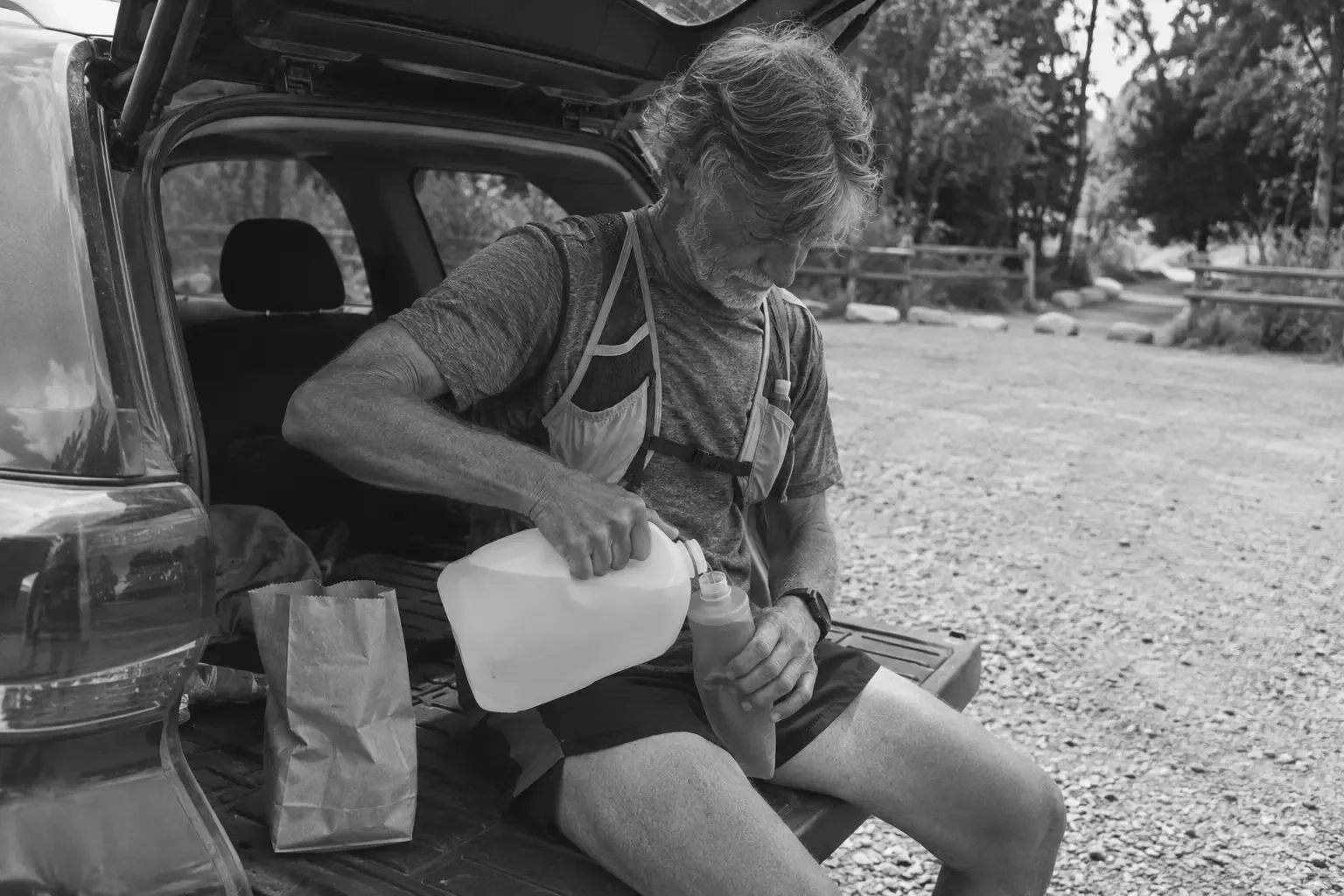
Do the math for your race. A 50 km that takes you 6 hours at 40 g of carbs an hour is 240 g of carbs. Check the label on your gels or chews and work out how many that is. Then eat on that schedule in every long run over 2 hours, starting in the first 30 minutes, so your stomach learns to handle it. Many ultra runners switch to real food after a few hours: a small sandwich, boiled potatoes, crackers. Try those in training too.
Gear you actually need
Keep it short. You need shoes that grip on your race terrain, a running vest that carries your water and food, and the kit your race lists as mandatory.

Wear every item on at least three long runs before race day: shoes, socks, vest, shorts, the lot. A vest that rubs at 20 km (12.4 mi) will rub much worse at 45 km (28 mi). If your race starts in the dark or runs past sunset, practice with a headlamp on a real trail. Our list of ultra training tips shows how to plan that first night run and how to time your aid station stops.
Ultra marathon training tips: the mistakes that cost the most
| Mistake | What it costs | Fix |
|---|---|---|
| Running long runs too fast | You arrive at the peak tired and stale | Keep long runs at a talking pace, walk the climbs |
| Never eating on training runs | Stomach trouble and no energy late in the race | Race food on every run over 2 hours |
| Only running on roads | Sore quads and slow, nervous descents | Long runs on race-like terrain from week 5 |
| Adding distance too fast | Niggles that turn into weeks off | About a quarter cut every third or fourth week |
| New gear on race day | Blisters and rubbing | Test everything on three long runs |
| Skipping the taper | Starting tired | Cut to about 70% then 50% in the last two weeks |
The marathon taper rules work for a 50 km almost unchanged.
Where a written plan breaks
Everything above works on paper. The wall comes in week 7, when a work trip lands on your back-to-back weekend, or you get a cold and miss the 28 km (17.4 mi) long run. A fixed schedule does not move. You are left guessing whether to make it up, skip it, or push the whole block back, and most runners guess by doing too much the next weekend. Our guide to a missed long run covers the rules, but the plan still does not move when your week does.
That is the part Raceblock handles. Raceblock builds marathon plans, the base block most first 50 km runners train from. Build your free plan for your race date. On the Coach plan, next week re-plans itself when you miss a run.
Free training plan
Build your free plan for your race date.
Pick your race and race date. Every week from today to race day is planned for you, with distances in km and miles.
Your first ultra in one line
Build from a marathon base, keep your running easy, train in hours on race-like terrain, walk the hills on purpose, and eat 30 to 50 g of carbs an hour on every long run. Then taper and start slower than feels right.

If your race is booked, set the date in a free plan and build the base block that the ultra work sits on.
Source: intensity split from Seiler (2010), International Journal of Sports Physiology and Performance; fueling and fluid figures from the International Society of Sports Nutrition position stand on ultra marathon nutrition (2019). Schedules on this page are general coaching guidance.
Frequently asked questions
Pick a 50 km (31 mi) race about 16 weeks out, build from a base of about 40 km (25 mi) a week, and train mostly at easy pace. Add back-to-back long runs, power hiking and eating on the run from the build phase, taper for two weeks, and start the race slower than feels right.
It means about 80% of your training is easy and about 20% is hard. For ultra training the easy share is often higher, because the long runs and back-to-back runs are all at a talking pace. Keep one quality session a week, such as hills.
Yes, if you have run a marathon in the last six months and already run about 40 km (25 mi) a week with long runs of 25 to 30 km (16 to 19 mi). From a half marathon base or less, give yourself 16 to 24 weeks.
Free training plan
Build your free plan for your race date.
On the Coach plan, next week re-plans itself when you miss a run.
Share article
About the author
More running training guides

Marathon training · 11 min
Ultramarathon Training Tips: 12 Habits Beyond the Miles
The best ultramarathon training tips are about everything except the running: your stomach, your feet, your stops, the dark and the downhills. Here are 12, one job at a time.

Marathon training · 9 min
How Long Is a Marathon Run? 26.2 Miles, 42.2 km and Hours
A marathon run is 42.195 km (26.2 miles). See the exact distance, why your watch reads long, how many hours it takes at each pace, and how to plan for yours.

Marathon training · 12 min
Boston Marathon Training Guide: Hills, Downhills and Pacing
To train for the Boston Marathon, run a normal 16 to 18 week marathon build and add two things: downhill running for your quads and a patient first half. Here is the block for April 19, 2027, the hill work, a peak week and a pacing plan.

Marathon training · 10 min
Marathon: The Ultimate Training Guide Review and Plan Picker
Hal Higdon's Marathon: The Ultimate Training Guide is worth reading for the rules behind its plans: pick a program by your running today, protect the long run, step back every third week. Here is what it covers, which program fits you, and how to keep a printed plan working when your week changes.

Marathon training · 13 min
Marathon Training Routine: Build a Week You Can Repeat
A good marathon training routine fixes two days, the long run and one quality session, and keeps everything else easy. Here is the weekly structure for 3, 4 or 5 runs, where strength and rest go, and how to fit it around work.

Marathon training · 10 min
16 Week Marathon Training Plan for Beginners: 4 Runs a Week
A 16 week marathon training plan for beginners who already run: 4 runs a week, a long run that grows from 18 km (11.2 mi) to 29 km (18 mi), lighter weeks every fourth week and a 3-week taper, in km and miles.