
50K Ultramarathon Training Plan: 16 Weeks, Week by Week
Raceblock team November 20, 2026 10 min read
Free marathon plan for your race date
Free marathon plan for your race date
Build my free planIn this article
A 50K ultramarathon training plan for a first ultra takes 16 weeks if you already run about 40 km (25 mi) a week, or 12 weeks if you have a recent marathon in your legs. The plan below lists every week: weekly distance, the Saturday long run, the Sunday back-to-back run and the one key session, with every distance in km and miles.
Here is the part most plans hide: your midweek barely changes from marathon training. The whole 50K plan lives on the weekend. Get the weekends right and the rest is the running you already do.
Which version of the 50K plan fits you?
Pick your start point by what you run now, not by the race you want. The table is the verdict.
| Where you are now | Plan length | Start at |
|---|---|---|
| Ran a marathon in the last 6 months, about 50 km (31 mi) a week now | 12 weeks | Week 5 of the plan below |
| Half marathon runner, 35 to 45 km (22 to 28 mi) a week | 16 weeks | Week 1 |
| Under 30 km (19 mi) a week | 20 weeks or more | Build to 40 km (25 mi) a week first, then week 1 |
If you are in the last row, spend those first weeks on easy running only. A plain marathon training plan base phase does that job well. For the bigger picture of what changes between a marathon and an ultra, our ultra marathon training guide covers it phase by phase. This post is the full week by week schedule.
The 16 week 50K training plan, week by week
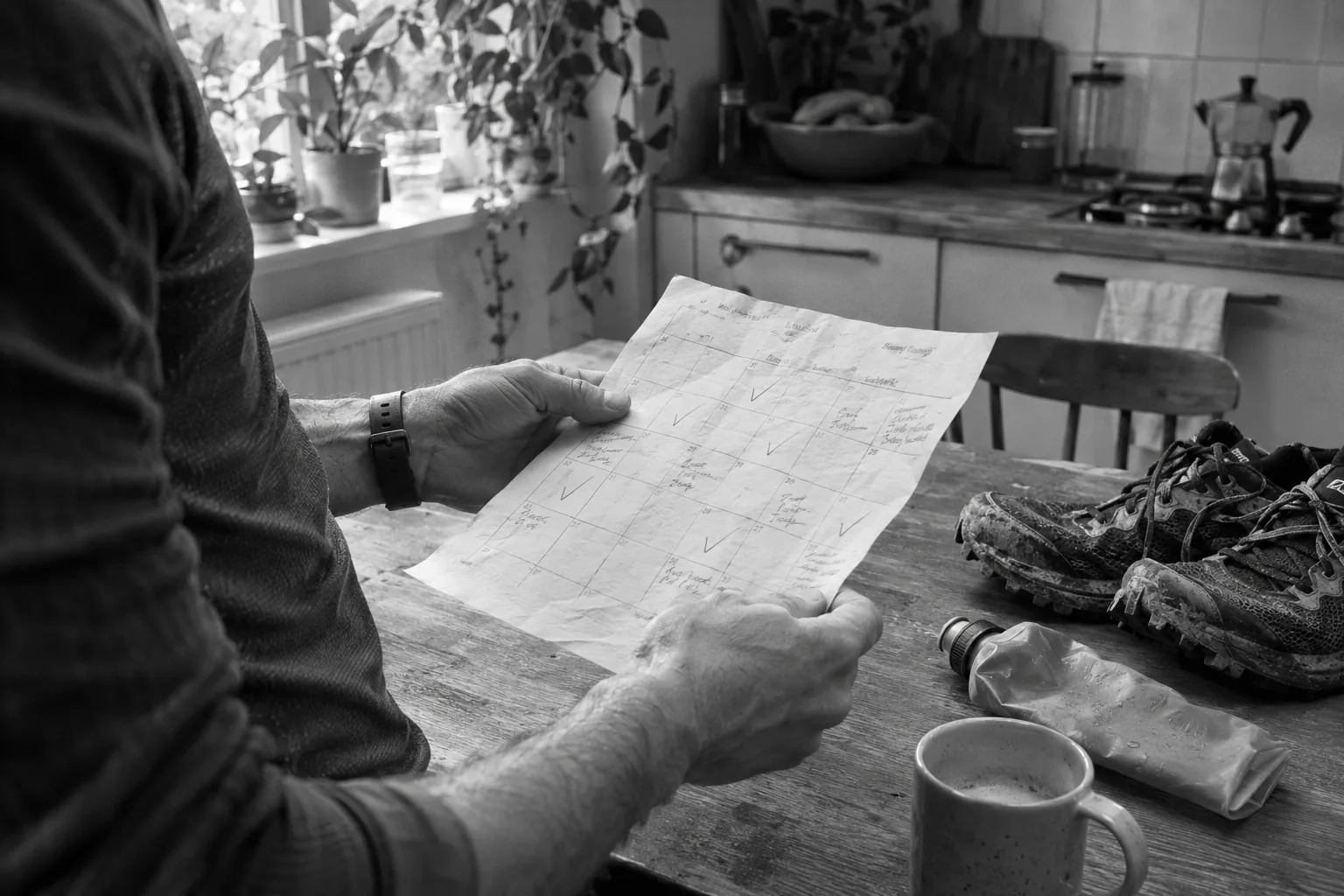
Four runs on weekdays stay short: two easy runs, one key session and one optional easy run or rest. Everything that makes this an ultra plan sits in the two weekend columns.
| Week | Phase | Weekly distance | Saturday long run | Sunday run | Key midweek session |
|---|---|---|---|---|---|
| 1 | Base | 40 km (25 mi) | 18 km (11 mi) | Rest | 6 x 20 seconds strides |
| 2 | Base | 44 km (27 mi) | 20 km (12.4 mi) | 6 km (3.7 mi) | 6 x 60 seconds uphill |
| 3 | Base | 48 km (30 mi) | 22 km (13.7 mi) | 8 km (5 mi) | 8 x 60 seconds uphill |
| 4 | Cutback | 38 km (24 mi) | 16 km (10 mi) | Rest | Strides only |
| 5 | Build | 50 km (31 mi) | 24 km (15 mi) | 10 km (6.2 mi) | 6 x 90 seconds uphill |
| 6 | Build | 54 km (34 mi) | 26 km (16 mi) | 12 km (7.5 mi) | 8 x 90 seconds uphill |
| 7 | Build | 58 km (36 mi) | 28 km (17.4 mi) | 12 km (7.5 mi) | 20 minutes steady, comfortably hard |
| 8 | Cutback | 44 km (27 mi) | 20 km (12.4 mi) | 8 km (5 mi) | Strides only |
| 9 | Build | 60 km (37 mi) | 30 km (18.6 mi) | 14 km (8.7 mi) | 10 x 90 seconds uphill |
| 10 | Peak | 64 km (40 mi) | 32 km (20 mi) on race terrain | 15 km (9.3 mi) | 25 minutes steady |
| 11 | Peak | 66 km (41 mi) | 34 km (21 mi), the longest run | 12 km (7.5 mi) | Easy hills, hike the steep parts |
| 12 | Cutback | 48 km (30 mi) | 22 km (13.7 mi) | 8 km (5 mi) | Strides only |
| 13 | Peak | 68 km (42 mi) | 30 km (18.6 mi) | 18 km (11 mi), the biggest weekend | 8 x 90 seconds uphill |
| 14 | Taper | 50 km (31 mi) | 24 km (15 mi) | 8 km (5 mi) | 15 minutes steady |
| 15 | Taper | 38 km (24 mi) | 16 km (10 mi) | 6 km (3.7 mi) | Strides only |
| 16 | Race week | About 20 km (12 mi) before race day | Race: 50 km (31 mi) | Rest | 3 short easy runs |
General training guidance, not medical advice. Check with a doctor before increasing training if you have symptoms or a health condition.
How to read the table
- Easy means easy. Run the long runs and the Sunday runs at a pace where you can talk in full sentences, often 60 to 90 seconds per km (1:37 to 2:25 per mi) slower than your marathon pace.
- Weekdays fill the gap. Weekly distance minus the weekend is your weekday total. In week 9 that is 60 minus 44, so 16 km (10 mi) over three short runs.
- Hill reps are effort, not pace. Run up hard but controlled, then walk or jog down. They build the climbing legs a 50K needs without long fast running.
- The weeks are a guide, not a contract. If a cutback week lands on a holiday, swap it with the week before. Keep the order of the big weekends.

Why the weekend does the work
The 50K is only 7.8 km (4.9 mi) longer than a marathon, but it usually takes an hour or more longer because of hills, terrain and walking. What breaks first is not your fitness. It is your legs late in the day.
The back-to-back weekend trains exactly that. Saturday tires you, and Sunday makes you run on those tired legs without the recovery cost of one giant run. Week 13 gives you 48 km (30 mi) in two days, close to race distance, while your longest single run never goes past 34 km (21 mi). That is the trade: you get the race-day fatigue in training and still recover by Tuesday.
Treat the Sunday run as the easiest run of the week. If it feels slow and heavy, it is working. If you feel fresh, you probably ran Saturday too easy, which is fine.
Road 50K or trail 50K: adjust the plan
The weekly numbers stay the same either way. What changes is where you run the long runs and how much you walk.
| Your race | Long runs on | Hiking | What to add |
|---|---|---|---|
| Flat road or path 50K | Road or flat paths | Little or none | Practice an even pace and a short walk break every 5 km (3.1 mi) |
| Rolling trail, under 1,000 m (3,300 ft) of climb | Trail, mixed | Walk the steep pitches | Downhill running on the long runs |
| Hilly trail, over 1,000 m (3,300 ft) of climb | The steepest trail you can reach | Hike every climb you cannot run at easy effort | Hill reps every week and the strength work runners need twice a week |
On a hilly course, practice power hiking on purpose. Hands on thighs, short steps, steady breathing. Most first 50K runners walk more than they planned, so practice the walking too.

For hilly races, judge the long run by time on your feet as well as distance. A 30 km (18.6 mi) trail run can take as long as a 36 km (22 mi) road run.
Fuel every long run like race day
A 50K on its feet for five to seven hours needs food, and your gut needs training as much as your legs. Use every Saturday from week 5 on as a rehearsal.
- Carbs per hour: start near 30 g an hour and build toward 60 g. That range comes from sports nutrition research on carbohydrate intake during exercise for efforts of one to three hours.
- Real food counts: a 50K is slow enough to eat. Try a mix of gels, bars and plain foods, and keep what your stomach likes.
- Fluids and salt: drink to thirst and test the drink the race will serve.
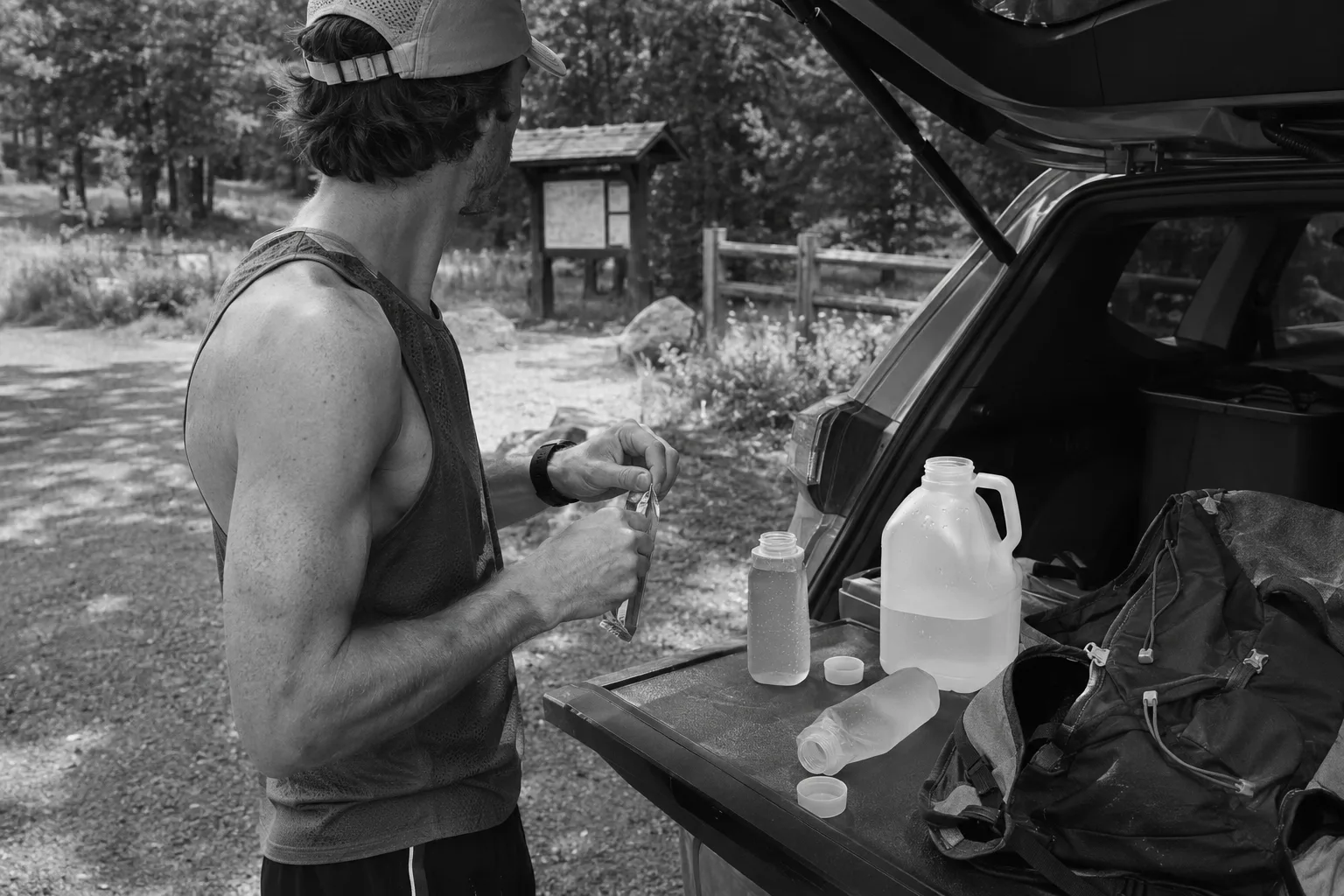
- Rehearse the stop: set up your car or a bench as an aid station on a loop course and practice refilling in under two minutes.
The International Society of Sports Nutrition position stand on ultramarathon training is worth a read if you want the detail. Our ultramarathon training tips post covers gut training and aid station practice in more depth.
The 50K plan mistakes that cost the most
- Running the weekend too fast. A Saturday at marathon effort leaves nothing for Sunday and wrecks the next week. Slow down until Sunday is possible.
- Making up a missed long run. Do not stack it onto the next weekend. Read our rules for a missed long run and move on.
- Skipping cutback weeks. Weeks 4, 8 and 12 are where your body absorbs the work. Treat them as training, not as a break.
- Chasing a 50 km training run. You do not need it. The 48 km (30 mi) weekend in week 13 is the test.
- Adding weekly distance too fast. If your current week is well under the week 1 number, see how many miles a week you should run and build first.
- Changing anything on race day. New shoes, a new vest or a new gel at km 30 (mi 19) is a gamble. Race in what you trained in.
Any pain that changes how you run, swelling, chest pain or dizziness means stop and see a doctor or physio.
Taper and race week
Weeks 14 to 16 cut the distance to about 75%, then 55%, then a few short runs. Keep one steady session and some strides so your legs stay sharp. The rules are the same as a marathon taper: less running, same easy rhythm, more sleep.

On race day, start slower than feels right. Walk the first big climb even if you could run it. The goal for a first 50K is to reach the second half still able to eat and still able to jog the flats.
Where a written plan breaks
The table above works on paper. The wall comes in week 9, when a work trip lands on your back-to-back weekend, or a cold takes out the 30 km (18.6 mi) long run. A fixed plan does not move. You guess whether to repeat the week, skip it, or push everything back, and most runners guess by doing too much the next weekend. The plan doesn't move when your week does.
That is the part Raceblock handles. Raceblock builds marathon plans, the base block most first 50K runners train from. Build your free plan for your race date. On the Coach plan, next week re-plans itself when you miss a run.
Free training plan
Build your free plan for your race date.
Pick your race and race date. Every week from today to race day is planned for you, with distances in km and miles.
Your 50K plan in one line
Build to 40 km (25 mi) a week, then run 16 weeks of easy weekdays and back-to-back weekends, cut back every fourth week, eat on every long run and taper for three weeks. After the race, give yourself a proper recovery after running before you plan the next one.
If your race is booked, set the date in a free plan and build the base block that these weekends sit on.
Frequently asked questions
Yes, if you ran a marathon in the last six months and still run about 50 km (31 mi) a week. Start at week 5 of the plan above and skip the base weeks. If you are coming from a half marathon or less, 12 weeks is too short to build the weekend distance safely, so give it 16 weeks or more.
In this plan, weekly distance runs from 40 km (25 mi) in week 1 to a peak of 68 km (42 mi) in week 13, with cutback weeks in between. A peak between 55 and 70 km (34 and 43 mi) a week is enough for a first 50K. More is not better if it costs you the back-to-back weekends.
Around 30 to 34 km (19 to 21 mi). In this plan the longest single run is 34 km (21 mi) in week 11, and the biggest weekend is 30 km plus 18 km (18.6 mi plus 11 mi) in week 13. You do not need to run 50 km (31 mi) before race day.
Free training plan
Build your free plan for your race date.
On the Coach plan, next week re-plans itself when you miss a run.
Share article
About the author
More running training guides

Marathon training · 11 min
Ultramarathon Training Tips: 12 Habits Beyond the Miles
The best ultramarathon training tips are about everything except the running: your stomach, your feet, your stops, the dark and the downhills. Here are 12, one job at a time.

Marathon training · 9 min
How Long Is a Marathon Run? 26.2 Miles, 42.2 km and Hours
A marathon run is 42.195 km (26.2 miles). See the exact distance, why your watch reads long, how many hours it takes at each pace, and how to plan for yours.
Marathon training · 12 min
Boston Marathon Training Guide: Hills, Downhills and Pacing
To train for the Boston Marathon, run a normal 16 to 18 week marathon build and add two things: downhill running for your quads and a patient first half. Here is the block for April 19, 2027, the hill work, a peak week and a pacing plan.

Marathon training · 10 min
Marathon: The Ultimate Training Guide Review and Plan Picker
Hal Higdon's Marathon: The Ultimate Training Guide is worth reading for the rules behind its plans: pick a program by your running today, protect the long run, step back every third week. Here is what it covers, which program fits you, and how to keep a printed plan working when your week changes.

Marathon training · 11 min
Ultra Marathon Training Guide: First 50K Schedule and Tips
To train for your first ultra marathon, take a marathon build and change three things: train in hours on your feet, add back-to-back long runs, and practice walking the hills and eating on the run. Here is a 16 week 50K schedule by phase, a typical week, the fueling math and the mistakes that cost the most.

Marathon training · 13 min
Marathon Training Routine: Build a Week You Can Repeat
A good marathon training routine fixes two days, the long run and one quality session, and keeps everything else easy. Here is the weekly structure for 3, 4 or 5 runs, where strength and rest go, and how to fit it around work.