
Couch to 5K in 6 Weeks: The Run/Walk Plan, Week by Week
Raceblock team November 20, 2026 10 min read
Free training plan for your race date
Free training plan for your race date
Build my free planIn this article
Yes, you can go from the couch to running 5 km (3.1 mi) in 6 weeks, if you start a little ahead of zero: able to walk briskly for 30 minutes and jog for 1 minute without stopping. Below is a 6-week run/walk plan with three runs a week, the exact intervals for every session, and the rule that keeps it safe: repeat a week when the last run of it went badly.
Here is the part most 6-week plans leave out. The classic 9-week Couch to 5K ends at 30 minutes of running, not at 5 km. At a typical beginner pace, 30 minutes covers about 4 km (2.5 mi). So the real target of a fast plan is time on your feet, and the 5 km follows once you can run long enough at your own pace. This plan builds to 30 to 35 minutes of continuous running for that reason.
Can you really do Couch to 5K in 6 weeks?
You can, if you already walk regularly and can jog for about a minute. The original NHS program takes 9 weeks and starts with 1 minute runs and 90 second walks. A 6-week version skips the gentlest early steps and moves the run intervals up faster, so it suits people who are inactive but not starting from nothing.
If you cannot jog for a full minute yet, the 9-week NHS Couch to 5K is the better start. There is no prize for finishing in 6 weeks. The race is the same 5 km either way.
Which plan fits where you are now?
Your starting point decides the plan, not the date on the calendar. Find your row.
| Where you are now | Best plan | Time to 5 km (3.1 mi) |
|---|---|---|
| You cannot walk briskly for 30 minutes yet | Walk 30 minutes, 3 to 4 times a week, then start the 9-week plan | 11 to 12 weeks |
| You can walk 30 minutes but cannot jog 1 minute | The 9-week NHS Couch to 5K | 9 to 10 weeks |
| You can walk 30 minutes and jog 1 to 2 minutes | The 6-week plan on this page | 6 to 8 weeks |
| You can already run 10 to 15 minutes without stopping | Start this plan at week 4 | 3 to 4 weeks |
| You can run 30 minutes without stopping | A 5K training routine with one key session a week | Ready now |
Be honest with the row. Starting one row too high is the most common reason a fast plan falls apart in week 3.
The 6-week Couch to 5K plan
Run three days a week with a rest day between each, for example Monday, Wednesday and Saturday. Every session starts with a 5 minute brisk walk and ends with a 5 minute easy walk. Those 10 minutes are not in the table below.
| Week | Runs 1 and 2 | Run 3 | Running time per session |
|---|---|---|---|
| 1 | Run 1 min, walk 1 min, 10 times | Same as runs 1 and 2 | 10 min |
| 2 | Run 2 min, walk 1 min, 7 times | Run 3 min, walk 1 min, 5 times | 14 to 15 min |
| 3 | Run 5 min, walk 1 min, 4 times | Run 5 min, walk 1 min, 4 times | 20 min |
| 4 | Run 8 min, walk 1 min, 3 times | Run 10 min, walk 1 min, 2 times, then run 5 min | 24 to 25 min |
| 5 | Run 12 min, walk 1 min, 2 times | Run 20 min without stopping | 20 to 24 min |
| 6 | Run 25 min without stopping | Run 5 km (3.1 mi), or 30 to 35 min | 25 to 35 min |
The jump that matters is week 5, run 3: the first run with no walk break. It feels big because it is. Go slower than you think you need to, and it will hold.
General training guidance, not medical advice. Check with a doctor before increasing training if you have symptoms or a health condition.
How to run a Couch to 5K session
- Walk briskly for 5 minutes
Walk fast enough to breathe a little harder than normal. This warms your legs and lets your heart rate rise slowly. Our warm-up before running guide adds a few drills if you want them.
- Run the intervals at a talking pace
Jog slowly enough to say a full sentence. If you cannot, slow down until you can. Walk every walk break at a brisk pace, not a stroll.
- Walk for 5 minutes to finish
Let your breathing settle before you stop. A few gentle calf and thigh stretches afterwards are fine if they feel good.
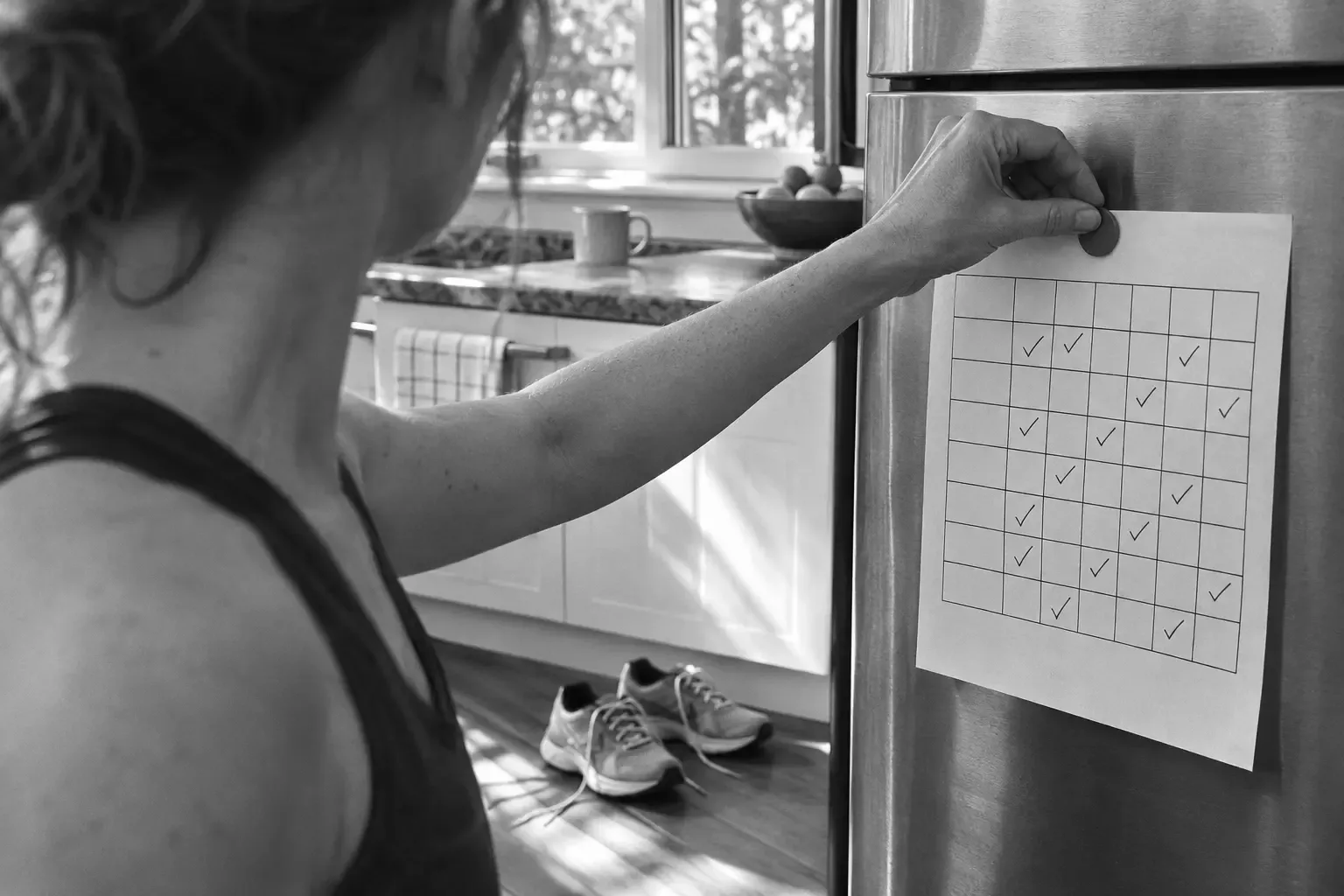
- Tick off the session
Write down what you ran and how it felt, one word is enough. That note decides whether you move on or repeat the week.
How fast should you run?
Slower than feels right. A beginner's easy pace is often 7:00 to 9:00 per km (11:16 to 14:29 per mi), and some people jog even slower. That is normal. The talk test beats any number: if you can speak in full sentences, the pace is right.
The pace also decides how long 5 km takes, which is why this plan ends with 30 to 35 minutes of running instead of exactly 30.
| Easy pace | 5 km (3.1 mi) takes | Distance in 30 minutes |
|---|---|---|
| 6:00 /km (9:39 /mi) | 30:00 | 5.0 km (3.1 mi) |
| 7:00 /km (11:16 /mi) | 35:00 | 4.3 km (2.7 mi) |
| 8:00 /km (12:52 /mi) | 40:00 | 3.8 km (2.3 mi) |
| 9:00 /km (14:29 /mi) | 45:00 | 3.3 km (2.1 mi) |
If your pace sits at 8:00 /km (12:52 /mi), you need about 40 minutes for the full 5 km, and that is fine. Run the week 6 sessions by time, then add 5 minutes a run over the following weeks until you cover the distance. The 5K running pace chart has every pace from 4:00 to 10:00 per km if you want your exact numbers.

When should you repeat a week?
Repeat a week when you could not finish its last run, or you finished it but felt wrecked the next day. Moving on before your legs are ready is how a 6-week plan turns into a 3-week plan and a break.
Use the note you wrote after each session:
- Finished, felt fine: move to the next week.
- Finished, but it was a struggle: repeat the last run of the week once, then move on.
- Could not finish: repeat the whole week.
- Pain that changes how you run, or pain that is worse the next morning: stop and see a doctor or physio before running again.
Repeating one or two weeks turns 6 weeks into 7 or 8. That is still well inside the 9-week classic plan.
Mistakes that stall a 6-week plan
Most people who stop do so for the same few reasons. Each one has a simple fix.
| Mistake | What it costs | The fix |
|---|---|---|
| Running the intervals too fast | You cannot finish the session and the next week feels impossible | Use the talk test on every run |
| Running two days in a row | Tired legs on run 3, often a missed week | Keep a rest day between runs |
| Skipping the 5 minute walk warm-up | The first interval feels much harder than it should | Walk briskly for the full 5 minutes |
| Chasing distance in week 6 | A rushed 5 km that feels like a race | Run by time, let distance come later |
| Skipping a week and jumping back in | The plan restarts ahead of your fitness | Repeat the last week you finished |
| New shoes or a new route on test day | Surprise rubbing or hills | Run the final session where you trained |
Two smaller ones: eating a big meal right before a run (see what to eat before a 5K), and comparing yourself with friends. Your pace is your own. If you are curious anyway, the average 5K time by age puts a first finish in context.

Where a fixed 6-week plan breaks
The plan above works on paper. The wall is real life: a cold in week 3, a work trip in week 4, a week of rain. A printed plan does not move when your week does. You are left guessing whether to repeat, skip ahead or start over, and guessing wrong is how most beginners drop out.
The repeat rule above covers a lot of it. For a longer goal after your 5K, such as a half marathon, the guessing gets harder because there are more weeks and bigger runs to move around.
That is the part Raceblock handles. Build your free plan for your race date. On the Coach plan, next week re-plans itself when you miss a run.
Free training plan
Build your free plan for your race date.
Pick your race and race date. Every week from today to race day is planned for you, with distances in km and miles.
The plan in one line
Three runs a week, rest days between, run slow enough to talk, and repeat any week you could not finish. Six weeks gets you to 25 to 35 minutes of continuous running, and at your own pace that is your first 5 km (3.1 mi).

When the 5K is done, the next step is a 5K training routine to run it better, or a 10K beginner training schedule to run further. And if a bigger race is on your mind, build a free half marathon training plan for your race date and let next week follow the week you actually ran.
Sources: program structure and first-week intervals from the NHS Couch to 5K page. Paces and distances on this page are computed from the paces shown.
Frequently asked questions
Yes, if you can already walk briskly for 30 minutes and jog for about a minute. The plan above uses three run/walk sessions a week and builds to 25 to 35 minutes of continuous running. If you cannot jog for a minute yet, the 9-week NHS plan is the better start.
Not for true beginners who cannot jog at all yet. The 6-week plan skips the gentlest early weeks of the classic program. Start with the 9-week NHS Couch to 5K, or walk for 2 to 3 weeks first, then use the 6-week plan from week 1.
Repeat that week. If you finished but it was a real struggle, repeat only the last run of the week. Repeating a week or two turns 6 weeks into 7 or 8, which still gets you to 5 km sooner than the 9-week plan.
Three days a week, with a rest day between each run. Each session is about 20 to 45 minutes including the 5 minute walk at the start and the end. Walking or gentle cycling on rest days is fine.
Free training plan
Build your free plan for your race date.
On the Coach plan, next week re-plans itself when you miss a run.
Share article
About the author
More running training guides

Running basics · 12 min
What Is a Recovery Run? Pace, Length and When to Skip It
A recovery run is a short, very easy run you do the day after a long run or hard session. Here is how slow to run it, how long, how it differs from an easy run and a rest day, where it fits in a half or marathon week, and when to skip it.
Running basics · 10 min
10K Beginner Training Schedule: 10 Weeks From Run-Walk
A 10k beginner training schedule for runners starting from run-walk: 10 weeks, three timed sessions a week, a long session that grows to about 70 minutes, the paces behind common finish times and how to adjust the plan to your week.

Running basics · 11 min
10K Training Routine: 3 Runs a Week for 8 Weeks
A 10k training routine is three runs a week on fixed days: one easy run, one faster session and a long run that builds to the full 10 km (6.2 mi) at an easy pace. Here is the weekly layout, the 8-week schedule, the paces and the mistakes that break it.

Running basics · 11 min
5K Training Routine: The Weekly Schedule to Repeat
A good 5K training routine is three or four runs a week on fixed days: one key session, one longer easy run and easy running in between. Here are both weekly layouts, your paces, an 8-week schedule and the mistakes that stall it.

Running basics · 11 min
Interval Training Plan for Running: 8 Weeks With Paces
A simple 8-week interval training plan for running: one session a week at 5 km to 10 km effort, with paces per km and per mile, jog recoveries, a sample week and how to adjust it for a half marathon, a marathon or a comeback.

Running basics · 10 min
Running in the Heat: 9 Tips to Train Safely All Summer
Running in the heat tips that work: run early, run by effort instead of pace, drink and add salt on long runs, adapt over two weeks, and know the warning signs that mean stop.