
HYROX Stations: All 8 in Order, With Weights and Distances
Raceblock team October 17, 2026 9 min read
Free HYROX plan for your race date

Free HYROX plan for your race date
Build my free planIn this article
HYROX has 8 stations, always in the same order: SkiErg, sled push, sled pull, burpee broad jumps, rowing, farmers carry, sandbag lunges and wall balls. Before each one you run 1 km (0.62 mi), so every race is 8 km (4.97 mi) of running plus the 8 stations.
The loads change with your division. The order, the distances and the running never do.
What are the 8 HYROX stations, in order?
In race order: SkiErg 1,000 m (0.62 mi), sled push 50 m (55 yd), sled pull 50 m (55 yd), burpee broad jumps 80 m (87 yd), rowing 1,000 m (0.62 mi), farmers carry 200 m (219 yd), sandbag lunges 100 m (109 yd) and 100 wall balls. Every station comes after a 1 km (0.62 mi) run.
Once you know the station order, these practical gym and home workouts show how to practice individual pieces without rehearsing the whole race every session.
This table follows the official race format (HYROX: The Fitness Race, checked October 2026). Every station comes after a 1 km (0.62 mi) run.
The eight HYROX stations
| Order | Station, after a 1 km (0.62 mi) run | Distance or reps | Women, open | Men, open |
|---|---|---|---|---|
| 1 | SkiErg | 1 km (0.6 mi) | No added load | No added load |
| 2 | Sled push2 lengths of 25 m, weight includes the sled | 50 m (55 yd) | 102 kg (225 lb) | 152 kg (335 lb) |
| 3 | Sled pull2 lengths of 25 m, weight includes the sled | 50 m (55 yd) | 78 kg (172 lb) | 103 kg (227 lb) |
| 4 | Burpee broad jumps | 80 m (87 yd) | Body weight | Body weight |
| 5 | Rowing | 1 km (0.6 mi) | No added load | No added load |
| 6 | Farmers carrytwo kettlebells, weight per hand | 200 m (219 yd) | 16 kg (35 lb) | 24 kg (53 lb) |
| 7 | Sandbag lunges | 100 m (109 yd) | 10 kg (22 lb) | 20 kg (44 lb) |
| 8 | Wall balls | 100 reps | 4 kg (9 lb) | 6 kg (13 lb) |
HYROX is a race format. Raceblock is not affiliated with HYROX.
Source: HYROX: race format, stations, weights and distances. Checked 2026-10-13.
Between the run and the station you pass through the Roxzone, the transition area where you enter and leave each station. Its length depends on the venue, so it is not in the table, but it adds time to every lap.
HYROX station weights by division
Five stations have a load that depends on your division. SkiErg, burpee broad jumps and rowing are the same for everyone. Sled weights include the sled itself.
| Station | Open women | Open men | Pro women | Pro men |
|---|---|---|---|---|
| Sled push | 102 kg (225 lb) | 152 kg (335 lb) | 152 kg (335 lb) | 202 kg (445 lb) |
| Sled pull | 78 kg (172 lb) | 103 kg (227 lb) | 103 kg (227 lb) | 153 kg (337 lb) |
| Farmers carry, per hand | 16 kg (35 lb) | 24 kg (53 lb) | 24 kg (53 lb) | 32 kg (71 lb) |
| Sandbag lunges | 10 kg (22 lb) | 20 kg (44 lb) | 20 kg (44 lb) | 30 kg (66 lb) |
| Wall ball | 4 kg (9 lb) | 6 kg (13 lb) | 6 kg (13 lb) | 9 kg (20 lb) |
| Wall ball target height | 2.7 m (8 ft 10 in) | 3.0 m (9 ft 10 in) | 2.7 m (8 ft 10 in) | 3.0 m (9 ft 10 in) |
One pattern makes this easy to remember: pro women carry the same loads as open men, and only the wall ball target is lower. Loads are set in the rulebook for each season, so check the current one for your event before you train with exact weights.
What each station asks of you
1. SkiErg, 1,000 m (0.62 mi)
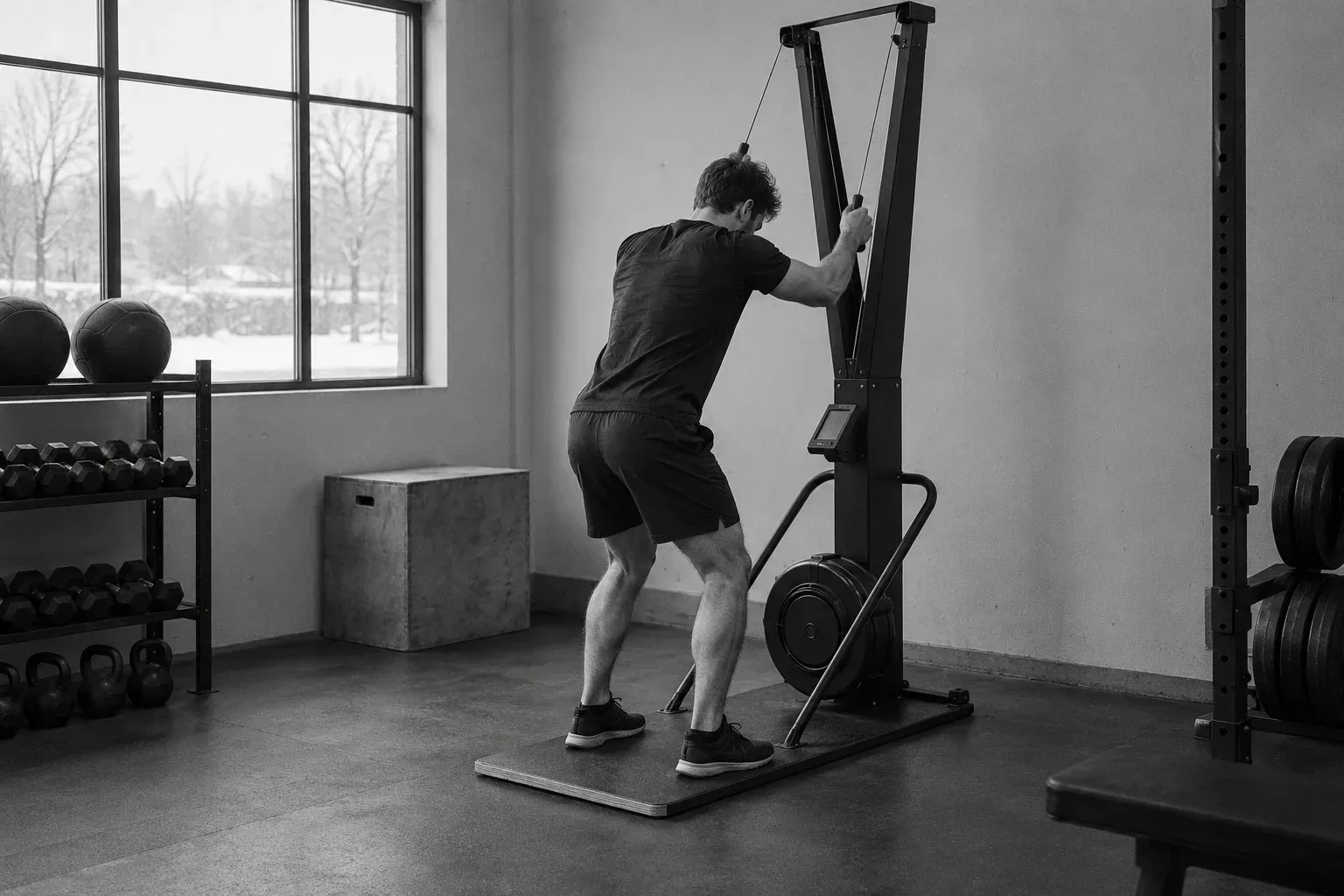
A standing pull on a ski machine. It comes straight after the first run, when everyone is fresh, which makes it easy to go out too hard. Most athletes treat it as a steady effort.
2 and 3. Sled push and sled pull, 50 m (55 yd) each
The heaviest loads of the day. Each is 50 m (55 yd) in total, usually 2 lengths of 25 m (27 yd) with a turn in between.
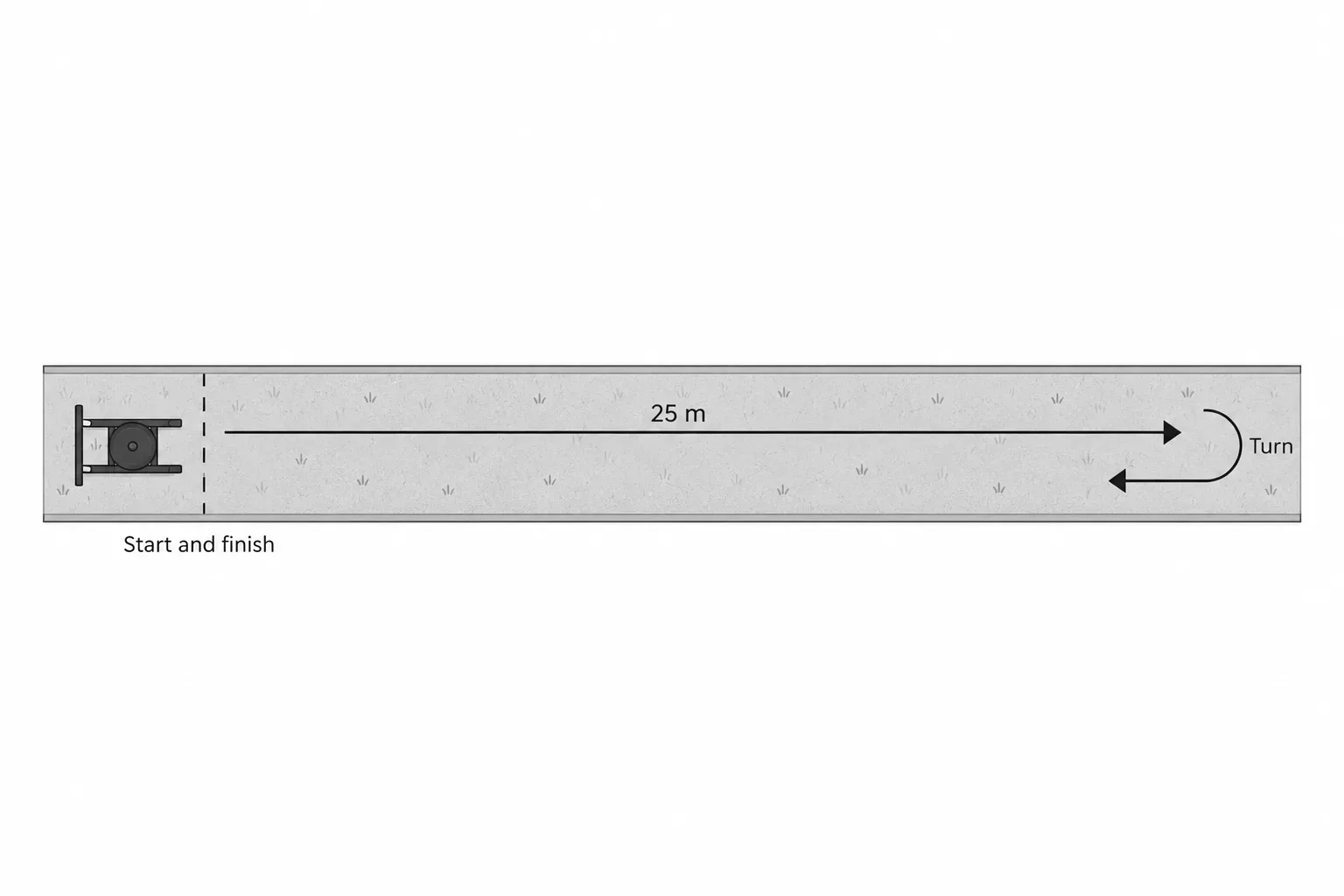
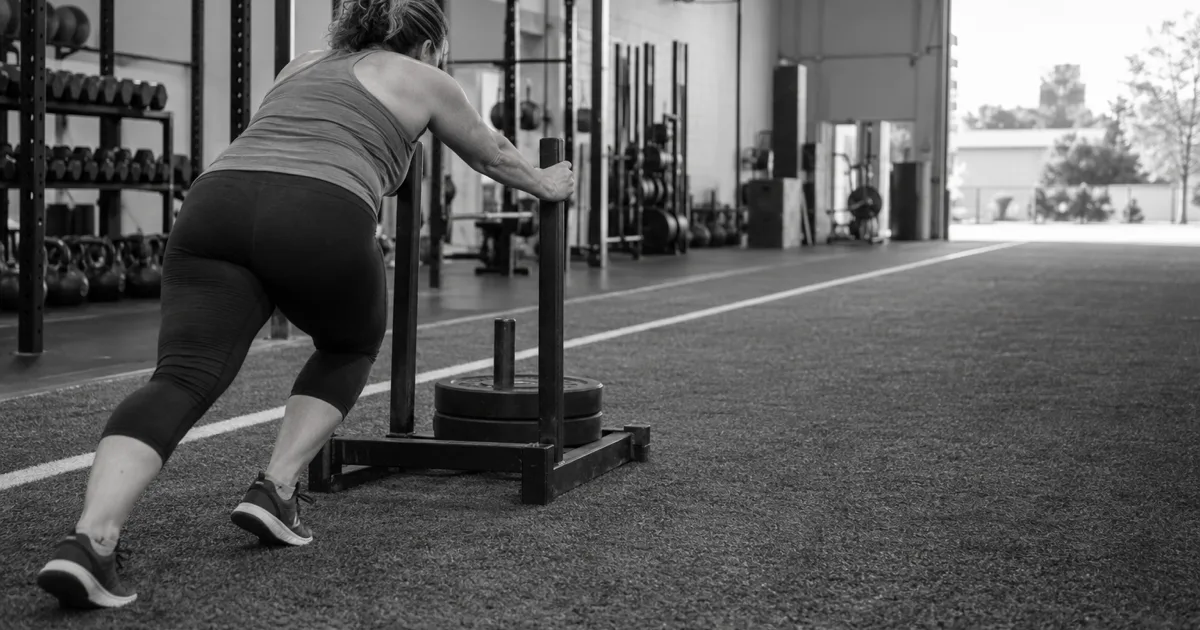
The push is legs and a low body angle; the pull is a rope, hand over hand, while you walk backward.

Rest your legs on the pull by letting your body weight do the work: lean back, keep the rope close and take short steps backward between pulls. The surface and the sled vary by venue, so the same load can feel different from one event to the next.
4. Burpee broad jumps, 80 m (87 yd)

A burpee, then a two-footed jump forward, repeated until you cover 80 m (87 yd). No load, but it raises your heart rate quickly, so a steady repeatable rhythm beats fast early reps.
5. Rowing, 1,000 m (0.62 mi)
A seated row. Coming after the burpees, it is a chance to settle into a rhythm.

6. Farmers carry, 200 m (219 yd)
Two kettlebells, one in each hand, carried for 200 m (219 yd). Grip is the limit for most people, not the legs.

7. Sandbag lunges, 100 m (109 yd)
Walking lunges with a sandbag on your shoulders, back knee touching the floor on each rep.
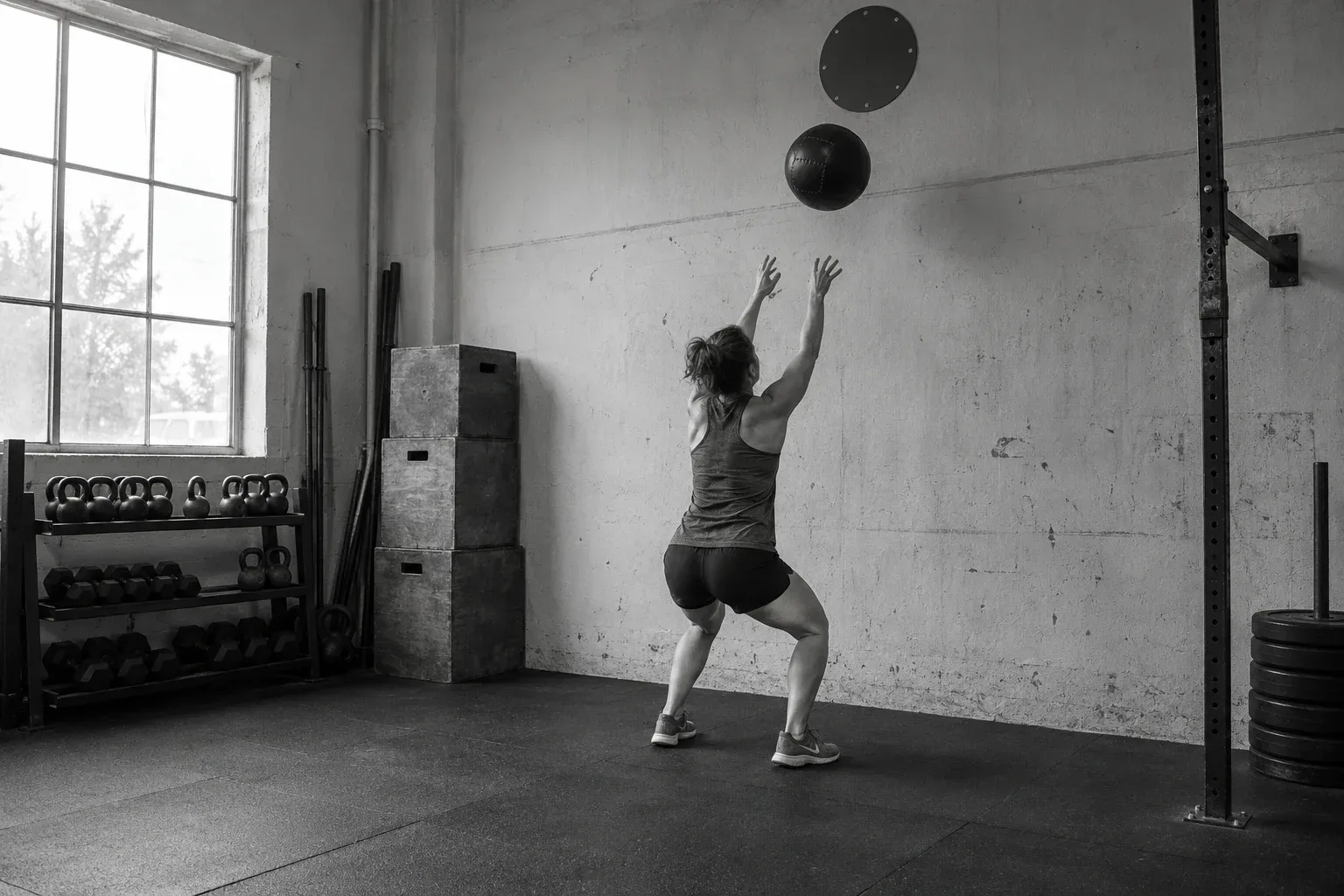
8. Wall balls, 100 reps
A squat, then a throw of the ball to a target on the wall, 100 times. It comes last, after 8 km (4.97 mi) of running and 7 stations.
How do the runs fit around the stations?
You run 1 km (0.62 mi) eight times, and each run starts with legs that just finished a station. That is why HYROX training includes the compromised run: a short block of station work followed straight away by a run at a controlled effort.
The running adds up fast. At 6:00 /km (9:39 /mi), the 8 runs alone take 48 minutes, before any station or Roxzone time. At 5:00 /km (8:03 /mi) they take 40 minutes. If you know a recent 5K time, the race time predictor turns it into estimated paces for longer races, a useful starting point for your steady pace.
| Steady run pace | 8 runs of 1 km (0.62 mi) |
|---|---|
| 5:00 /km (8:03 /mi) | 40 minutes |
| 5:30 /km (8:51 /mi) | 44 minutes |
| 6:00 /km (9:39 /mi) | 48 minutes |
| 6:30 /km (10:28 /mi) | 52 minutes |
| 7:00 /km (11:16 /mi) | 56 minutes |
Doubles and relay: who does which station?
In doubles, both partners run all 8 km (4.97 mi) together and split the work at each station between them as they like. In the relay, a team of 4 shares the race, with each person running and completing stations for part of it. The stations and their order do not change. Check the division details on the official race page when you enter.
Training for the stations without a HYROX gym
Running and the bodyweight stations need no special equipment. Lunges, burpee broad jumps and air squats as a stand-in for wall balls can be done anywhere. The sleds, the SkiErg and the rower need a gym, so book a few sessions before race day and practice below race weight first.
A typical week puts 3 or 4 runs next to one station day. The 12-week HYROX training plan for beginners shows how that looks for a first race: three runs and one strength and stations day a week, with the running distances kept separate from station practice.
12-week HYROX training plan
Every distance is in km and miles; every pace is per km and per mile. Lighter weeks are marked under the week number.
| Week | Mon | Tue | Wed | Thu | Fri | Sat | Sun | Total |
|---|---|---|---|---|---|---|---|---|
| Week 1Base | MonRest | TueEasy4.1 km (2.5 mi)7:00 to 7:34 /km (11:16 to 12:10 /mi) | WedRest | ThuEasy4 km (2.5 mi)7:00 to 7:34 /km (11:16 to 12:10 /mi) | FriStrength + stations | SatRest | SunLong8.1 km (5 mi)7:00 to 7:34 /km (11:16 to 12:10 /mi) | Week total16.2 km (10.1 mi) |
| Week 2Base | MonRest | TueEasy4.4 km (2.7 mi)7:00 to 7:34 /km (11:16 to 12:10 /mi) | WedRest | ThuEasy4.4 km (2.7 mi)7:00 to 7:34 /km (11:16 to 12:10 /mi) | FriStrength + stations | SatRest | SunLong8.8 km (5.5 mi)7:00 to 7:34 /km (11:16 to 12:10 /mi) | Week total17.6 km (10.9 mi) |
| Week 3Base | MonRest | TueEasy4.8 km (3 mi)7:00 to 7:34 /km (11:16 to 12:10 /mi) | WedRest | ThuEasy4.8 km (3 mi)7:00 to 7:34 /km (11:16 to 12:10 /mi) | FriStrength + stations | SatRest | SunLong9.6 km (6 mi)7:00 to 7:34 /km (11:16 to 12:10 /mi) | Week total19.2 km (11.9 mi) |
| Week 4Build, lighter week | MonRest | TueEasy4.3 km (2.7 mi)7:00 to 7:34 /km (11:16 to 12:10 /mi) | WedRest | ThuEasy4.3 km (2.7 mi)7:00 to 7:34 /km (11:16 to 12:10 /mi) | FriStrength + stations | SatRest | SunLong8.7 km (5.4 mi)7:00 to 7:34 /km (11:16 to 12:10 /mi) | Week total17.3 km (10.7 mi) |
| Week 5Build | MonRest | TueEasy4.7 km (2.9 mi)7:00 to 7:34 /km (11:16 to 12:10 /mi) | WedRest | ThuEasy4.7 km (2.9 mi)7:00 to 7:34 /km (11:16 to 12:10 /mi) | FriStrength + stations | SatRest | SunLong9.4 km (5.8 mi)7:00 to 7:34 /km (11:16 to 12:10 /mi) | Week total18.8 km (11.7 mi) |
| Week 6Build | MonRest | TueEasy5.1 km (3.2 mi)7:00 to 7:34 /km (11:16 to 12:10 /mi) | WedRest | ThuCompromised run5.1 km (3.2 mi)6:10 to 6:26 /km (9:55 to 10:22 /mi) | FriStrength + stations | SatRest | SunLong10.3 km (6.4 mi)7:00 to 7:34 /km (11:16 to 12:10 /mi) | Week total20.5 km (12.7 mi) |
| Week 7Build | MonRest | TueEasy5.6 km (3.5 mi)7:00 to 7:34 /km (11:16 to 12:10 /mi) | WedRest | ThuCompromised run5.6 km (3.5 mi)6:10 to 6:26 /km (9:55 to 10:22 /mi) | FriStrength + stations | SatRest | SunLong11.2 km (7 mi)7:00 to 7:34 /km (11:16 to 12:10 /mi) | Week total22.4 km (13.9 mi) |
| Week 8Build, lighter week | MonRest | TueEasy5.1 km (3.2 mi)7:00 to 7:34 /km (11:16 to 12:10 /mi) | WedRest | ThuEasy5 km (3.1 mi)7:00 to 7:34 /km (11:16 to 12:10 /mi) | FriStrength + stations | SatRest | SunLong10.1 km (6.3 mi)7:00 to 7:34 /km (11:16 to 12:10 /mi) | Week total20.2 km (12.6 mi) |
| Week 9Peak | MonRest | TueEasy5.5 km (3.4 mi)7:00 to 7:34 /km (11:16 to 12:10 /mi) | WedRest | ThuEasy5.5 km (3.4 mi)7:00 to 7:34 /km (11:16 to 12:10 /mi) | FriStrength + stations | SatRest | SunLong11 km (6.8 mi)7:00 to 7:34 /km (11:16 to 12:10 /mi) | Week total22 km (13.7 mi) |
| Week 10Peak | MonRest | TueEasy6 km (3.7 mi)7:00 to 7:34 /km (11:16 to 12:10 /mi) | WedRest | ThuCompromised run6 km (3.7 mi)6:10 to 6:26 /km (9:55 to 10:22 /mi) | FriStrength + stations | SatRest | SunLong12 km (7.5 mi)7:00 to 7:34 /km (11:16 to 12:10 /mi) | Week total24 km (14.9 mi) |
| Week 11Taper | MonRest | TueEasy4.5 km (2.8 mi)7:00 to 7:34 /km (11:16 to 12:10 /mi) | WedRest | ThuEasy4.5 km (2.8 mi)7:00 to 7:34 /km (11:16 to 12:10 /mi) | FriStrength + stations | SatRest | SunLong9 km (5.6 mi)7:00 to 7:34 /km (11:16 to 12:10 /mi) | Week total18 km (11.2 mi) |
| Week 12Taper, race week | MonRest | TueEasy3.4 km (2.1 mi)7:00 to 7:34 /km (11:16 to 12:10 /mi) | WedRest | ThuEasy3.3 km (2.1 mi)7:00 to 7:34 /km (11:16 to 12:10 /mi) | FriStrength + stations | SatRest | SunLong6.8 km (4.2 mi)7:00 to 7:34 /km (11:16 to 12:10 /mi) | Week total13.5 km (8.4 mi) |
Race week. Keep the final week light. Start conservatively and adjust to conditions. Goal pace is a target, not a promised finish time.
- Rest
- Absorb training and recover for the next session.
- Easy
- Build aerobic endurance at a conversational effort.
- Strength + stations
- Practice station technique with manageable loads and full recovery.
- Long
- Build time on your feet without racing the session.
- Compromised run
- Practice running after light station work, keeping effort controlled.
General training guidance, not medical advice. Check with a doctor before increasing training if you have symptoms or a health condition.
General training guidance, not medical advice. Check with a doctor before increasing training if you have symptoms or a health condition.
The hard part is not writing that week. It is keeping it when the week changes. A late shift takes out the station day, a cold takes out three runs (or a missed long run), and a fixed plan just carries on as if you did them. The plan doesn't move when your week does.
That is what Raceblock is for.
Free training plan
Build your free plan for your race date.
Pick your race and race date. Every week from today to race day is planned for you, with distances in km and miles.
Build your free plan for your race date. On the Coach plan, next week re-plans itself when you miss a run. It is built for Garmin and Apple Watch runners; see how Free and Coach compare, or how it works as a Runna alternative.
How to practice the HYROX stations
- Learn the order
SkiErg, sled push, sled pull, burpee broad jumps, rowing, farmers carry, sandbag lunges, wall balls. Practice them in that order when you can.
- Start below race weight
Build technique on the sleds, carries and lunges with lighter loads, then add weight across the plan.
- Practice the bodyweight stations anywhere
Burpee broad jumps, lunges and air squats need no gym. Do short sets well below the race totals.
- Add compromised runs
After a short station block, go straight into a controlled run. That transition is the skill the race tests 8 times.
- Check your division loads
Confirm the current weights for your division in the official rulebook before you train at race load.
Mistakes that cost time at the stations
- Racing the first run. The first 1 km (0.62 mi) feels easy and sets up a hard SkiErg. Hold your steady pace.
- Training only at race weight. Build technique below race load first, then add weight across the plan.
- Skipping grip work. The farmers carry often fails at the hands. Carries in training fix that more than extra running.
- Never running after stations. Running fresh and running after sleds are different skills. Do compromised runs every week.
- Ignoring pain. Sharp pain, pain that changes how you move, or dizziness means stop and see a doctor or physio.
Learn the order once and it never changes: SkiErg, sled push, sled pull, burpee broad jumps, rowing, farmers carry, sandbag lunges, wall balls, each after 1 km (0.62 mi). Pick your division, check its loads in the current rulebook, and give the 8 km (4.97 mi) of running as much attention as the stations.
For a full schedule, start with the HYROX training plan guide, which compares plan lengths and shows how runs and stations share a week. If your event is close, the 2-week version in our taper guide works for the running side too.
When your week stops matching the plan, build your free plan for your race date. On the Coach plan, next week re-plans itself when you miss a run.
Frequently asked questions
SkiErg, sled push, sled pull, burpee broad jumps, rowing, farmers carry, sandbag lunges and wall balls, in that order, each after a 1 km (0.62 mi) run.
Run 1 km (0.62 mi), SkiErg 1,000 m, run, sled push 50 m (55 yd), run, sled pull 50 m, run, burpee broad jumps 80 m (87 yd), run, rowing 1,000 m, run, farmers carry 200 m (219 yd), run, sandbag lunges 100 m (109 yd), run, 100 wall balls.
1 km (0.62 mi) before each of the 8 stations, so 8 km (4.97 mi) in total, plus the walk or jog through the Roxzone at each station.
Open women push 102 kg (225 lb), pull 78 kg (172 lb), carry 16 kg (35 lb) per hand, lunge with 10 kg (22 lb) and throw a 4 kg (9 lb) ball. Open men use 152 kg (335 lb), 103 kg (227 lb), 24 kg (53 lb), 20 kg (44 lb) and 6 kg (13 lb). Pro loads are in the table above.
There is no official answer, and it depends on the athlete. The sleds carry the heaviest loads, burpee broad jumps raise the heart rate quickly, and wall balls come last on tired legs.
They test different things. A marathon is 42.2 km (26.2 mi) of continuous running. HYROX is 8 km (4.97 mi) of running broken up by 8 strength and conditioning stations. Neither score converts into the other.
Free training plan
Build your free plan for your race date.
On the Coach plan, next week re-plans itself when you miss a run.
Share article
About the author
More running training guides
HYROX guides · 10 min
HYROX Workout: 5 Sessions for the Gym, Home and Running
Choose a HYROX workout for easy running, station practice or transitions, with five scalable sessions for the gym and home.

HYROX guides · 12 min
HYROX Training Plan for Beginners: Free 12-Week Schedule
A 12-week HYROX training plan for beginners: three runs and a strength and stations day each week, compromised runs, lighter weeks, a two-week taper and paces per km and per mile.

HYROX guides · 11 min
HYROX Training Plan: Free Running and Station Plans
A HYROX training plan that puts runs, compromised runs and a strength and stations day into one week, with the 8 stations, open division weights, plan lengths by race date and a worked 10-week sample.