
HYROX Workout: 5 Sessions for the Gym, Home and Running
Raceblock team Updated November 5, 2026 10 min read
Free HYROX plan for your race date
Free HYROX plan for your race date
Build my free planIn this article
A useful HYROX workout practices one job: easy running, a station skill, or the switch between them. You do not need to rehearse the whole race every time you train.
The five sessions below are starting options, not five extra workouts to stack into one week. Choose the one that addresses your current gap, keep the effort repeatable, and leave room for the runs already in your schedule.
General training guidance, not medical advice. Check with a doctor before increasing training if you have symptoms or a health condition.
What does a HYROX workout need to prepare you for?
The race alternates eight 1 km (0.62 mi) runs with eight workout stations. That makes 8 km (4.97 mi) of running, plus the station work. The official HYROX race format sets the order; checked October 17, 2026. HYROX is used here to describe the race, not an affiliation or endorsement.
The eight HYROX stations
| Order | Station, after a 1 km (0.62 mi) run | Distance or reps | Women, open | Men, open |
|---|---|---|---|---|
| 1 | SkiErg | 1 km (0.6 mi) | No added load | No added load |
| 2 | Sled push2 lengths of 25 m, weight includes the sled | 50 m (55 yd) | 102 kg (225 lb) | 152 kg (335 lb) |
| 3 | Sled pull2 lengths of 25 m, weight includes the sled | 50 m (55 yd) | 78 kg (172 lb) | 103 kg (227 lb) |
| 4 | Burpee broad jumps | 80 m (87 yd) | Body weight | Body weight |
| 5 | Rowing | 1 km (0.6 mi) | No added load | No added load |
| 6 | Farmers carrytwo kettlebells, weight per hand | 200 m (219 yd) | 16 kg (35 lb) | 24 kg (53 lb) |
| 7 | Sandbag lunges | 100 m (109 yd) | 10 kg (22 lb) | 20 kg (44 lb) |
| 8 | Wall balls | 100 reps | 4 kg (9 lb) | 6 kg (13 lb) |
HYROX is a race format. Raceblock is not affiliated with HYROX.
Source: HYROX: race format, stations, weights and distances. Checked 2026-10-13.
Read the station-by-station guide for the event sequence. Use your current event rulebook for division requirements rather than copying the load someone else uses in the gym.
The practical distinction is between a race and a training session. The race tests the whole sequence. A training session can isolate the part you cannot yet do calmly. If every workout becomes a race simulation, you lose that distinction.
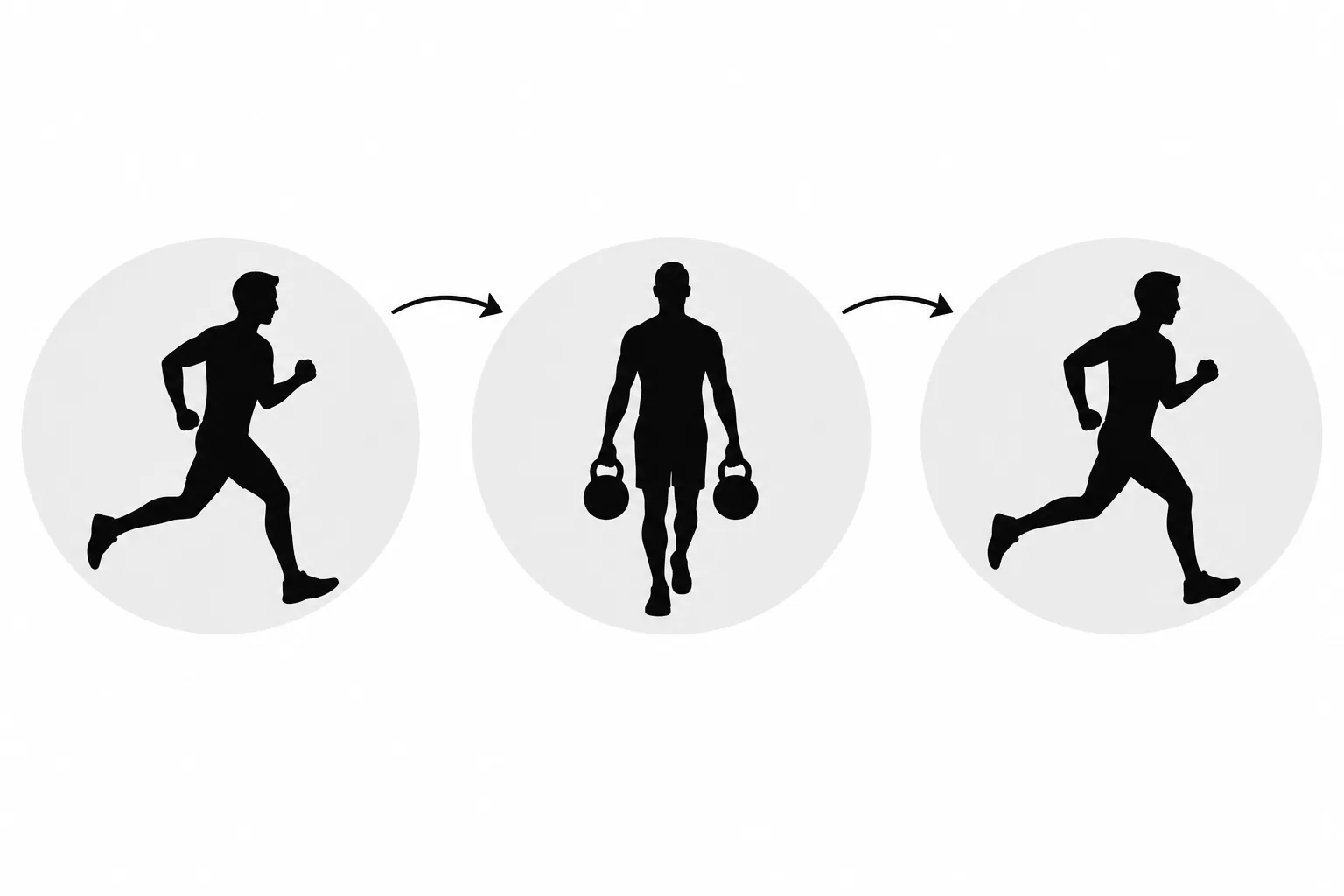
Pick one of these five HYROX workouts
Start with the row that describes what you need now. The timings and repetitions below are illustrative starting options, not a requirement to increase your current training. If a session exceeds what you already tolerate, shorten it or choose a simpler option.
| Your situation | Session to choose | What to watch |
|---|---|---|
| Running itself feels demanding | 1. Easy run or run-walk | You can speak in full sentences |
| Running is familiar, station technique is not | 2. Station practice | Each repetition looks controlled |
| Both parts feel comfortable separately | 3. Run-carry transitions | You can settle back into running |
| You have an ordinary gym but no sled lane | 4. Row and squat session | Keep the movements separate and unhurried |
| You are training at home | 5. Run and bodyweight circuit | Leave time for actual equipment practice later |
1. Easy running, without a station finisher
Use 20 to 30 minutes for an easy run or a shorter run-walk that fits your present routine. Start gently. Keep the whole session conversational, including the last few minutes. If you need walking breaks to do that, take them.
This is deliberately a running workout, not a circuit. Do not bolt on a hard sled block because an easy run feels too plain. If you have a race booked, the beginner HYROX training plan shows where ordinary running sits alongside the gym day.

2. Station practice with enough rest to pay attention
Choose two movements you already know how to perform safely, such as an unloaded squat and a light farmers carry. Spend five minutes warming up with easy movement. A short jog with leg swings and walking lunges, like this pre-run warm-up routine, covers it. Then alternate a small set of five controlled squats with a brief carry of about 20 seconds. Rest fully between attempts. Stop after two or three comfortable rounds rather than chasing fatigue.
The objective is to notice your stance, grip and control. Pick loads you can put down calmly. For equipment or movements you have not learned, get instruction before adding load or speed. A practice squat is not a substitute for learning the actual wall-ball movement and event standard.

3. A short run-carry-run transition workout
After an easy warm-up, run gently for three minutes, carry a manageable pair of weights for about 20 seconds, put them down safely, then return to gentle running for three minutes. Walk or rest until you feel ready to repeat. Two rounds are enough to learn whether the transition is comfortable; a third is optional for someone already used to this work.
Do not race the carry or force a target pace afterward. Notice whether you can relax your hands and settle into your usual easy rhythm. If the running becomes a struggle, make the station work smaller next time. This is transition practice, not a race predictor.
Keep the route clear and the weights away from other gym users. Do not run while holding them. Count the running as running and record the carry separately, never convert station minutes into invented running mileage.
4. A HYROX gym workout without a sled lane
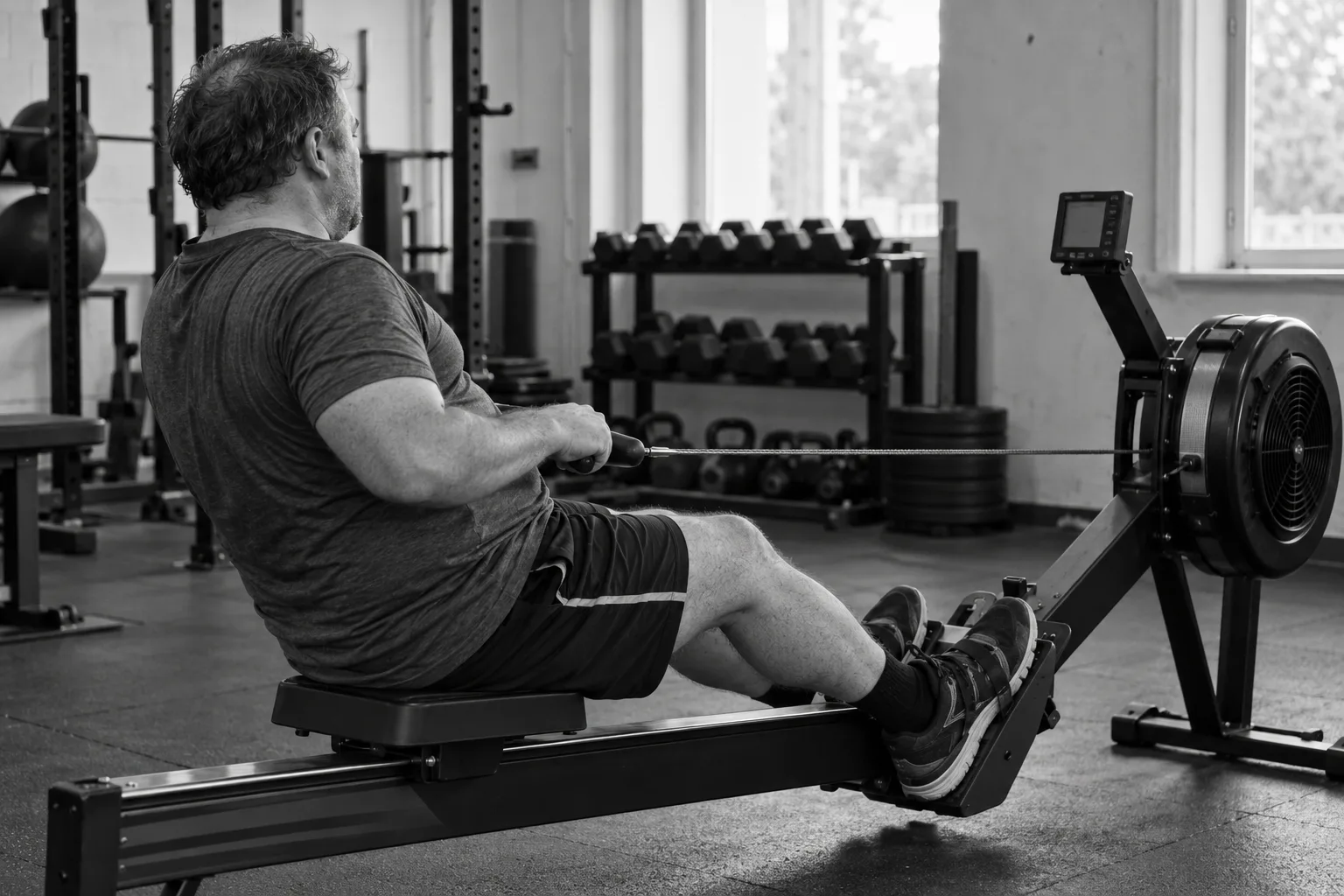
Warm up easily, then row at a controlled effort for two minutes. Step off carefully, do five comfortable bodyweight squats, and rest for at least a minute or longer if needed. Repeat two or three times only while both movements stay controlled. Finish with easy movement rather than a sprint.
This lets you practice changing tasks in an ordinary gym. It does not reproduce a sled push, sled pull or the full race. Choose equipment you know how to use, and arrange separate practice on race-specific equipment before relying on it at an event.
5. A HYROX workout at home
Use a short, familiar easy run or run-walk as the first part. At home, practice five controlled squats and a few comfortable reverse lunges, with support if needed. Rest, then repeat only if the movements remain easy to control. Keep the floor clear and skip any movement you cannot do comfortably.
This is a way to keep some running and general movement in your week. It cannot teach you how a loaded sled feels or how to handle a rowing machine. Do not improvise a sled by dragging heavy furniture or attach a rope to a door. Access to the right equipment is a separate planning task.

How to turn one workout into a repeatable week
Choose a session to replace a similar session, not to add automatically on top of everything else. A runner already following a program may need only a small amount of station practice; someone who mainly lifts may need more attention to ordinary easy running.
How to choose and scale your next session
- Look at the week you already do
Write down runs, lifting sessions and rest days. Include other demanding activities, not just workouts labeled HYROX.
- Choose one clear purpose
Pick easy running, station technique or transitions. Do not demand all three from every session.
- Begin below your maximum
Use familiar movements, manageable loads and a short session. Keep enough room to stop with control.
- Record running and stations separately
Log running time or distance, then the movements and loads. Note whether the next planned session still felt manageable.
- Adjust one part at a time
Before making the next session harder, decide whether the current version fits your week. More rounds, more load and faster running are different changes.
If you want a longer framework, compare the available HYROX training plans. The sample below shows the phases and running volume for one beginner block. It is not a prescription to jump immediately to the distance displayed.
- Base weeks 1 to 3
- Build weeks 4 to 8
- Peak weeks 9 to 10
- Taper weeks 11 to 12
- Lighter weeks 4 and 8
The sample assumes an existing running base. A person starting from less should not force that first week. The chart describes running only; gym work is additional and must be considered separately.
Common workout mistakes and what to change
| Mistake | Why the session becomes less useful | A practical change |
|---|---|---|
| Every session is a full simulation | You stop isolating the skill you meant to practice | Pick one station or one transition |
| Race loads before basic control | Load becomes the goal instead of the movement | Use a manageable load and get instruction |
| A hard station finisher after every run | Easy days no longer stay easy | Keep ordinary easy runs separate |
| Treating home exercises as identical replacements | You reach the event without equipment experience | Book actual station practice |
| Adding missed work to the next day | The written week no longer reflects the load you are doing | Reassess the remaining sessions |
If a run gets missed, our guide to deciding what to do with a missed long run explains the scheduling question. Do not assume that doing twice as much tomorrow is the right answer.
For road-running estimates, the race time predictor is a separate tool. It does not predict a HYROX result or account for station performance. A road-running estimate should not become a promised race finish.
When a useful workout stops fitting your calendar
The manual method is straightforward: write down your week, choose one session for the gap you need to address, record what you did, and review before the next week. You can do all of that on paper.
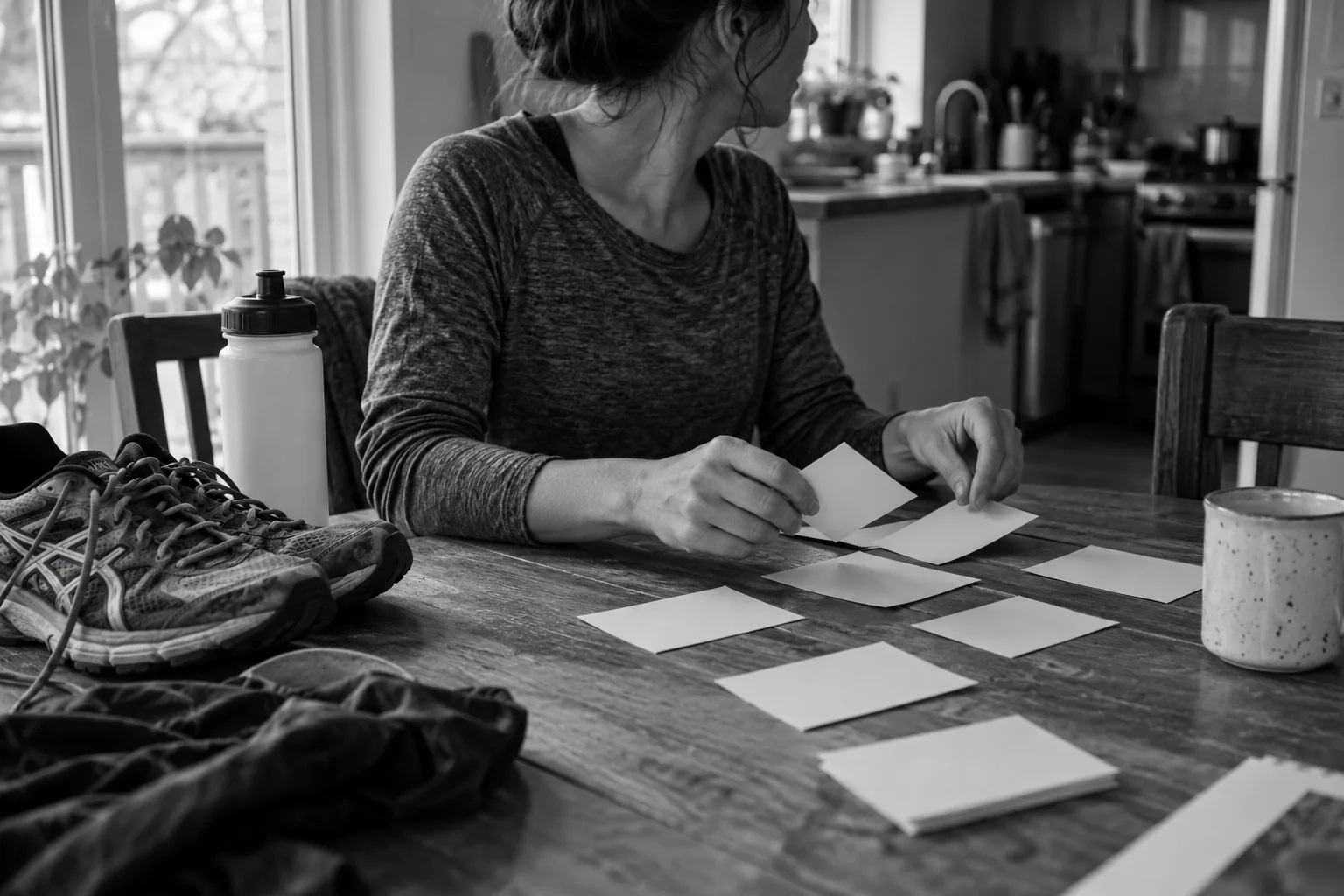
The wall is that the plan does not move when your week does. A work trip removes a gym day, a missed run changes the week, or your race date changes. A saved workout still looks the same, while you have to decide how the rest of the schedule should change.
Free training plan
Build your free plan for your race date.
Pick your race and race date. Every week from today to race day is planned for you, with distances in km and miles.
Build your free plan for your race date. On the Coach plan, next week re-plans itself when you miss a run. Raceblock is built for Garmin and Apple Watch runners. You can compare Free and Coach before choosing.
Keep the session smaller than the race
Pick the workout that fits your current gap. Run easily when you need running practice, slow down when you need station practice, and combine the two only when each part is comfortable. A session does not need to feel like the whole event to earn its place in the week.
When a fixed schedule no longer fits, build your free plan for your race date. On the Coach plan, next week re-plans itself when you miss a run.
Frequently asked questions
The race has eight workout stations, each after a 1 km (0.62 mi) run. The stations are SkiErg, sled push, sled pull, burpee broad jumps, rowing, farmers carry, sandbag lunges and wall balls. Check the official format and your event rulebook for the requirements of your division.
For someone learning the movements, a short session of controlled squats, manageable carries and generous rest is a useful starting option. It is not a complete station simulation. Learn the event movements with appropriate instruction, and do not add load simply to match another athlete.
There is no single eight-week plan that fits everyone. Start from the running and strength work you already do, the equipment you can access and your race date. Do not compress a longer program into eight weeks by stacking sessions. A date-based plan still needs a realistic starting point; completing it does not guarantee a race result.
Free training plan
Build your free plan for your race date.
On the Coach plan, next week re-plans itself when you miss a run.
Share article
About the author
More running training guides

HYROX guides · 12 min
HYROX Training Plan for Beginners: Free 12-Week Schedule
A 12-week HYROX training plan for beginners: three runs and a strength and stations day each week, compromised runs, lighter weeks, a two-week taper and paces per km and per mile.

HYROX guides · 11 min
HYROX Training Plan: Free Running and Station Plans
A HYROX training plan that puts runs, compromised runs and a strength and stations day into one week, with the 8 stations, open division weights, plan lengths by race date and a worked 10-week sample.

HYROX guides · 9 min
HYROX Stations: All 8 in Order, With Weights and Distances
The 8 HYROX stations in race order with distances, reps and the loads for open and pro, women and men, in kg and lb, and how to plan the running around them.