
How Long Is a Half Marathon? Distance in Km and Miles
Raceblock team Updated November 14, 2026 9 min read
Free half marathon plan for your race date

Free half marathon plan for your race date
Build my free planIn this article
A half marathon is 21.0975 km (13.1094 mi), usually rounded to 21.1 km (13.1 mi). The distance is fixed; how long it takes depends on your pace, walking breaks, stops and the course.
That distinction matters when you enter your first race. Knowing the distance answers what you have signed up for. Knowing your likely time on your feet helps you choose an event cutoff and a training plan that fit you.
How long is a half marathon in km and miles?
The official distance is 21.0975 km (13.1094 mi), exactly half the marathon distance of 42.195 km (26.2188 mi). World Athletics' half marathon guide confirms the distance in both units.
| Race distance | Kilometers | Miles, rounded |
|---|---|---|
| Short road race | 5 km | 3.11 mi |
| Longer short road race | 10 km | 6.21 mi |
| Half marathon | 21.0975 km | 13.1094 mi |
| Marathon | 42.195 km | 26.2188 mi |
The conversions use 1 mi = 1.609344 km. A half marathon is a little more than twice a 10 km (6.21 mi) race, not exactly twice it. That extra distance is 1.0975 km (0.682 mi). If you are weighing the full distance instead, here is how long a marathon run is in km, miles and hours.
For a familiar out-and-back route, the halfway point would be 10.54875 km (6.5547 mi) from the start. That is a way to picture the distance, not a recommendation to run it all this weekend.

Is a half marathon exactly 21.1 km (13.1 mi)?
No. Both numbers are rounded. The exact distance is 21.0975 km (13.1094 mi), so using 21.1 km (13.1 mi) in conversation is fine, but a precise calculator should use the official distance.
A watch reaching the rounded distance is not your finish line. Finish at the event's marked line, not when your device first shows the number you expected.
There is also a difference between the course distance and the path you take. Weaving around other runners or swinging wide through bends adds travel. The diagram below illustrates the geometry, not a measured race course. Stay inside the permitted route and give other runners space.
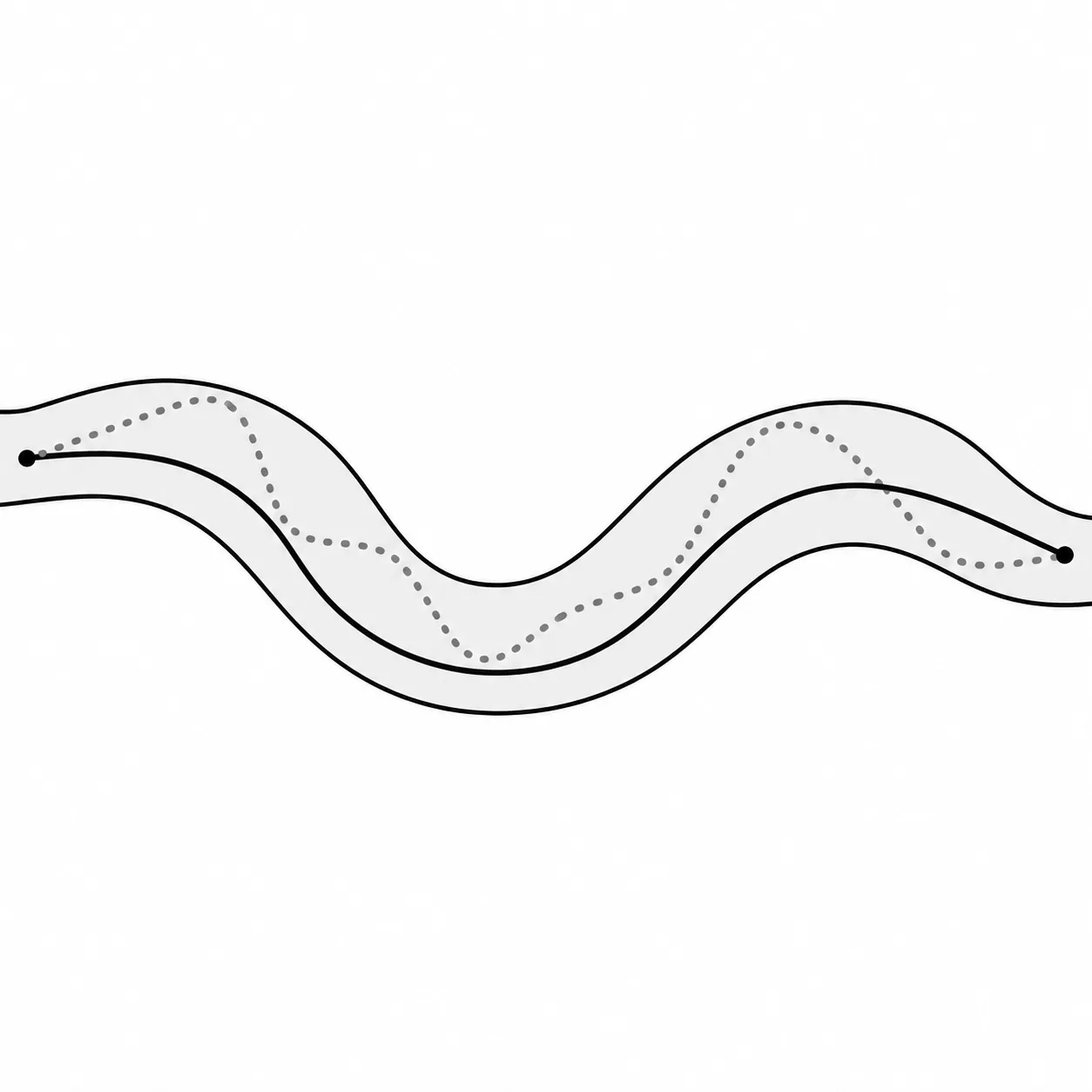
For US events, the USATF course certification program explains why reliable course distances matter. Check the event's own certification information if comparing results is important to you; a GPS display alone is not a course certificate.
How long does a half marathon take?
There is no single time everyone should take. At an average 6:00 /km (9:39 /mi), the official distance works out to about 2:06:35; that is a calculation assuming the same average pace over the whole event, not a forecast of your result. To see how real finishers spread out, our breakdown of the average half marathon time shows the median by age and gender.
Use time = distance x pace. Keep the units matched: multiply kilometers by minutes per kilometer, or miles by minutes per mile. Add time for stops if the pace you entered covers moving time only.
Half marathon pace calculator
Splits for a 2:00:00 half marathon, even pace
- Average pace per km
- 5:41 /km
- Average pace per mile
- 9:09 /mi
- Halfway
- 1:00:00
- Second half
- 1:00:00
Kilometer splits
| km | mi | Split | Elapsed |
|---|---|---|---|
| 1 | 0.6 | 5:41 | 5:41 |
| 2 | 1.2 | 5:41 | 11:23 |
| 3 | 1.9 | 5:41 | 17:04 |
| 4 | 2.5 | 5:41 | 22:45 |
| 5 | 3.1 | 5:41 | 28:26 |
| 6 | 3.7 | 5:41 | 34:08 |
| 7 | 4.3 | 5:41 | 39:49 |
| 8 | 5 | 5:41 | 45:30 |
| 9 | 5.6 | 5:41 | 51:11 |
| 10 | 6.2 | 5:41 | 56:53 |
| 11 | 6.8 | 5:41 | 1:02:34 |
| 12 | 7.5 | 5:41 | 1:08:15 |
| 13 | 8.1 | 5:41 | 1:13:57 |
| 14 | 8.7 | 5:41 | 1:19:38 |
| 15 | 9.3 | 5:41 | 1:25:19 |
| 16 | 9.9 | 5:41 | 1:31:00 |
| 17 | 10.6 | 5:41 | 1:36:42 |
| 18 | 11.2 | 5:41 | 1:42:23 |
| 19 | 11.8 | 5:41 | 1:48:04 |
| 20 | 12.4 | 5:41 | 1:53:45 |
| 21 | 13 | 5:41 | 1:59:27 |
| 21.1 | 13.1 | 0:33 | 2:00:00 |
Mile splits
| Mile | km | Split | Elapsed |
|---|---|---|---|
| 1 | 1.6 | 9:09 | 9:09 |
| 2 | 3.2 | 9:09 | 18:18 |
| 3 | 4.8 | 9:09 | 27:28 |
| 4 | 6.4 | 9:09 | 36:37 |
| 5 | 8 | 9:09 | 45:46 |
| 6 | 9.7 | 9:09 | 54:55 |
| 7 | 11.3 | 9:09 | 1:04:05 |
| 8 | 12.9 | 9:09 | 1:13:14 |
| 9 | 14.5 | 9:09 | 1:22:23 |
| 10 | 16.1 | 9:09 | 1:31:32 |
| 11 | 17.7 | 9:09 | 1:40:41 |
| 12 | 19.3 | 9:09 | 1:49:51 |
| 13 | 20.9 | 9:09 | 1:59:00 |
| 13.1 | 21.1 | 1:00 | 2:00:00 |
2:00:00 half marathon · even pace
- 5 km28:26
- 10 km56:53
- 15 km1:25:19
- 20 km1:53:45
- 21.1 km2:00:00
Raceblock pace band · myraceblock.com
For a wider set of checkpoints, the half marathon pace chart shows the arithmetic for different goal times. A goal is a planning input, not proof that the pace fits your current running.
Half marathon pace chart
| Goal time | Pace per km | Pace per mile | 5K 5 km (3.1 mi) | 10K 10 km (6.2 mi) | 15K 15 km (9.3 mi) | 20K 20 km (12.4 mi) |
|---|---|---|---|---|---|---|
| 1:10:00 | 3:19 /km | 5:20 /mi | 16:35 | 33:11 | 49:46 | 1:06:22 |
| 1:15:00 | 3:33 /km | 5:43 /mi | 17:46 | 35:33 | 53:19 | 1:11:06 |
| 1:20:00 | 3:48 /km | 6:06 /mi | 18:58 | 37:55 | 56:53 | 1:15:50 |
| 1:25:00 | 4:02 /km | 6:29 /mi | 20:09 | 40:17 | 1:00:26 | 1:20:35 |
| 1:30:00 | 4:16 /km | 6:52 /mi | 21:20 | 42:40 | 1:03:59 | 1:25:19 |
| 1:35:00 | 4:30 /km | 7:15 /mi | 22:31 | 45:02 | 1:07:33 | 1:30:03 |
| 1:40:00 | 4:44 /km | 7:38 /mi | 23:42 | 47:24 | 1:11:06 | 1:34:48 |
| 1:45:00 | 4:59 /km | 8:01 /mi | 24:53 | 49:46 | 1:14:39 | 1:39:32 |
| 1:50:00 | 5:13 /km | 8:23 /mi | 26:04 | 52:08 | 1:18:12 | 1:44:17 |
| 1:55:00 | 5:27 /km | 8:46 /mi | 27:15 | 54:31 | 1:21:46 | 1:49:01 |
| 2:00:00 | 5:41 /km | 9:09 /mi | 28:26 | 56:53 | 1:25:19 | 1:53:45 |
| 2:05:00 | 5:55 /km | 9:32 /mi | 29:37 | 59:15 | 1:28:52 | 1:58:30 |
| 2:10:00 | 6:10 /km | 9:55 /mi | 30:49 | 1:01:37 | 1:32:26 | 2:03:14 |
| 2:15:00 | 6:24 /km | 10:18 /mi | 32:00 | 1:03:59 | 1:35:59 | 2:07:59 |
| 2:20:00 | 6:38 /km | 10:41 /mi | 33:11 | 1:06:22 | 1:39:32 | 2:12:43 |
| 2:25:00 | 6:52 /km | 11:04 /mi | 34:22 | 1:08:44 | 1:43:06 | 2:17:27 |
| 2:30:00 | 7:07 /km | 11:27 /mi | 35:33 | 1:11:06 | 1:46:39 | 2:22:12 |
| 2:35:00 | 7:21 /km | 11:49 /mi | 36:44 | 1:13:28 | 1:50:12 | 2:26:56 |
| 2:40:00 | 7:35 /km | 12:12 /mi | 37:55 | 1:15:50 | 1:53:45 | 2:31:41 |
| 2:45:00 | 7:49 /km | 12:35 /mi | 39:06 | 1:18:12 | 1:57:19 | 2:36:25 |
| 2:50:00 | 8:03 /km | 12:58 /mi | 40:17 | 1:20:35 | 2:00:52 | 2:41:09 |
| 2:55:00 | 8:18 /km | 13:21 /mi | 41:28 | 1:22:57 | 2:04:25 | 2:45:54 |
| 3:00:00 | 8:32 /km | 13:44 /mi | 42:40 | 1:25:19 | 2:07:59 | 2:50:38 |
| 3:05:00 | 8:46 /km | 14:07 /mi | 43:51 | 1:27:41 | 2:11:32 | 2:55:23 |
| 3:10:00 | 9:00 /km | 14:30 /mi | 45:02 | 1:30:03 | 2:15:05 | 3:00:07 |
| 3:15:00 | 9:15 /km | 14:52 /mi | 46:13 | 1:32:26 | 2:18:39 | 3:04:51 |
| 3:20:00 | 9:29 /km | 15:15 /mi | 47:24 | 1:34:48 | 2:22:12 | 3:09:36 |
| 3:25:00 | 9:43 /km | 15:38 /mi | 48:35 | 1:37:10 | 2:25:45 | 3:14:20 |
| 3:30:00 | 9:57 /km | 16:01 /mi | 49:46 | 1:39:32 | 2:29:18 | 3:19:05 |
The useful question is not whether a number sounds fast. It is whether you can make a realistic plan around the event's rules and your present training. Check whether its cutoff is measured from the starting signal or from when you cross the line, and whether intermediate checkpoints have separate limits.

Can you walk part of a half marathon?
You can choose running, planned walking breaks or walking if your event allows it and its time limit fits. Check the specific race policy instead of assuming that every event welcomes the same pace.
Walking changes the average speed, not the distance: you still cover 21.0975 km (13.1094 mi). Try any run/walk pattern in training before using it at an event. Include the walking portions when estimating your time, along with water stops and any other pauses.
| Your situation | What to check before entering | Useful next step |
|---|---|---|
| You already run regularly | The course profile and your recent long-run duration | Compare the event with your current routine |
| You use planned walk breaks | Walking policy and every cutoff | Estimate total elapsed time, not running time alone |
| You are just starting | Whether the race date gives you enough preparation time | Build consistency before choosing a demanding schedule |
| You have a short preparation window | Whether week one already matches what you do | Choose a later event if the starting load is too large |
The half marathon plan comparison is a better place to choose a schedule than a distance conversion. Match the opening week to what you can already do, not to what you hope race day will feel like.
Turn the distance into a practical preparation plan
You do not need an app to make the first decisions. Write down the race date, its cutoff, your current weekly running and the days you can usually train. Compare that information with a plan's first week before adding sessions to your calendar.
The 12-week half marathon plan gives a complete sample schedule. The 16-week version starts with a lower weekly load, but extra weeks alone do not make a plan suitable for everyone.

How to plan for your first half marathon distance
- Check the event details
Confirm the distance, route, cutoff and whether walking is allowed. Save the organizer's current information.
- Write down what you do now
Use recent normal weeks, not your best-ever week. Record how often you run and how long your longest comfortable outing lasts.
- Compare the opening week
Choose a schedule whose first week fits your present routine. Do not treat a beginner label as a substitute for reading the actual sessions.
- Put the sessions on real days
Allow room for work, family and rest. Keep the plan visible in a paper diary or calendar.
- Review after a disrupted week
Look at what you actually completed before deciding what comes next. Do not squeeze missed sessions together just to restore a checked box.
Here is the same 12-week sample shown as phases rather than another distance table. It helps you see that preparation includes lighter weeks and a taper, not just a countdown to the full race distance.
- Base weeks 1 to 3
- Build weeks 4 to 8
- Peak weeks 9 to 10
- Taper weeks 11 to 12
- Lighter weeks 4 and 8
General training guidance, not medical advice. Check with a doctor before increasing training if you have symptoms or a health condition.
Where the paper plan stops helping
The manual method works while your routine stays close to the schedule. The wall is specific: the plan doesn't move when your week does. A work trip or missed long run leaves you deciding how to adjust the next week while the printed dates keep advancing.
Raceblock addresses that planning problem. Build your free plan for your race date. On the Coach plan, next week re-plans itself when you miss a run.
Free training plan
Build your free plan for your race date.
Pick your race and race date. Every week from today to race day is planned for you, with distances in km and miles.
If that is already the problem in front of you, read the guide to a missed long run before trying to catch up. More distance in fewer days is not the same as completing the original schedule.
Mistakes that make the distance harder to interpret
- Confusing distance with duration. The race distance is fixed. Your total time depends on the pace you actually average, including stops.
- Rounding too early. Rounded labels are convenient, but use the official distance when doing precise pace arithmetic.
- Treating your watch as the finish line. Follow the marked course to the official finish, even if the display reaches your expected number first.
- Choosing a plan by its last week. The opening week tells you whether it is a reasonable starting point for you.
- Ignoring the cutoff. A suitable training schedule does not change an organizer's time limit. Check the rules before committing to the event.
A half marathon is 21.0975 km (13.1094 mi). Keep that fixed distance separate from the three decisions you control: which event to enter, how to prepare from your current routine and what pace to plan around.
Start with the event rules and a realistic calendar. When you want those weeks built around a date, build your free plan. On the Coach plan, next week re-plans itself when you miss a run.
Frequently asked questions
No. The exact distance is 21.0975 km (13.1094 mi). The usual 21.1 km (13.1 mi) description is rounded.
There is no universal time you should run. Calculate a scenario from the official distance and a realistic average pace, include stops, and compare it with the event cutoff. The result is an estimate, not a promise.
It can be a personal goal, but it is not a universal standard for a good race. A two-hour calculation requires about 5:41 /km (9:09 /mi) averaged over the full distance, including any stops. Whether that is appropriate depends on your current running.
If the event's cutoff allows it, two and a half hours can be a valid personal goal. The arithmetic is about 7:07 /km (11:27 /mi) over 21.0975 km (13.1094 mi). Check intermediate cutoffs too; there is no requirement to copy another runner's target.
Being able to cover 10 km (6.2 mi) gives you useful information, but it does not establish readiness for 21.0975 km (13.1094 mi). Consider your weekly consistency, how that run felt, the preparation time available and the demands of the schedule you choose.
A marathon is exactly twice the distance: 42.195 km (26.2188 mi) instead of 21.0975 km (13.1094 mi). That does not mean it feels exactly twice as hard. It requires a separate decision about preparation and time on your feet, not just doubling your half marathon target time.
Free training plan
Build your free plan for your race date.
On the Coach plan, next week re-plans itself when you miss a run.
Share article
About the author
More running training guides
Half marathon training · 12 min
Half Marathon Training Routine: The Week to Repeat
A good half marathon training routine fixes the long run, keeps almost every other run easy, and repeats the same 3 or 4 running days from week one to race day. Here is the weekly layout, where strength and rest go, and how to fit it around work.
Half marathon training · 11 min
Average Half Marathon Time by Age and Gender (2:15 Median)
The average half marathon time is about 2:15: the median man runs 1:59:48 and the median woman 2:24:03. Here are the percentiles, times by age, what 2:00 to 3:00 means, and how to predict your own time.

Half marathon training · 10 min
16 Week Half Marathon Training Plan: Gentle 3-Day Build
A 16 week half marathon training plan with 3 runs a week, a 4-week easy base, lighter weeks every fourth week and a 2-week taper. Every week, in km and miles, with paces per km and per mile.
Half marathon training · 12 min
Half Marathon Training Plan: Free 8 to 16 Week Plans
Four half marathon training plans compared: week one, peak week, long run and run days for the 8, 10, 12 and 16 week plans, plus a worked 14-week sample and how to pick the right length.

Half marathon training · 10 min
10 Week Half Marathon Training Plan: Week by Week
Four runs a week, mostly easy: the 10-week half marathon plan from a 27.1 km (16.8 mi) first week to a 16 km (9.9 mi) long run, with steady Thursdays, two lighter weeks and a 2-week taper.

Half marathon training · 11 min
8 Week Half Marathon Training Plan: Full Schedule
A short, four-run half marathon block for runners already at about 30 km (18.6 mi) a week: the entry check, every week in km and miles, two tempo Thursdays and a 2-week taper.