
Average Half Marathon Time by Age and Gender (2:15 Median)
Raceblock team Updated November 11, 2026 11 min read
Free half marathon plan for your race date
Free half marathon plan for your race date
Build my free planIn this article
The average half marathon time is about 2:15. In RunRepeat's race results, the median finisher crosses the line in 2:14:59, which is 6:24 /km (10:18 /mi) held for 21.1 km (13.1 mi); the median man runs 1:59:48 and the median woman 2:24:03.
That number describes who shows up on race day, not what your body can do. The field has slowed over the decades because more people run for the experience, so the useful comparison is your time against runners like you, and the most useful number of all is the one you predict from your own recent running.
If you are still working out the distance itself, our guide to how long a half marathon is covers the exact course length and walking breaks.
What is the average half marathon time?
The median half marathon time is 2:14:59 across all runners in RunRepeat's finish time percentiles, 1:59:48 for men and 2:24:03 for women. Half the field finishes faster than those times and half finishes slower.
The median is the fairer "average" for race results. A handful of very fast or very slow finishers barely move it, and it answers the question most runners are really asking: where would I land in the field?
| Place in the field | All runners | Men | Women |
|---|---|---|---|
| Fastest 10% | 1:47:10 | 1:40:35 | 1:57:01 |
| Fastest 20% | 1:56:12 | 1:49:13 | 2:05:58 |
| Fastest 30% | 2:02:48 | 1:55:03 | 2:12:25 |
| Median (fastest 50%) | 2:14:59 | 1:59:48 | 2:24:03 |
| Fastest 70% | 2:29:48 | 2:16:31 | 2:39:05 |
| Fastest 90% | 2:59:18 | 2:42:48 | 3:08:21 |
As paces, the three medians are 6:24 /km (10:18 /mi) for all runners, 5:41 /km (9:08 /mi) for men and 6:50 /km (10:59 /mi) for women.
Why the average half marathon time keeps getting slower
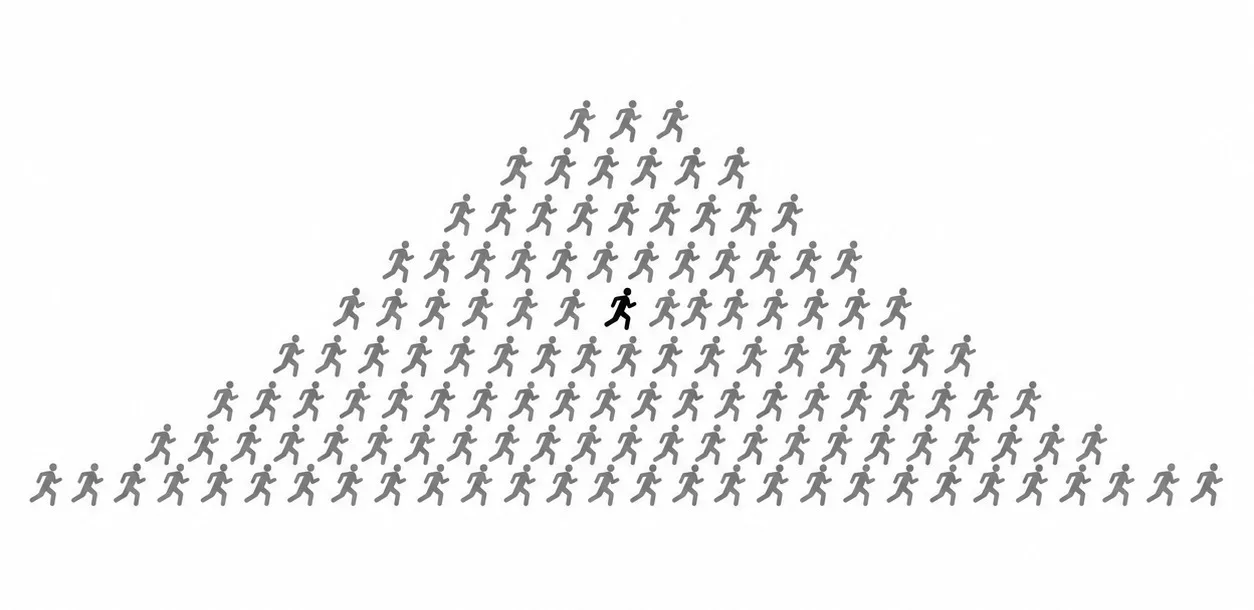
This is the part most "good time" articles skip. RunRepeat's State of Running report found that recreational runners have never been slower, and it is explicit about why: it is not that each runner got slower, it is that the field changed. More people now enter for health, travel and the social side of race day, and fewer treat it purely as a competition.
So the average is a picture of a crowd. A slower average means more people having a go, which is good news for anyone on their first start line. It also means "faster than average" is a lower bar than it was 20 years ago, so do not read too much into beating it or missing it.
Average half marathon time by age
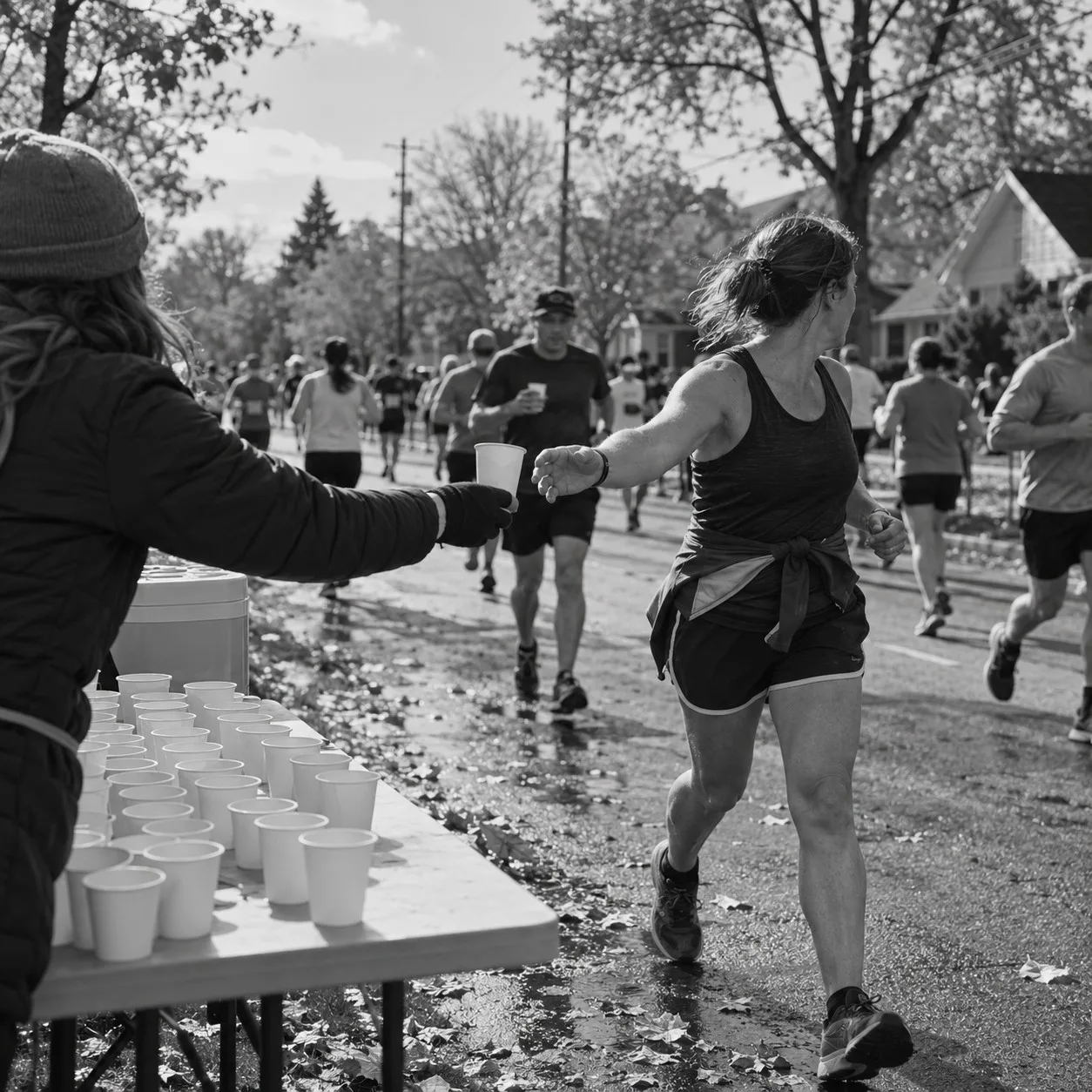
Age changes the picture less than people expect until about 40, then a little more with each decade. The table below uses the intermediate standard from Running Level, the time that beats half of the 119,039 community results it is built on. That pool skews quicker than a big race field, which is why its times are faster than the RunRepeat medians above. Read the pattern across ages rather than the exact clock time.
| Age | Men | Men's pace | Women | Women's pace |
|---|---|---|---|---|
| 20 | 1:45:48 | 5:01 /km (8:04 /mi) | 2:04:51 | 5:55 /km (9:31 /mi) |
| 30 | 1:45:50 | 5:01 /km (8:04 /mi) | 2:03:47 | 5:52 /km (9:27 /mi) |
| 40 | 1:49:49 | 5:12 /km (8:23 /mi) | 2:08:00 | 6:04 /km (9:46 /mi) |
| 50 | 1:59:35 | 5:40 /km (9:07 /mi) | 2:17:26 | 6:31 /km (10:29 /mi) |
| 60 | 2:11:32 | 6:14 /km (10:02 /mi) | 2:31:13 | 7:10 /km (11:32 /mi) |
| 70 | 2:26:07 | 6:56 /km (11:09 /mi) | 2:55:59 | 8:20 /km (13:25 /mi) |
From 20 to 30 the standard barely moves. From 40 to 60 it slows by roughly 20 minutes for both men and women. A 60-year-old who runs 2:15 is doing something very different from a 25-year-old who runs 2:15, and an age-by-age comparison is the only fair way to say so.
Average half marathon time for men and women
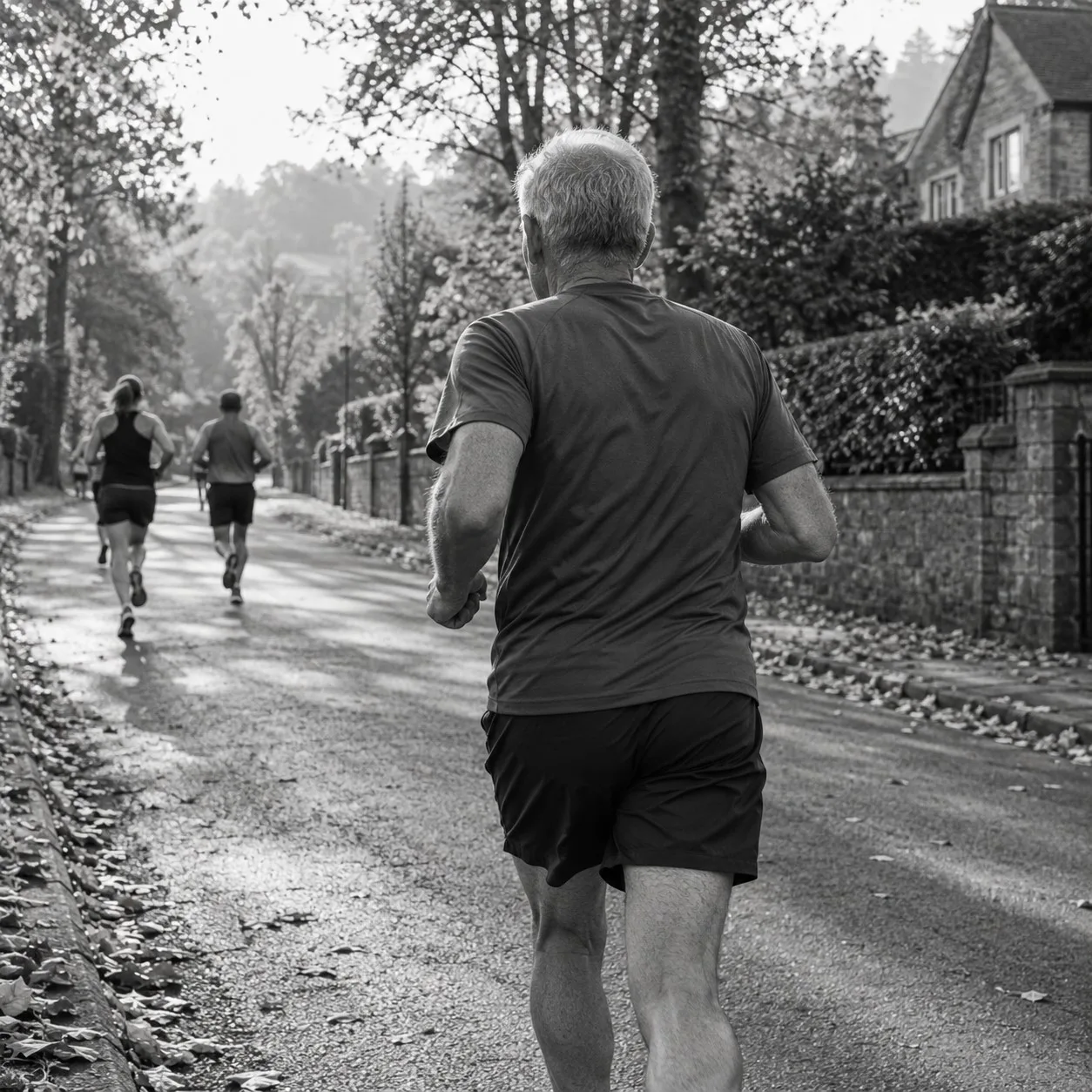
The median man finishes in 1:59:48 and the median woman in 2:24:03, a gap of about 24 minutes. RunRepeat's State of Running puts the average half marathon pace at 5:40 /km (9:07 /mi) for men and 6:22 /km (10:15 /mi) for women, which works out to roughly 1:59:33 and 2:14:19 over the full distance.
The two sources differ because they slice the data differently, one by percentile and one by average pace. Both say the same thing in practice: men's and women's times sit on separate curves, so compare yourself with your own column.
Average half marathon time for beginners
There is no clean dataset for first-timers, because race results do not record whether it is someone's first half. What the percentiles do show is that a big share of the field finishes after 2:30, and about one finisher in ten takes longer than 2:59:18. A first half marathon somewhere between 2:15 and 3:00 is ordinary.
What matters more for a first race is the event cutoff. Check it on the race website before you enter, and plan for walk breaks and water stops as part of your time rather than as a failure. Running Level's beginner standard (faster than 5% of its community results) is 2:23:33 for men and 2:44:56 for women, a useful reminder of how wide normal is.
Is your half marathon time good?
A time is good if it is a fair reflection of your training on the day. As a reference point, here is where some common goal times sit in the field, worked out from the RunRepeat percentiles above.
| Finish time | Average pace | Share of all finishers faster | Men faster | Women faster |
|---|---|---|---|---|
| 2:00:00 | 5:41 /km (9:09 /mi) | about 25% | about 50% | under 20% |
| 2:10:00 | 6:10 /km (9:55 /mi) | about 42% | about 60% | about 25% |
| 2:30:00 | 7:07 /km (11:27 /mi) | about 70% | over 80% | about 60% |
| 3:00:00 | 8:32 /km (13:44 /mi) | about 90% | over 90% | about 85% |
A 2:00 half marathon puts you ahead of roughly three quarters of all finishers. A 2:30 is a normal mid-to-back-of-pack result, and a 3:00 finish is still a half marathon finish. To see the 5 km (3.1 mi) and 10 km (6.2 mi) splits for any of these times, use the calculator below or the full half marathon pace chart.
Half marathon pace calculator
Splits for a 2:00:00 half marathon, even pace
- Average pace per km
- 5:41 /km
- Average pace per mile
- 9:09 /mi
- Halfway
- 1:00:00
- Second half
- 1:00:00
Kilometer splits
| km | mi | Split | Elapsed |
|---|---|---|---|
| 1 | 0.6 | 5:41 | 5:41 |
| 2 | 1.2 | 5:41 | 11:23 |
| 3 | 1.9 | 5:41 | 17:04 |
| 4 | 2.5 | 5:41 | 22:45 |
| 5 | 3.1 | 5:41 | 28:26 |
| 6 | 3.7 | 5:41 | 34:08 |
| 7 | 4.3 | 5:41 | 39:49 |
| 8 | 5 | 5:41 | 45:30 |
| 9 | 5.6 | 5:41 | 51:11 |
| 10 | 6.2 | 5:41 | 56:53 |
| 11 | 6.8 | 5:41 | 1:02:34 |
| 12 | 7.5 | 5:41 | 1:08:15 |
| 13 | 8.1 | 5:41 | 1:13:57 |
| 14 | 8.7 | 5:41 | 1:19:38 |
| 15 | 9.3 | 5:41 | 1:25:19 |
| 16 | 9.9 | 5:41 | 1:31:00 |
| 17 | 10.6 | 5:41 | 1:36:42 |
| 18 | 11.2 | 5:41 | 1:42:23 |
| 19 | 11.8 | 5:41 | 1:48:04 |
| 20 | 12.4 | 5:41 | 1:53:45 |
| 21 | 13 | 5:41 | 1:59:27 |
| 21.1 | 13.1 | 0:33 | 2:00:00 |
Mile splits
| Mile | km | Split | Elapsed |
|---|---|---|---|
| 1 | 1.6 | 9:09 | 9:09 |
| 2 | 3.2 | 9:09 | 18:18 |
| 3 | 4.8 | 9:09 | 27:28 |
| 4 | 6.4 | 9:09 | 36:37 |
| 5 | 8 | 9:09 | 45:46 |
| 6 | 9.7 | 9:09 | 54:55 |
| 7 | 11.3 | 9:09 | 1:04:05 |
| 8 | 12.9 | 9:09 | 1:13:14 |
| 9 | 14.5 | 9:09 | 1:22:23 |
| 10 | 16.1 | 9:09 | 1:31:32 |
| 11 | 17.7 | 9:09 | 1:40:41 |
| 12 | 19.3 | 9:09 | 1:49:51 |
| 13 | 20.9 | 9:09 | 1:59:00 |
| 13.1 | 21.1 | 1:00 | 2:00:00 |
2:00:00 half marathon · even pace
- 5 km28:26
- 10 km56:53
- 15 km1:25:19
- 20 km1:53:45
- 21.1 km2:00:00
Raceblock pace band · myraceblock.com
Predict your own half marathon time instead
The average tells you about other people. A prediction from your own recent race or time trial tells you about you, which is why it is the better number to train and pace from. Enter a recent result below; the race time predictor guide explains how the formula works and why longer predictions tend to run optimistic.
Race time predictor: enter a recent result
Estimates from a 25:00 5K
| Race | Riegel | VDOT-style | Estimated range | Pace range |
|---|---|---|---|---|
| 5K 5 km (3.1 mi) | 25:00 | 25:00 | 25:00 | 5:00 /km (8:03 /mi) |
| 10K 10 km (6.2 mi) | 52:07 | 51:53 | 51:53 to 52:07 | 5:11 to 5:13 /km (8:21 to 8:23 /mi) |
| Half marathon 21.1 km (13.1 mi) | 1:55:00 | 1:55:04 | 1:55:00 to 1:55:04 | 5:27 /km (8:46 to 8:47 /mi) |
| Marathon 42.2 km (26.2 mi) | 3:59:47 | 3:57:55 | 3:57:55 to 3:59:47 | 5:38 to 5:41 /km (9:04 to 9:09 /mi) |
Predictions for the marathon run optimistic for runners without marathon-specific training. Treat the faster end as a ceiling, not a target.
Training paces from your 5K equivalent (25:00)
- Easy
- 6:15 to 6:45 /km (10:04 to 10:52 /mi)
- Steady
- 5:30 to 5:45 /km (8:51 to 9:15 /mi)
- Tempo
- 5:12 to 5:24 /km (8:22 to 8:41 /mi)
- Intervals
- 4:54 to 5:06 /km (7:53 to 8:12 /mi)
Paces are general training guidance, not medical advice. Check with a doctor before starting a new training plan, and stop if you feel pain, chest pain or dizziness.
Predicted times from 5K results
| 5K time 5 km (3.1 mi) | 10K 10 km (6.2 mi) | Half marathon 21.1 km (13.1 mi) | Marathon 42.2 km (26.2 mi) |
|---|---|---|---|
| 18:00 | 37:20 to 37:32 | 1:22:33 to 1:22:48 | 2:52:25 to 2:52:38 |
| 19:00 | 39:24 to 39:37 | 1:27:11 to 1:27:24 | 3:01:52 to 3:02:14 |
| 20:00 | 41:28 to 41:42 | 1:31:50 to 1:32:00 | 3:11:17 to 3:11:49 |
| 21:00 | 43:32 to 43:47 | 1:36:28 to 1:36:36 | 3:20:41 to 3:21:25 |
| 22:00 | 45:37 to 45:52 | 1:41:07 to 1:41:12 | 3:30:03 to 3:31:00 |
| 23:00 | 47:42 to 47:57 | 1:45:46 to 1:45:48 | 3:39:22 to 3:40:36 |
| 24:00 | 49:48 to 50:02 | 1:50:24 to 1:50:25 | 3:48:40 to 3:50:11 |
| 25:00 | 51:53 to 52:07 | 1:55:00 to 1:55:04 | 3:57:55 to 3:59:47 |
| 26:00 | 53:59 to 54:12 | 1:59:36 to 1:59:42 | 4:07:08 to 4:09:22 |
| 27:00 | 56:05 to 56:18 | 2:04:12 to 2:04:20 | 4:16:19 to 4:18:58 |
| 28:00 | 58:11 to 58:23 | 2:08:48 to 2:08:57 | 4:25:28 to 4:28:33 |
| 29:00 | 1:00:17 to 1:00:28 | 2:13:24 to 2:13:34 | 4:34:35 to 4:38:09 |
| 30:00 | 1:02:23 to 1:02:33 | 2:18:00 to 2:18:10 | 4:43:39 to 4:47:44 |
| 31:00 | 1:04:29 to 1:04:38 | 2:22:36 to 2:22:45 | 4:52:41 to 4:57:19 |
| 32:00 | 1:06:35 to 1:06:43 | 2:27:12 to 2:27:20 | 5:01:42 to 5:06:55 |
| 33:00 | 1:08:41 to 1:08:48 | 2:31:48 to 2:31:53 | 5:10:40 to 5:16:30 |
| 34:00 | 1:10:47 to 1:10:53 | 2:36:24 to 2:36:26 | 5:19:36 to 5:26:06 |
| 35:00 | 1:12:53 to 1:12:58 | 2:40:59 to 2:41:00 | 5:28:30 to 5:35:41 |
| 36:00 | 1:14:59 to 1:15:03 | 2:45:30 to 2:45:36 | 5:37:22 to 5:45:17 |
| 37:00 | 1:17:05 to 1:17:09 | 2:50:01 to 2:50:12 | 5:46:13 to 5:54:52 |
| 38:00 | 1:19:11 to 1:19:14 | 2:54:30 to 2:54:48 | 5:55:01 to 6:04:28 |
| 39:00 | 1:21:17 to 1:21:19 | 2:58:59 to 2:59:24 | 6:03:48 to 6:14:03 |
| 40:00 | 1:23:22 to 1:23:24 | 3:03:27 to 3:04:00 | 6:12:33 to 6:23:39 |
Sources
- Peter Riegel (Wikipedia): race time prediction formula Checked Oct 12, 2026
- Jack Daniels (Wikipedia): VDOT and training intensities Checked Oct 12, 2026
How to find your own half marathon time
- Run a recent benchmark
Use a 5 km (3.1 mi) or 10 km (6.2 mi) race from the last six weeks, or a solo time trial on a track or a flat loop after an easy week. To see how that benchmark stacks up first, our 5K times by age tables put it next to runners your age.
- Enter it in the predictor
Type the distance and finish time. A 10 km (6.2 mi) result usually predicts a half marathon better than a 5 km (3.1 mi) one because it is closer in length.
- Read the range, not one number
Treat the result as a starting estimate. Hills, heat, wind and how much long running you have done all move it.
- Turn it into a pace
Divide by 21.1 km (13.1 mi), or use the pace calculator above, to get a pace per km and per mile.
- Practice that pace in training
Run a few kilometers at that pace inside a long run a few weeks out. If it feels out of reach, adjust the estimate rather than forcing it.
- Start the race on the slow side
Run the first 5 km (3.1 mi) a few seconds per km slower than your goal pace and build from there.
General training guidance, not medical advice. Check with a doctor before increasing training if you have symptoms or a health condition.
Pace the race at an even effort
Whatever your target, the way you spread it over 21.1 km (13.1 mi) matters as much as the number. A common way to miss a target is to run the first 5 km (3.1 mi) on race-day adrenaline, then pay for it after 15 km (9.3 mi).
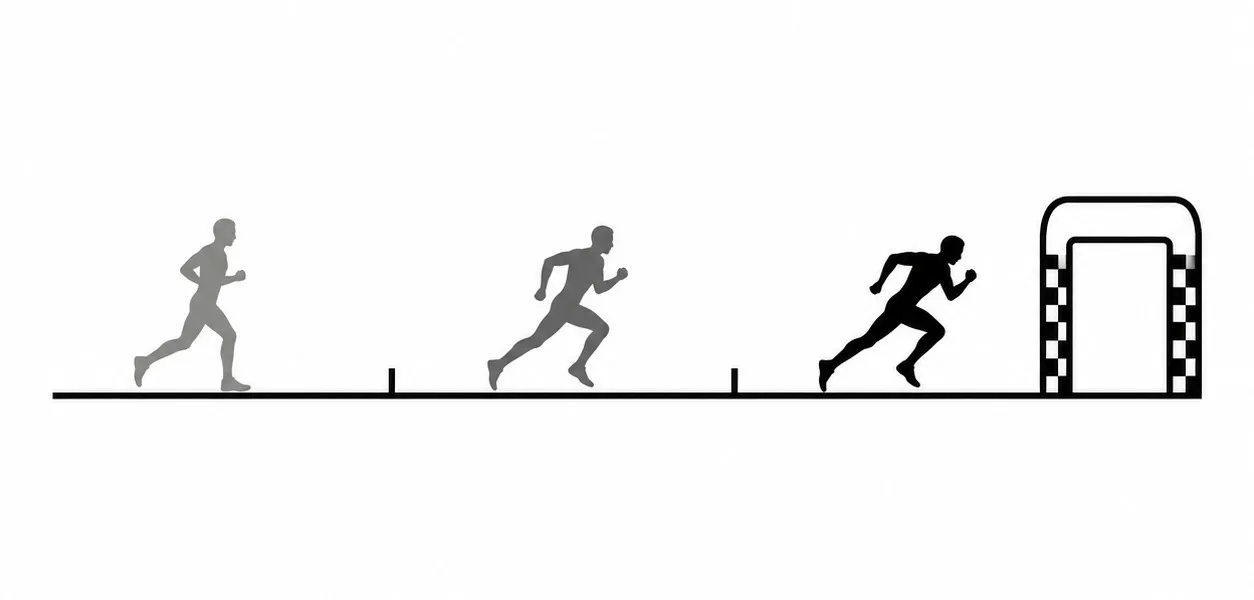
- First third, 0 to 7 km (0 to 4.3 mi). Controlled, slightly slower than goal pace. It should feel easy.
- Middle third, 7 to 14 km (4.3 to 8.7 mi). Settle on goal pace and stay there.
- Last third, 14 to 21.1 km (8.7 to 13.1 mi). Hold pace, and press on only in the last few kilometers if you have it.
Where the average stops helping
Once you have a target time, you need weeks of training that lead to it: easy runs, a long run that grows, a taper. The free way is a printed plan, and our half marathon training plan guide lays out every length side by side, from the 12-week beginner plan to the gentler 16-week build.
| Plan | Weeks | Runs a week | Peak week | Longest run | Level |
|---|---|---|---|---|---|
| 8-week half marathon plan | 8 | 4 | 38.1 km (23.7 mi) | 16.2 km (10.1 mi) | Intermediate |
| 10-week half marathon plan | 10 | 4 | 37.6 km (23.4 mi) | 16 km (9.9 mi) | Beginner |
| 12-week half marathon plan for beginners | 12 | 3 | 32 km (19.9 mi) | 16 km (9.9 mi) | Beginner |
| 16-week half marathon plan | 16 | 3 | 31.9 km (19.8 mi) | 16 km (9.9 mi) | Beginner |
The trouble starts in week 5 or 6. A cold costs you a week, a work trip lands on a long run, or the race date moves. A printed plan has no answer for that, because it doesn't move when your week does. You end up guessing whether to skip ahead, repeat a week or cram the missed run in, and a guess is how most target times drift away.
The fix is a plan built from your race date and the running you actually did. Build your free plan for your race date. On the Coach plan, next week re-plans itself when you miss a run.
Free training plan
Build your free plan for your race date.
Pick your race and race date. Every week from today to race day is planned for you, with distances in km and miles.
If you are weighing it up, see how Free and Coach compare.
Mistakes when you compare your half marathon time
- Comparing with the wrong column. Use your gender and age group, not the overall median.
- Comparing courses as if they were equal. A hilly or hot course can cost minutes against a flat, cool one.
- Picking a goal from the average. A target taken from the field, not from your own recent running, is a guess.
- Racing your training runs. Long runs at goal pace every week leave you tired on race day. Most of your running should be easy.
- Ignoring warning signs. Chest pain, fainting, sharp pain or swelling means stop and see a doctor or physio, whatever the clock says.
The average half marathon time is about 2:15 for all runners, close to 2:00 for men and 2:24 for women, and it gets slower with age after 40. It is a portrait of a crowd that increasingly runs for the experience, not a standard you have to meet.
Use it for context, then set your own target from a recent 5 km (3.1 mi) or 10 km (6.2 mi) result, pace it evenly, and give yourself a plan that bends when life does. Build your free plan for your race date: on the Coach plan, next week re-plans itself when you miss a run.
Frequently asked questions
Any finish you trained for is respectable. For context, the median finisher runs 2:14:59, so anything near or under 2:15 is in the faster half of the field, and a time under 2:00 beats roughly three quarters of all finishers.
Yes. A 2:10 is 6:10 /km (9:55 /mi) and faster than more than half of all finishers in RunRepeat's percentiles. For women it is faster than about three quarters of the field.
About one finisher in four runs under 2:00 overall. For men it sits right at the median of 1:59:48, and RunRepeat puts it ahead of more than 80% of women.
It is a normal result. A 2:30 is 7:07 /km (11:27 /mi) and lands close to the 70th percentile overall, so about 30% of finishers are slower.
No, as long as it is inside the event cutoff. About one finisher in ten takes longer than 2:59:18, and many first-timers finish around 3:00 with planned walk breaks.
There is no official beginner average, because results do not record a first race. Most first half marathons land somewhere between 2:15 and 3:00, and a prediction from a recent 5 km (3.1 mi) is a better guide than any average.
Free training plan
Build your free plan for your race date.
On the Coach plan, next week re-plans itself when you miss a run.
Share article
About the author
More running training guides
Half marathon training · 12 min
Half Marathon Training Routine: The Week to Repeat
A good half marathon training routine fixes the long run, keeps almost every other run easy, and repeats the same 3 or 4 running days from week one to race day. Here is the weekly layout, where strength and rest go, and how to fit it around work.
Half marathon training · 9 min
How Long Is a Half Marathon? Distance in Km and Miles
A half marathon is 21.0975 km (13.1094 mi). See the exact distance, pace math, walking and cutoff checks, and how to choose a preparation plan.
Half marathon training · 10 min
16 Week Half Marathon Training Plan: Gentle 3-Day Build
A 16 week half marathon training plan with 3 runs a week, a 4-week easy base, lighter weeks every fourth week and a 2-week taper. Every week, in km and miles, with paces per km and per mile.
Half marathon training · 12 min
Half Marathon Training Plan: Free 8 to 16 Week Plans
Four half marathon training plans compared: week one, peak week, long run and run days for the 8, 10, 12 and 16 week plans, plus a worked 14-week sample and how to pick the right length.

Half marathon training · 10 min
10 Week Half Marathon Training Plan: Week by Week
Four runs a week, mostly easy: the 10-week half marathon plan from a 27.1 km (16.8 mi) first week to a 16 km (9.9 mi) long run, with steady Thursdays, two lighter weeks and a 2-week taper.
Half marathon training · 11 min
8 Week Half Marathon Training Plan: Full Schedule
A short, four-run half marathon block for runners already at about 30 km (18.6 mi) a week: the entry check, every week in km and miles, two tempo Thursdays and a 2-week taper.